chainer-骨干网络backbone-MobileNetV3代码重构【附源码】
文章目录
- 前言
- 代码实现
- 调用方式
前言
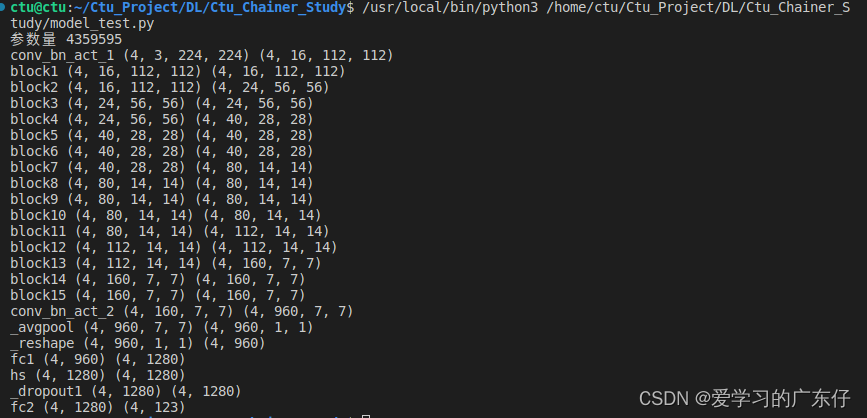
本文基于chainer实现MobileNetV3网络结构,并基于torch的结构方式构建chainer版的,并计算MobileNetV3的参数量。
本次基于chainer 实现了Hardsigmoid、Hardswish、Relu6、Relu等激活函数
代码实现
def _make_divisible(ch, divisor=8, min_ch=None):if min_ch is None:min_ch = divisornew_ch = max(min_ch, int(ch + divisor / 2) // divisor * divisor)if new_ch < 0.9 * ch:new_ch += divisorreturn new_chclass Hardsigmoid(chainer.Chain):def __init__(self):super(Hardsigmoid, self).__init__()def __call__(self, x):return F.relu6(x+3) / 6class Hardswish(chainer.Chain):def __init__(self):super(Hardswish, self).__init__()def __call__(self, x):out = x * F.relu6(x + 3) / 6return outclass Relu6(chainer.Chain):def __init__(self):super(Relu6, self).__init__()def __call__(self, x):out = F.relu6(x)return outclass ReLU(chainer.Chain):def __init__(self):super(ReLU, self).__init__()def __call__(self, x):out = F.relu(x)return out# 标准卷积+标准化+激活函数
class ConvBNActivation(chainer.Chain):def __init__(self, in_planes: int, out_planes: int,kernel_size: int = 3, stride: int = 1, groups: int = 1,norm_layer = None, activation_layer = None):padding = (kernel_size - 1) // 2if norm_layer is None:norm_layer = L.BatchNormalizationif activation_layer is None:activation_layer = Relu6()super(ConvBNActivation, self).__init__()self.layers = []self.layers += [('conv',L.Convolution2D(in_channels=in_planes,out_channels=out_planes,ksize=kernel_size,stride=stride,pad=padding,groups=groups, nobias=True))]self.layers += [('bn',norm_layer(out_planes))]self.layers += [('relu',activation_layer)]with self.init_scope():for n in self.layers:if not n[0].startswith('_'):setattr(self, n[0], n[1])def __call__(self, x):for n, f in self.layers:if not n.startswith('_'):x = getattr(self, n)(x)else:x = f.apply((x,))[0]return x# SE模块
class SqueezeExcitation(chainer.Chain):# 注意力机制def __init__(self, input_c: int, squeeze_factor: int = 4):super(SqueezeExcitation, self).__init__()# 满足1/4关系:input_c // squeeze_factorsqueeze_c = _make_divisible(input_c // squeeze_factor, 8)self.layers = []self.layers += [('fc1',L.Convolution2D(in_channels=input_c,out_channels=squeeze_c,ksize=1))]self.layers += [('relu',ReLU())]self.layers += [('fc2',L.Convolution2D(in_channels=squeeze_c,out_channels=input_c,ksize=1))]self.layers += [('hardsigmoid',Hardsigmoid())]with self.init_scope():for n in self.layers:if not n[0].startswith('_'):setattr(self, n[0], n[1])def forward(self, x):short_cut = xx = F.average_pooling_2d(x, x.shape[2:], stride=1)for n, f in self.layers:if not n.startswith('_'):x = getattr(self, n)(x)else:x = f.apply((x,))[0]return x * short_cutclass InvertedResidualConfig:def __init__(self, input_c: int, kernel: int, expanded_c: int, out_c: int, use_se: bool, activation: str, stride: int, width_multi: float):self.input_c = self.adjust_channels(input_c, width_multi)self.kernel = kernelself.expanded_c = self.adjust_channels(expanded_c, width_multi)self.out_c = self.adjust_channels(out_c, width_multi)self.use_se = use_seself.use_hs = activation == "HS"self.stride = stride@staticmethoddef adjust_channels(channels: int, width_multi: float):return _make_divisible(channels * width_multi, 8)class InvertedResidual(chainer.Chain):def __init__(self, cnf, norm_layer):super(InvertedResidual, self).__init__()if cnf.stride not in [1, 2]:raise ValueError("illegal stride value.")# 是否有shortcut连接self.use_res_connect = (cnf.stride == 1 and cnf.input_c == cnf.out_c)self.layers = []activation_layer = Hardswish() if cnf.use_hs else ReLU()# 这里开始作bneck层了(两边瘦,中间胖)# 第一个1*1(升维)if cnf.expanded_c != cnf.input_c:self.layers += [('conv_bn_act_1',ConvBNActivation(cnf.input_c, cnf.expanded_c, kernel_size=1, norm_layer=norm_layer, activation_layer=activation_layer))]# 深度可分离卷积self.layers += [('conv_bn_act_2',ConvBNActivation(cnf.expanded_c, cnf.expanded_c, kernel_size=cnf.kernel, stride=cnf.stride, groups=cnf.expanded_c, norm_layer=norm_layer, activation_layer=activation_layer))]# 注意力机制if cnf.use_se:self.layers += [('se1',SqueezeExcitation(cnf.expanded_c))]# 1*1卷基层(降维)self.layers += [('conv_bn_act_3',ConvBNActivation(cnf.expanded_c, cnf.out_c, kernel_size=1, norm_layer=norm_layer, activation_layer=None))]self.out_channels = cnf.out_cself.is_strided = cnf.stride > 1with self.init_scope():for n in self.layers:if not n[0].startswith('_'):setattr(self, n[0], n[1])def forward(self, x):short_cut = xfor n, f in self.layers:if not n.startswith('_'):x = getattr(self, n)(x)else:x = f.apply((x,))[0]if self.use_res_connect:return short_cut + xreturn xclass MobileNet_V3(chainer.Chain):cfgs = {'mobilenetv3_large':None,'mobilenetv3_small':None}def __init__(self,model_name = 'mobilenetv3_large',channels=3,width_multi=1.0,reduced_tail=False,batch_size=4,num_classes: int = 1000,image_size = 244,block = None,norm_layer = None):super(MobileNet_V3, self).__init__()bneck_conf = partial(InvertedResidualConfig, width_multi=width_multi)adjust_channels = partial(InvertedResidualConfig.adjust_channels, width_multi=width_multi)reduce_divider = 2 if reduced_tail else 1self.image_size = image_sizeif model_name == 'mobilenetv3_large':inverted_residual_setting = [# input_c, kernel, expanded_c, out_c, use_se, activation, stridebneck_conf(16, 3, 16, 16, False, "RE", 1),bneck_conf(16, 3, 64, 24, False, "RE", 2),  # C1bneck_conf(24, 3, 72, 24, False, "RE", 1),bneck_conf(24, 5, 72, 40, True, "RE", 2),  # C2bneck_conf(40, 5, 120, 40, True, "RE", 1),bneck_conf(40, 5, 120, 40, True, "RE", 1),bneck_conf(40, 3, 240, 80, False, "HS", 2),  # C3bneck_conf(80, 3, 200, 80, False, "HS", 1),bneck_conf(80, 3, 184, 80, False, "HS", 1),bneck_conf(80, 3, 184, 80, False, "HS", 1),bneck_conf(80, 3, 480, 112, True, "HS", 1),bneck_conf(112, 3, 672, 112, True, "HS", 1),bneck_conf(112, 5, 672, 160 // reduce_divider, True, "HS", 2),  # C4bneck_conf(160 // reduce_divider, 5, 960 // reduce_divider, 160 // reduce_divider, True, "HS", 1),bneck_conf(160 // reduce_divider, 5, 960 // reduce_divider, 160 // reduce_divider, True, "HS", 1),]last_channel = adjust_channels(1280 // reduce_divider)  # C5if model_name == 'mobilenetv3_small':inverted_residual_setting = [# input_c, kernel, expanded_c, out_c, use_se, activation, stridebneck_conf(16, 3, 16, 16, True, "RE", 2),  # C1bneck_conf(16, 3, 72, 24, False, "RE", 2),  # C2bneck_conf(24, 3, 88, 24, False, "RE", 1),bneck_conf(24, 5, 96, 40, True, "HS", 2),  # C3bneck_conf(40, 5, 240, 40, True, "HS", 1),bneck_conf(40, 5, 240, 40, True, "HS", 1),bneck_conf(40, 5, 120, 48, True, "HS", 1),bneck_conf(48, 5, 144, 48, True, "HS", 1),bneck_conf(48, 5, 288, 96 // reduce_divider, True, "HS", 2),  # C4bneck_conf(96 // reduce_divider, 5, 576 // reduce_divider, 96 // reduce_divider, True, "HS", 1),bneck_conf(96 // reduce_divider, 5, 576 // reduce_divider, 96 // reduce_divider, True, "HS", 1)]last_channel = adjust_channels(1024 // reduce_divider)  # C5if block is None:block = InvertedResidualif norm_layer is None:norm_layer = partial(L.BatchNormalization, eps=0.001)self.layers = []# 第一层  #224*224*3 -> 112*112*16firstconv_output_c = inverted_residual_setting[0].input_cself.layers += [('conv_bn_act_1',ConvBNActivation(channels, firstconv_output_c, kernel_size=3, stride=2, norm_layer=norm_layer, activation_layer=Hardswish()))]output_size = int((self.image_size-3+2*((3-1)//2))/2+1)# 遍历 residual blockslayer_num = 0for cnf in inverted_residual_setting:layer_num +=1self.layers += [('block{0}'.format(layer_num),block(cnf, norm_layer))]output_size = math.ceil(output_size / cnf.stride)# 最后一层卷基层  7*7*160 -> 7*7*960lastconv_input_c = inverted_residual_setting[-1].out_clastconv_output_c = 6 * lastconv_input_cself.layers += [('conv_bn_act_2',ConvBNActivation(lastconv_input_c, lastconv_output_c, kernel_size=1, norm_layer=norm_layer, activation_layer=Hardswish()))]output_size = int((output_size-1+2*((1-1)//2))/1+1)# 平均池化self.layers += [('_avgpool',AveragePooling2D(ksize=output_size,stride=1,pad=0))]self.layers += [('_reshape',Reshape((batch_size,lastconv_output_c)))]self.layers += [('fc1',L.Linear(lastconv_output_c, last_channel))]self.layers += [('hs',Hardswish())]self.layers += [("_dropout1",Dropout(0.2))]self.layers += [('fc2',L.Linear(last_channel, num_classes))]with self.init_scope():for n in self.layers:if not n[0].startswith('_'):setattr(self, n[0], n[1])def forward(self, x):for n, f in self.layers:origin_size = x.shapeif not n.startswith('_'):x = getattr(self, n)(x)else:x = f.apply((x,))[0]print(n,origin_size,x.shape)if chainer.config.train:return xreturn F.softmax(x)
注意此类就是MobileNetV3的实现过程,注意网络的前向传播过程中,分了训练以及测试。
训练过程中直接返回x,测试过程中会进入softmax得出概率
调用方式
if __name__ == '__main__':batch_size = 4n_channels = 3image_size = 224num_classes = 123model = MobileNet_V3(num_classes=num_classes, channels=n_channels,image_size=image_size,batch_size=batch_size)print("参数量",model.count_params())x = np.random.rand(batch_size, n_channels, image_size, image_size).astype(np.float32)t = np.random.randint(0, num_classes, size=(batch_size,)).astype(np.int32)with chainer.using_config('train', True):y1 = model(x)loss1 = F.softmax_cross_entropy(y1, t)
本文来自互联网用户投稿,文章观点仅代表作者本人,不代表本站立场,不承担相关法律责任。如若转载,请注明出处。 如若内容造成侵权/违法违规/事实不符,请点击【内容举报】进行投诉反馈!