2019-Improving human mobility identification with trajectory augmentation
[1] Zhou F, Yin R, Trajcevski G, et al. Improving human mobility identification with trajectory augmentation[J]. GeoInformatica, 2019: 1-31.
GeoInformatica ∈ 计算机科学3区
生词
identification 识别
- 粗读
文章目录
- `概述`
- `Abstract`
- `Index words`
- `其他介绍`
概述
🐂主要是轨迹分类问题
🐂用到了生成对抗网络(GAN)
Abstract
Many location-based social networks (LBSNs) applications such as customized Point-Of-Interest (POI) recommendation, preference-based trip planning, travel time estimation, etc., involve an important task of understanding human trajectory patterns. In particular, identifying and linking trajectories to users who generate them – a problem called Trajectory-User Linking (TUL) – has become a focus of many recent works. TUL is usually studied as a multi-class classification problem and has gained recent attention because: (1) the number of labels/classes (i.e., users) is way larger than the number of motion patterns among various trajectories; and (2) the location-based trajectory data, especially the check-ins – i.e., events of reporting a location at particular Point of Interest (POI) with known semantics – are often extremely sparse. Towards addressing these challenges, we introduce a Trajectory Generative Adversarial Network (TGAN) as an approach to enable learning users motion patterns and location distribution, and to eventually identify human mobility. TGAN consists of two jointly trained neural networks, playing a Minimax game to (iteratively) optimize both components. The first one is the generator, learning trajectory representation by a Recurrent Neural Network (RNN) based model, aiming at fitting the underlying trajectory distribution of a particular individual and generate synthetic trajectories with intrinsic invariance and global coherence. The second one is the discriminator – a Convolutional Neural Network (CNN) based model that discriminates the generated trajectory from the real ones and provides guidance to train the generator model. We demonstrate that the above two models can be well tuned together to improve the TUL performance, while achieving superior accuracy when compared to existing approaches.
- 许多基于位置的社交网络(LBSNs)应用,如定制兴趣点(POI)推荐、基于偏好的旅行计划、旅行时间估计等,都涉及到
理解人类轨迹模式的重要任务。 - 识别轨迹并将其链接到生成轨迹的用户——
轨迹-用户链接问题(Trajectory-User Linking,TUL) - TUL通常被研究为一个
多分类问题,挑战:(1)标签/类(即用户)的数量远远大于各种轨迹中运动模式的数量;(2)签到数据非常稀疏。 - 引入
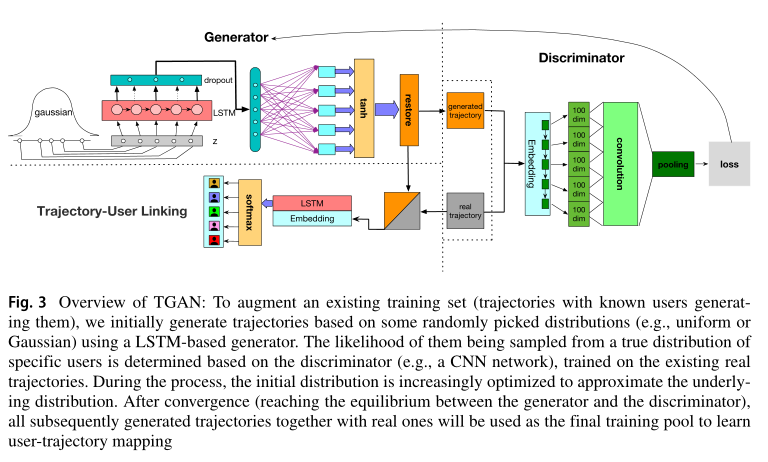
轨迹生成对抗网络(TGAN)学习用户的运动模式和位置分布,并最终确定人类的移动。 - TGAN由两个联合训练的神经网络组成,进行极大极小博弈(迭代)优化这两个组件。第一种是生成器(generator),通过基于递归神经网络(RNN)的模型
学习轨迹表示,拟合特定个体的潜在轨迹分布,生成具有内在不变性和全局一致性的合成轨迹。第二种是判别器(discriminator)——一种基于卷积神经网络(CNN)的模型,它将生成的轨迹与真实的轨迹区分开来,并为训练生成器模型提供指导。 - 我们证明了上述两个模型可以很好地协调在一起,以提高TUL性能,同时实现了优于现有方法的精度。
***简单来说***
TUL问题就是为一些轨迹(或轨迹段)找到对应的产生它的用户
(研究中将其看作一个多分类问题,*轨迹分类*)。
而文中提出的TGAN方法可以提高TUL问题的性能。
Index words
- Adversarial learning 对抗学习
- Spatio-temporal learning 时空学习
- Synthetic trajectory generation 综合轨迹生成
- Motion pattern recognition 运动模式识别
其他介绍
现有GAN:
- 连续的GAN—— 用于图像生成
- 离散的GAN—— 用于序列建模、文本生成
方法/steps:
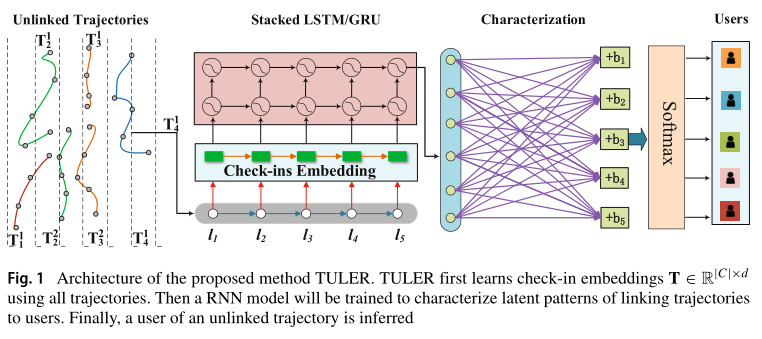
🦌1). 将轨迹按照一定的time interval分割
🦌2). 轨迹通过RNN获得相应的表示向量
🦌3). 轨迹通过多分类模型得到它的分类结果(所属用户)
提出的方法TULER的架构:
TGAN Model:
本文来自互联网用户投稿,文章观点仅代表作者本人,不代表本站立场,不承担相关法律责任。如若转载,请注明出处。 如若内容造成侵权/违法违规/事实不符,请点击【内容举报】进行投诉反馈!