数据结构(集合)学习之Map(二)
集合
框架关系图
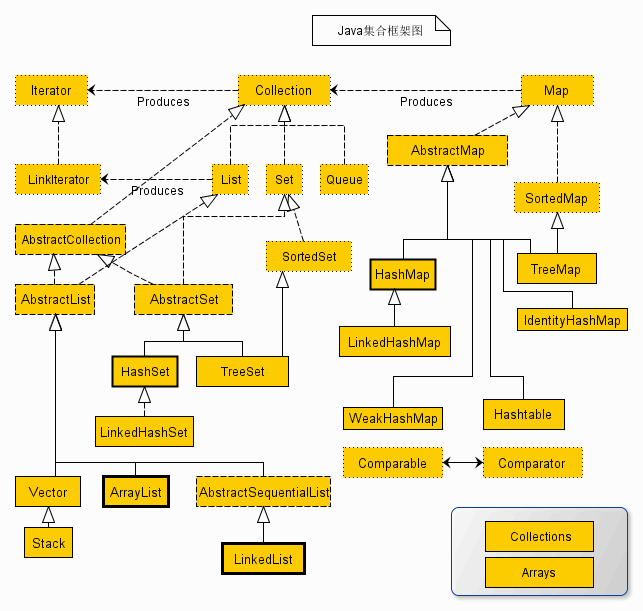
补充:HashTable父类是Dictionary,不是AbstractMap。
一:HashMap中的链循环:
一般来说HashMap中的链循环会发生在多线程操作时(虽然HashMap就不是线程安全的,一般多线程的时候也不会用它,但这种情况难免会发生)
以JDK1.7为例:
void addEntry(int hash, K key, V value, int bucketIndex) {if ((size >= threshold) && (null != table[bucketIndex])) {resize(2 * table.length);//扩容方法,参数为原来数组长度的2倍hash = (null != key) ? hash(key) : 0;bucketIndex = indexFor(hash, table.length);}createEntry(hash, key, value, bucketIndex);}void resize(int newCapacity) {Entry[] oldTable = table;//数组原来的数据int oldCapacity = oldTable.length;//原来数组的长度if (oldCapacity == MAXIMUM_CAPACITY) {threshold = Integer.MAX_VALUE;return;}Entry[] newTable = new Entry[newCapacity];//以新的初始容量创建新的数组transfer(newTable, initHashSeedAsNeeded(newCapacity));//转换方法table = newTable;threshold = (int)Math.min(newCapacity * loadFactor, MAXIMUM_CAPACITY + 1);}void transfer(Entry[] newTable, boolean rehash) {int newCapacity = newTable.length;for (Entry e : table) {while(null != e) {Entry next = e.next;if (rehash) {e.hash = null == e.key ? 0 : hash(e.key);}int i = indexFor(e.hash, newCapacity);//e是oldTable上的Entry对象,这里算出新数组的下标e.next = newTable[i];newTable[i] = e;e = next;}}}
通过代码分析:当old Table中的数值都转移到newTable时,元素的顺序会进行颠倒。效果图如下:
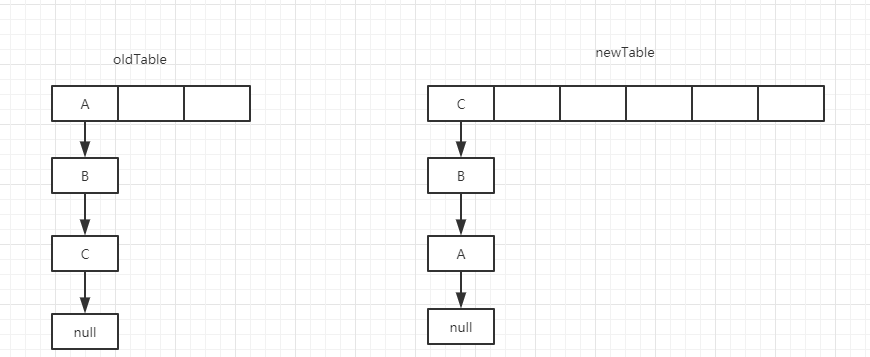
在这种情况下,假设有两个线程同时进行扩容的操作且都进入了transfer方法时,但是因为某个情况让线程一先执行完,线程二才开始执行。
这个时候如果线程一执行完了,线程二开始的状态就是这样:
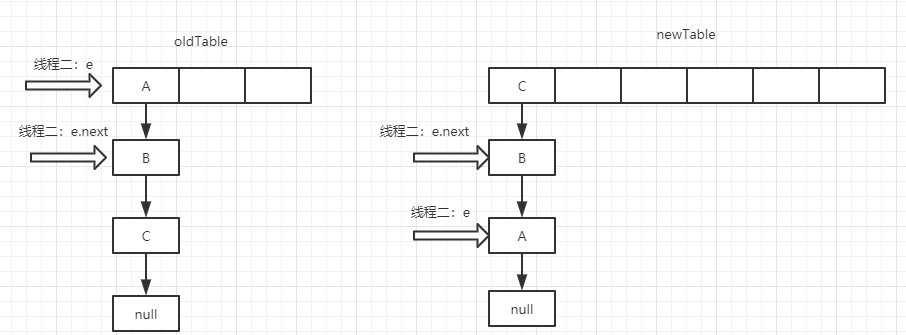
这个时候:线程二的e还是A对象,e.Next(A.Next)还是指向B,但是因为线程一的关系,实际上此时B.Next已经指向了A。于是就产生了循环:A.Next指向B,B.Next指向A。
二:hashtable
HashTable是Map接口下的一个子类,线程安全的,1.7和1.8差别不大,常和HashMap作比较,部分源码如下:


  1 //hashTable默认初始容量和加载因子2     public Hashtable() {3         this(11, 0.75f);4     }5 6 //Put方法7     public synchronized V put(K key, V value) {8         // 不允许存null9         if (value == null) {10             throw new NullPointerException();11         }12 13         // key相同时新值代替老值,并把老值返回出去14         Entry tab[] = table;15         int hash = hash(key);//哈希算法16         int index = (hash & 0x7FFFFFFF) % tab.length;17         for (Entry e = tab[index] ; e != null ; e = e.next) {18             if ((e.hash == hash) && e.key.equals(key)) {19                 V old = e.value;20                 e.value = value;21                 return old;22             }23         }24 25         modCount++;26         if (count >= threshold) {27             rehash();//扩容28 29             tab = table;30             hash = hash(key);31             index = (hash & 0x7FFFFFFF) % tab.length;32         }33 34         Entry e = tab[index];35         tab[index] = new Entry<>(hash, key, value, e);36         count++;37         return null;38     }39 //哈希算法40     private int hash(Object k) {41         return hashSeed ^ k.hashCode();42     }43 //扩容方法44     protected void rehash() {45         int oldCapacity = table.length;46         Entry[] oldMap = table;47 48         int newCapacity = (oldCapacity << 1) + 1;//扩容后容量为原来的2倍再加149         if (newCapacity - MAX_ARRAY_SIZE > 0) {50             if (oldCapacity == MAX_ARRAY_SIZE)51                 // Keep running with MAX_ARRAY_SIZE buckets52                 return;53             newCapacity = MAX_ARRAY_SIZE;54         }55         Entry[] newMap = new Entry[newCapacity];56 57         modCount++;58         threshold = (int)Math.min(newCapacity * loadFactor, MAX_ARRAY_SIZE + 1);59         boolean rehash = initHashSeedAsNeeded(newCapacity);60 61         table = newMap;62 63         for (int i = oldCapacity ; i-- > 0 ;) {64             for (Entry old = oldMap[i] ; old != null ; ) {65                 Entry e = old;66                 old = old.next;67 68                 if (rehash) {69                     e.hash = hash(e.key);70                 }71                 int index = (e.hash & 0x7FFFFFFF) % newCapacity;72                 e.next = newMap[index];73                 newMap[index] = e;74             }75         }76     }77 //remove方法78     public synchronized V remove(Object key) {79         Entry tab[] = table;80         int hash = hash(key);81         int index = (hash & 0x7FFFFFFF) % tab.length;82         for (Entry e = tab[index], prev = null ; e != null ; prev = e, e = e.next) {83             if ((e.hash == hash) && e.key.equals(key)) {84                 modCount++;85                 if (prev != null) {86                     prev.next = e.next;87                 } else {88                     tab[index] = e.next;89                 }90                 count--;91                 V oldValue = e.value;92                 e.value = null;93                 return oldValue;94             }95         }96         return null;97     }98 //get方法99     public synchronized V get(Object key) {
100         Entry tab[] = table;
101         int hash = hash(key);
102         int index = (hash & 0x7FFFFFFF) % tab.length;
103         for (Entry e = tab[index] ; e != null ; e = e.next) {
104             if ((e.hash == hash) && e.key.equals(key)) {
105                 return e.value;
106             }
107         }
108         return null;
109     }
110 //keySet方法
111     public Set keySet() {
112         if (keySet == null)
113             keySet = Collections.synchronizedSet(new KeySet(), this);
114         return keySet;
115     }
116
117     private class KeySet extends AbstractSet {
118         public Iterator iterator() {
119             return getIterator(KEYS);
120         }
121         public int size() {
122             return count;
123         }
124         public boolean contains(Object o) {
125             return containsKey(o);
126         }
127         public boolean remove(Object o) {
128             return Hashtable.this.remove(o) != null;
129         }
130         public void clear() {
131             Hashtable.this.clear();
132         }
133     }
134 //entrySet方法
135     public Set> entrySet() {
136         if (entrySet==null)
137             entrySet = Collections.synchronizedSet(new EntrySet(), this);
138         return entrySet;
139     }
140
141     private class EntrySet extends AbstractSet> {
142         public Iterator> iterator() {
143             return getIterator(ENTRIES);
144         }
145
146         public boolean add(Map.Entry o) {
147             return super.add(o);
148         }
149
150         public boolean contains(Object o) {
151             if (!(o instanceof Map.Entry))
152                 return false;
153             Map.Entry entry = (Map.Entry)o;
154             Object key = entry.getKey();
155             Entry[] tab = table;
156             int hash = hash(key);
157             int index = (hash & 0x7FFFFFFF) % tab.length;
158
159             for (Entry e = tab[index]; e != null; e = e.next)
160                 if (e.hash==hash && e.equals(entry))
161                     return true;
162             return false;
163         }
164 //clear方法
165     public synchronized void clear() {
166         Entry tab[] = table;
167         modCount++;
168         for (int index = tab.length; --index >= 0; )
169             tab[index] = null;
170         count = 0;
171     }
172 //size方法和isEmpty方法
173     public synchronized int size() {
174         return count;
175     }
176
177     public synchronized boolean isEmpty() {
178         return count == 0;
179     }
可以看出和HashMap比较,有以下特点:
1、初始容量为11。
2、扩容方法为:oldTable.Length*2+1。
3、不允许存null值。
4、计算hash,和获取数组下标不同:
HashTable:
int hash = key.hashCode();
int index = (hash & 0x7FFFFFFF) % tab.length;
HashMap:
int hash = hash(key);//
int i = indexFor(hash, table.length);
5、HashTable线程安全,主要的方法都用了synchronized,加锁。
6、HashMap和HashTable父类不同
public class HashMap
public class Hashtable
7、HashTable线程安全,但因为每个主要方法上都加上了锁,所以在执行效率上会慢很多。
三:其他线程安全Map
1、synchronizedMap
通过工具类Collections的方法,返回一个HashMap,例如:Map


 1     public static  Map synchronizedMap(Map m) {2         return new SynchronizedMap<>(m);3     }4 5     private static class SynchronizedMap6         implements Map, Serializable {7         private static final long serialVersionUID = 1978198479659022715L;8 9         private final Map m;     // Backing Map
10         final Object      mutex;        // Object on which to synchronize
11
12         SynchronizedMap(Map m) {
13             if (m==null)
14                 throw new NullPointerException();
15             this.m = m;
16             mutex = this;
17         }
18
19         SynchronizedMap(Map m, Object mutex) {
20             this.m = m;
21             this.mutex = mutex;
22         }
23
24         public int size() {
25             synchronized (mutex) {return m.size();}
26         }
27         public boolean isEmpty() {
28             synchronized (mutex) {return m.isEmpty();}
29         }
30         public boolean containsKey(Object key) {
31             synchronized (mutex) {return m.containsKey(key);}
32         }
33         public boolean containsValue(Object value) {
34             synchronized (mutex) {return m.containsValue(value);}
35         }
36         public V get(Object key) {
37             synchronized (mutex) {return m.get(key);}
38         }
39
40         public V put(K key, V value) {
41             synchronized (mutex) {return m.put(key, value);}
42         }
43         public V remove(Object key) {
44             synchronized (mutex) {return m.remove(key);}
45         }
46         public void putAll(Map map) {
47             synchronized (mutex) {m.putAll(map);}
48         }
49         public void clear() {
50             synchronized (mutex) {m.clear();}
51         }
52
53         private transient Set keySet = null;
54         private transient Set> entrySet = null;
55         private transient Collection values = null;
56
57         public Set keySet() {
58             synchronized (mutex) {
59                 if (keySet==null)
60                     keySet = new SynchronizedSet<>(m.keySet(), mutex);
61                 return keySet;
62             }
63         }
64
65         public Set> entrySet() {
66             synchronized (mutex) {
67                 if (entrySet==null)
68                     entrySet = new SynchronizedSet<>(m.entrySet(), mutex);
69                 return entrySet;
70             }
71         }
72
73         public Collection values() {
74             synchronized (mutex) {
75                 if (values==null)
76                     values = new SynchronizedCollection<>(m.values(), mutex);
77                 return values;
78             }
79         }
80
81         public boolean equals(Object o) {
82             if (this == o)
83                 return true;
84             synchronized (mutex) {return m.equals(o);}
85         }
86         public int hashCode() {
87             synchronized (mutex) {return m.hashCode();}
88         }
89         public String toString() {
90             synchronized (mutex) {return m.toString();}
91         }
92         private void writeObject(ObjectOutputStream s) throws IOException {
93             synchronized (mutex) {s.defaultWriteObject();}
94         }
95     }
可以看出,原理就是在原来Map的基础上,加上锁synchronized (mutex),来让线程变得安全,但和HashTable一样,效率慢。
2、ConcurrentHashMap
JDK1.7中的ConcurrentHashMap:
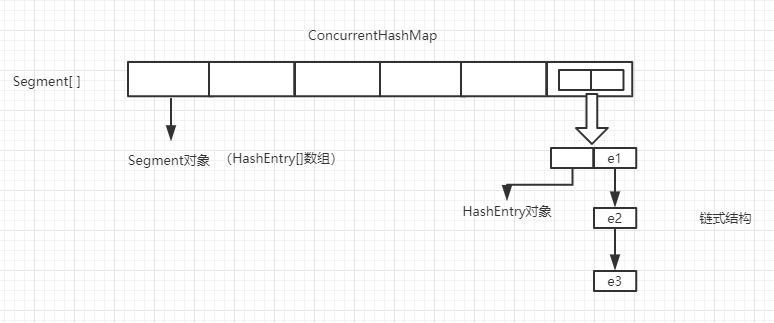
ConcurrentHashMap是线程安全的Map,继承AbstractMap。是和HashTable把整合数组共享一把锁不同,ConcurrentHashMap采用分段的思想,把HashMap分为多个段进行加锁的操作,这样既保证了线程安全性,又不会使效率像HashTable那样低。
ConcurrentHashMap的特点是分段式加锁,并利用Unsafe对象和volatile关键字来实现线程安全,他比较明显的一个局限性是并发级别一旦指定就不再更改。
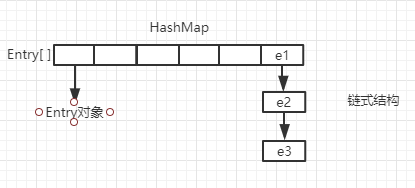
结构:
代码:


1 //默认初始容量(2的幂),实际上是指的HashEntry的数量2 static final int DEFAULT_INITIAL_CAPACITY = 16;3 //默认加载因子4 static final float DEFAULT_LOAD_FACTOR = 0.75f;5 //默认并发级别(实际上指的Segmengt对象的数量,初始化后不可更改)6 static final int DEFAULT_CONCURRENCY_LEVEL = 16;7 //最大容量小于等于2的30次幂8 static final int MAXIMUM_CAPACITY = 1 << 30;9 //最小SEGMENT容量(一个Segment里至少有两个HashEntry)10 static final int MIN_SEGMENT_TABLE_CAPACITY = 2;11 //最大SEGMENT容量容量12 static final int MAX_SEGMENTS = 1 << 16;13 //加锁之前的重试次数14 static final int RETRIES_BEFORE_LOCK = 2;15 //Segment数组16 final Segment[] segments;17 //计算segment位置的掩码,用于计算Segment[]下标18 final int segmentMask;19 //用于算segment位置时,hash参与运算的位数20 final int segmentShift;21 //内部类HashEntry,相当于HashMap中Entry[]中的Entry对象22 static final class HashEntry {23 final int hash;24 final K key;25 volatile V value;26 volatile HashEntry next;27 28 HashEntry(int hash, K key, V value, HashEntry next) {29 this.hash = hash;30 this.key = key;31 this.value = value;32 this.next = next;33 }34 35 final void setNext(HashEntry n) {36 UNSAFE.putOrderedObject(this, nextOffset, n);37 }38 39 static final sun.misc.Unsafe UNSAFE;40 static final long nextOffset;41 static {42 try {43 UNSAFE = sun.misc.Unsafe.getUnsafe();44 Class k = HashEntry.class;45 nextOffset = UNSAFE.objectFieldOffset46 (k.getDeclaredField("next"));47 } catch (Exception e) {48 throw new Error(e);49 }50 }51 }52 //hash函数53 private int hash(Object k) {54 int h = hashSeed;55 56 if ((0 != h) && (k instanceof String)) {57 return sun.misc.Hashing.stringHash32((String) k);58 }59 60 h ^= k.hashCode();61 62 h += (h << 15) ^ 0xffffcd7d;63 h ^= (h >>> 10);64 h += (h << 3);65 h ^= (h >>> 6);66 h += (h << 2) + (h << 14);67 return h ^ (h >>> 16);68 }69 //ConcurrentHashMap的构造方法70 public ConcurrentHashMap(int initialCapacity, float loadFactor, int concurrencyLevel) {//初始容量,加载因子,并发级别71 if (!(loadFactor > 0) || initialCapacity < 0 || concurrencyLevel <= 0)//保证参数不能小于072 throw new IllegalArgumentException();73 if (concurrencyLevel > MAX_SEGMENTS)//保证并发级别不能大于最大Segment容量74 concurrencyLevel = MAX_SEGMENTS;75 76 int sshift = 0;77 int ssize = 1;78 while (ssize < concurrencyLevel) {79 ++sshift;//统计ssize左移的次数80 ssize <<= 1;//初始是1,通过左移然后2、4、8、16...作用是找到大于等于并发级别的2的“sshift”次幂81 }82 this.segmentShift = 32 - sshift;//用于Put方法中,求Segment[]数组的下标时用83 this.segmentMask = ssize - 1;//Segmengt[].length-184 if (initialCapacity > MAXIMUM_CAPACITY)//如果初始容量大于最大85 initialCapacity = MAXIMUM_CAPACITY;//则选择最大容量作为容量86 int c = initialCapacity / ssize;//HashEntry[].length/Segmengt[].length,用来标记HashEntry的数量87 if (c * ssize < initialCapacity)//例如initialCapacity = 9,concurrencyLevel(ssize) = 8 ,则initialCapacity / ssize = 1,c * ssize < initialCapacity88 ++c; // 然后让C = 2, 此时 c * ssize >= initialCapacity ,这里的目的就是保证数据都被Segmengt存储。89 int cap = MIN_SEGMENT_TABLE_CAPACITY;90 while (cap < c)//拿最小的容量和刚刚计算的 c 进行比较91 cap <<= 1; // 保证最小容量是2的n次幂92 Segment s0 =93 new Segment(loadFactor, (int)(cap * loadFactor),94 (HashEntry[])new HashEntry[cap]);//初始化Segment对象95 Segment[] ss = (Segment[])new Segment[ssize];//初始化Segment数组96 UNSAFE.putOrderedObject(ss, SBASE, s0); //调用Unsafe中的方法,作用是把刚刚初始化的Segemengt对象s0,放到刚刚初始化Segment[]数组中的Segment[0],也就是第一位97 this.segments = ss;98 }99 //Put方法
100 public V put(K key, V value) {
101 Segment s;
102 if (value == null)
103 throw new NullPointerException();//不能传null,此处个人认为应该加个 key也不能为 null的判断
104 int hash = hash(key);//计算hash值
105 int j = (hash >>> segmentShift) & segmentMask; // 计算Segmengt[]下标,即数据存储的位置
106 if ((s = (Segment)UNSAFE.getObject(segments, (j << SSHIFT) + SBASE)) == null) // 调用Unsafe的方法,作用是获取Segmengt[j]的对象,如果等于空
107 s = ensureSegment(j);//判断第j个位置是不是为空,保证线程安全性
108 return s.put(key, hash, value, false);//调用Segmengt对象的put方法
109 }
110
111 //Segmengt的Put方法
112 final V put(K key, int hash, V value, boolean onlyIfAbsent) {
113 HashEntry node = tryLock() ? null : scanAndLockForPut(key, hash, value);//加锁,保证线程安全
114 V oldValue;
115 try {
116 HashEntry[] tab = table;
117 int index = (tab.length - 1) & hash;
118 HashEntry first = entryAt(tab, index);//获取该位置的第一个元素,然后遍历链表
119 for (HashEntry e = first;;) {
120 if (e != null) {
121 K k;
122 if ((k = e.key) == key ||
123 (e.hash == hash && key.equals(k))) {
124 oldValue = e.value;
125 if (!onlyIfAbsent) {
126 e.value = value;
127 ++modCount;
128 }
129 break;
130 }
131 e = e.next;
132 }
133 else {
134 if (node != null)
135 node.setNext(first);
136 else
137 node = new HashEntry(hash, key, value, first);
138 int c = count + 1;
139 if (c > threshold && tab.length < MAXIMUM_CAPACITY)
140 rehash(node);
141 else
142 setEntryAt(tab, index, node);
143 ++modCount;
144 count = c;
145 oldValue = null;
146 break;
147 }
148 }
149 } finally {
150 unlock();
151 }
152 return oldValue;
153 }
154
155 @SuppressWarnings("unchecked")
156 private void rehash(HashEntry node) {//扩容方法,只扩容HashEntry[],没扩容Segmengt[]
157
158 HashEntry[] oldTable = table;
159 int oldCapacity = oldTable.length;
160 int newCapacity = oldCapacity << 1;
161 threshold = (int)(newCapacity * loadFactor);
162 HashEntry[] newTable =
163 (HashEntry[]) new HashEntry[newCapacity];
164 int sizeMask = newCapacity - 1;
165 for (int i = 0; i < oldCapacity ; i++) {
166 HashEntry e = oldTable[i];
167 if (e != null) {
168 HashEntry next = e.next;
169 int idx = e.hash & sizeMask;
170 if (next == null)
171 newTable[idx] = e;
172 else {
173 HashEntry lastRun = e;
174 int lastIdx = idx;
175 for (HashEntry last = next;
176 last != null;
177 last = last.next) {
178 int k = last.hash & sizeMask;
179 if (k != lastIdx) {
180 lastIdx = k;
181 lastRun = last;
182 }
183 }
184 newTable[lastIdx] = lastRun;
185
186 for (HashEntry p = e; p != lastRun; p = p.next) {
187 V v = p.value;
188 int h = p.hash;
189 int k = h & sizeMask;
190 HashEntry n = newTable[k];
191 newTable[k] = new HashEntry(h, p.key, v, n);
192 }
193 }
194 }
195 }
196 int nodeIndex = node.hash & sizeMask;
197 node.setNext(newTable[nodeIndex]);
198 newTable[nodeIndex] = node;
199 table = newTable;
200 }
201
202 private HashEntry scanAndLockForPut(K key, int hash, V value) {
203 HashEntry first = entryForHash(this, hash);
204 HashEntry e = first;
205 HashEntry node = null;
206 int retries = -1;
207 while (!tryLock()) {
208 HashEntry f;
209 if (retries < 0) {
210 if (e == null) {
211 if (node == null)
212 node = new HashEntry(hash, key, value, null);
213 retries = 0;
214 }
215 else if (key.equals(e.key))
216 retries = 0;
217 else
218 e = e.next;
219 }
220 else if (++retries > MAX_SCAN_RETRIES) {
221 lock();
222 break;
223 }
224 else if ((retries & 1) == 0 &&
225 (f = entryForHash(this, hash)) != first) {
226 e = first = f;
227 retries = -1;
228 }
229 }
230 return node;
231 }
232
233 private void scanAndLock(Object key, int hash) {
234
235 HashEntry first = entryForHash(this, hash);
236 HashEntry e = first;
237 int retries = -1;
238 while (!tryLock()) {
239 HashEntry f;
240 if (retries < 0) {
241 if (e == null || key.equals(e.key))
242 retries = 0;
243 else
244 e = e.next;
245 }
246 else if (++retries > MAX_SCAN_RETRIES) {
247 lock();
248 break;
249 }
250 else if ((retries & 1) == 0 &&
251 (f = entryForHash(this, hash)) != first) {
252 e = first = f;
253 retries = -1;
254 }
255 }
256 }
257
258 final V remove(Object key, int hash, Object value) {
259 if (!tryLock())
260 scanAndLock(key, hash);
261 V oldValue = null;
262 try {
263 HashEntry[] tab = table;
264 int index = (tab.length - 1) & hash;
265 HashEntry e = entryAt(tab, index);
266 HashEntry pred = null;
267 while (e != null) {
268 K k;
269 HashEntry next = e.next;
270 if ((k = e.key) == key ||
271 (e.hash == hash && key.equals(k))) {
272 V v = e.value;
273 if (value == null || value == v || value.equals(v)) {
274 if (pred == null)
275 setEntryAt(tab, index, next);
276 else
277 pred.setNext(next);
278 ++modCount;
279 --count;
280 oldValue = v;
281 }
282 break;
283 }
284 pred = e;
285 e = next;
286 }
287 } finally {
288 unlock();
289 }
290 return oldValue;
291 }
292
293 final boolean replace(K key, int hash, V oldValue, V newValue) {
294 if (!tryLock())
295 scanAndLock(key, hash);
296 boolean replaced = false;
297 try {
298 HashEntry e;
299 for (e = entryForHash(this, hash); e != null; e = e.next) {
300 K k;
301 if ((k = e.key) == key ||
302 (e.hash == hash && key.equals(k))) {
303 if (oldValue.equals(e.value)) {
304 e.value = newValue;
305 ++modCount;
306 replaced = true;
307 }
308 break;
309 }
310 }
311 } finally {
312 unlock();
313 }
314 return replaced;
315 }
316
317 final V replace(K key, int hash, V value) {
318 if (!tryLock())
319 scanAndLock(key, hash);
320 V oldValue = null;
321 try {
322 HashEntry e;
323 for (e = entryForHash(this, hash); e != null; e = e.next) {
324 K k;
325 if ((k = e.key) == key ||
326 (e.hash == hash && key.equals(k))) {
327 oldValue = e.value;
328 e.value = value;
329 ++modCount;
330 break;
331 }
332 }
333 } finally {
334 unlock();
335 }
336 return oldValue;
337 }
338
339 final void clear() {
340 lock();
341 try {
342 HashEntry[] tab = table;
343 for (int i = 0; i < tab.length ; i++)
344 setEntryAt(tab, i, null);
345 ++modCount;
346 count = 0;
347 } finally {
348 unlock();
349 }
350 }
351 }
352 //Get方法
353 public V get(Object key) {
354 Segment s;
355 HashEntry[] tab;
356 int h = hash(key);
357 long u = (((h >>> segmentShift) & segmentMask) << SSHIFT) + SBASE;//先获取Segment[] 的下标
358 if ((s = (Segment)UNSAFE.getObjectVolatile(segments, u)) != null && (tab = s.table) != null) { //用Unsafe的方法获取到Segment对象
359 //用Unsafe的方法HashEntry对象,然后遍历链表
360 for (HashEntry e = (HashEntry) UNSAFE.getObjectVolatile(tab, ((long)(((tab.length - 1) & h)) << TSHIFT) + TBASE); e != null; e = e.next) {
361 K k;
362 if ((k = e.key) == key || (e.hash == h && key.equals(k)))
363 return e.value;
364 }
365 }
366 return null;
367 }
JDK1.8:
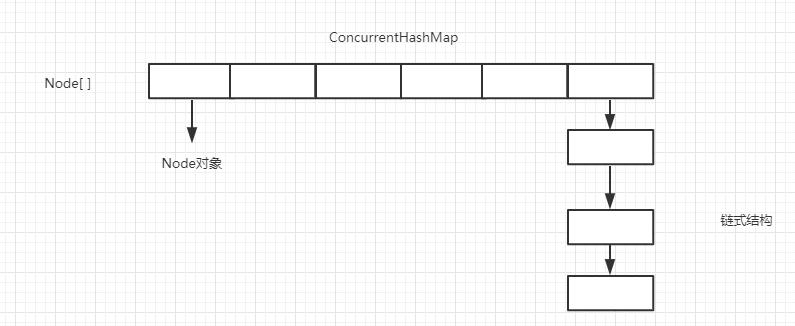
JDK1.8时,ConcurrentHashMap又放弃了分段式加锁的思想,而且也不在用Segment[]数组存值,而是采用在HashMap1.8的基础上,采用Node[] + 链表 + 红黑树 + CAS+ Synchronized 的思想保证线程安全。而且在扩容的时候,不仅要满足链表结构大于8,还要满足数据容量大于64。


  1 //最大容量2     private static final int MAXIMUM_CAPACITY = 1 << 30;3 //默认容量4     private static final int DEFAULT_CAPACITY = 16;5 //最大数组长度6     static final int MAX_ARRAY_SIZE = Integer.MAX_VALUE - 8;7 //默认并发等级(1.7遗留,兼容以前版本)8     private static final int DEFAULT_CONCURRENCY_LEVEL = 16;9 //加载因子(1.7遗留,兼容以前版本)10     private static final float LOAD_FACTOR = 0.75f;11 //转换为红黑树的阈值(道理和HashMap1.8中一样,这里指链表长度)12     static final int TREEIFY_THRESHOLD = 8;13 //红黑树反转成链表的阈值14     static final int UNTREEIFY_THRESHOLD = 6;15 //转换为红黑树的阈值(这里指数组长度)16     static final int MIN_TREEIFY_CAPACITY = 64;17 //扩容转移时的最小数组分组大小18 private static final int MIN_TRANSFER_STRIDE = 16;19 //本类中没提供修改的方法 用来根据n生成位置一个类似时间搓的功能20 private static int RESIZE_STAMP_BITS = 16;21 // 2^15-1,help resize的最大线程数22 private static final int MAX_RESIZERS = (1 << (32 - RESIZE_STAMP_BITS)) - 1; 23 // 32-16=16,sizeCtl中记录size大小的偏移量24 private static final int RESIZE_STAMP_SHIFT = 32 - RESIZE_STAMP_BITS; 25 //表示正在转移26 static final int MOVED = -1; 27 // 表示已转换为红黑树28 static final int TREEBIN = -2; 29 // 保留30 static final int RESERVED = -3; 31 // 用在计算hash时进行安位与计算消除负hash32 static final int HASH_BITS = 0x7fffffff; 33 // 可用处理器数量34 static final int NCPU = Runtime.getRuntime().availableProcessors(); 35 //构造函数36     public ConcurrentHashMap(int initialCapacity, float loadFactor, int concurrencyLevel) {37         if (!(loadFactor > 0.0f) || initialCapacity < 0 || concurrencyLevel <= 0)//判断参数是否大于等于038             throw new IllegalArgumentException();39         if (initialCapacity < concurrencyLevel)   40             initialCapacity = concurrencyLevel;   // 容量最小为1641         long size = (long)(1.0 + (long)initialCapacity / loadFactor);42         int cap = (size >= (long)MAXIMUM_CAPACITY) ?43             MAXIMUM_CAPACITY : tableSizeFor((int)size);//获取数组容量并保证不大于最大容量44         this.sizeCtl = cap;45     }46 //Put方法47     public V put(K key, V value) {48         return putVal(key, value, false);49     }50 51     final V putVal(K key, V value, boolean onlyIfAbsent) {52         if (key == null || value == null) throw new NullPointerException();//不允许存null53         int hash = spread(key.hashCode());//计算hash值54         int binCount = 0;55         for (Node[] tab = table;;) {56             Node f; int n, i, fh;57             if (tab == null || (n = tab.length) == 0)58                 tab = initTable();//懒加载,数组为空时初始化59             else if ((f = tabAt(tab, i = (n - 1) & hash)) == null) {//类似Unsafe获取对象的方法获取对象60                 if (casTabAt(tab, i, null,61                              new Node(hash, key, value, null)))//CAS,如果获取位置为空,则将数据存入62                     break;                   63             }64             else if ((fh = f.hash) == MOVED)//首地址处不null 并且Node的hash是-1  表示是ForwardingNode节点正在rehash扩容65                 tab = helpTransfer(tab, f);//帮助扩容的方法66             else {67                 V oldVal = null;68                 synchronized (f) {//加锁69                     if (tabAt(tab, i) == f) {70                         if (fh >= 0) {71                             binCount = 1;72                             for (Node e = f;; ++binCount) {73                                 K ek;74                                 if (e.hash == hash &&75                                     ((ek = e.key) == key ||76                                      (ek != null && key.equals(ek)))) {//遍历链表,如果key重复,值替换,老值返回出去77                                     oldVal = e.val;78                                     if (!onlyIfAbsent)79                                         e.val = value;80                                     break;81                                 }82                                 Node pred = e;83                                 if ((e = e.next) == null) {84                                     pred.next = new Node(hash, key,85                                                               value, null);86                                     break;87                                 }88                             }89                         }90                         else if (f instanceof TreeBin) {//如果为红黑树的对象,调用红黑树的put方法91                             Node p;92                             binCount = 2;93                             if ((p = ((TreeBin)f).putTreeVal(hash, key,94                                                            value)) != null) {95                                 oldVal = p.val;96                                 if (!onlyIfAbsent)97                                     p.val = value;98                             }99                         }
100                     }
101                 }
102                 if (binCount != 0) {
103                     if (binCount >= TREEIFY_THRESHOLD)
104                     //如果链表数据超过指定阈值,转换红黑树,并且会再进行一次判断,看数组容量是否大于64,数组大于64后才会转换为红黑树
105                         treeifyBin(tab, i);
106                     if (oldVal != null)
107                         return oldVal;
108                     break;
109                 }
110             }
111         }
112         addCount(1L, binCount);
113         return null;
114     }
115 //Get方法,基本和1.8HashMap一样,获取数组坐标,然后获取Node对象,并且没有加锁。
116     public V get(Object key) {
117         Node[] tab; Node e, p; int n, eh; K ek;
118         int h = spread(key.hashCode());
119         if ((tab = table) != null && (n = tab.length) > 0 &&
120             (e = tabAt(tab, (n - 1) & h)) != null) {
121             if ((eh = e.hash) == h) {
122                 if ((ek = e.key) == key || (ek != null && key.equals(ek)))
123                     return e.val;
124             }
125             else if (eh < 0)
126                 return (p = e.find(h, key)) != null ? p.val : null;
127             while ((e = e.next) != null) {
128                 if (e.hash == h &&
129                     ((ek = e.key) == key || (ek != null && key.equals(ek))))
130                     return e.val;
131             }
132         }
133         return null;
134     }
注意:分析ConcurrentHashMap源码前,需要先了解一下CAS、Unsafe、Synchronized 、Volatile相关知识。
本文来自互联网用户投稿,文章观点仅代表作者本人,不代表本站立场,不承担相关法律责任。如若转载,请注明出处。 如若内容造成侵权/违法违规/事实不符,请点击【内容举报】进行投诉反馈!