h 1 ( n ) h_1(n) h1(n) = number of misplaced tiles(错位的棋子数)
h 2 ( n ) h_2(n) h2(n) = total Manhattan distance(所有棋子到其目标位置的水平竖直距离和) (i.e., no. of squares from desired location of each tile
如下起始状态与结束状态
在上述两个启发式函数下,对到达目标状态的估计耗散为: h 1 ( S ) = 8 h_1(S)= 8 h1(S)=8 h 2 ( S ) = 3 + 1 + 2 + 2 + 2 + 3 + 3 + 2 = 18 h_2(S) = 3+1+2+2+2+3+3+2 = 18 h2(S)=3+1+2+2+2+3+3+2=18
如何评价启发式函数
If h 2 ( n ) ≥ h 1 ( n ) h_2(n) ≥ h_1(n) h2(n)≥h1(n)for all n (both admissible)
then h 2 h_2 h2 dominates h 1 h_1 h1 (dominate 统治、占优)即 h 2 h_2 h2 优于 h 1 h_1 h1
h 2 h_2 h2 is better for search
典型的搜索成本(扩展的平均节点数):
d=12
IDS = 3,644,035 nodes(迭代加深深度优先搜索)
A ∗ ( h 1 ) A^*(h_1) A∗(h1) = 227 nodes
A ∗ ( h 2 ) A^*(h_2) A∗(h2) = 73 nodes
d=24
IDS = too many nodes
A ∗ ( h 1 ) A^*(h_1) A∗(h1)= 39,135 nodes
A ∗ ( h 2 ) A^*(h_2) A∗(h2) = 1,641 nodes
给定任何可容许的启发函数 h a , h b h_a,h_b ha,hb h ( n ) = m a x ( h a ( n ) ; h b ( n ) ) h(n)=max(h_a(n);h_b(n)) h(n)=max(ha(n);hb(n)) 也是可容许的并且dominates h a , h b h_a,h_b ha,hb
使用 评价函数 f ( n ) = g ( n ) + h ( n ) f(n) = g(n) +h(n) f(n)=g(n)+h(n)搜索
如果有一个可采纳启发式的集合 h 1 , … , h m {h_1 ,…, h_m } h1,…,hm h ( n ) = m a x ( h 1 ( n ) , … , h m ( n ) ) h(n) = max(h_1(n),…, h_m(n)) h(n)=max(h1(n),…,hm(n))可采纳并比成员启发式更有优势
评价函数f(n)
h(n) — heuristic, estimate of cost from n to the closest goal (节点n到目标节点的最低耗散路径的耗散估计值)


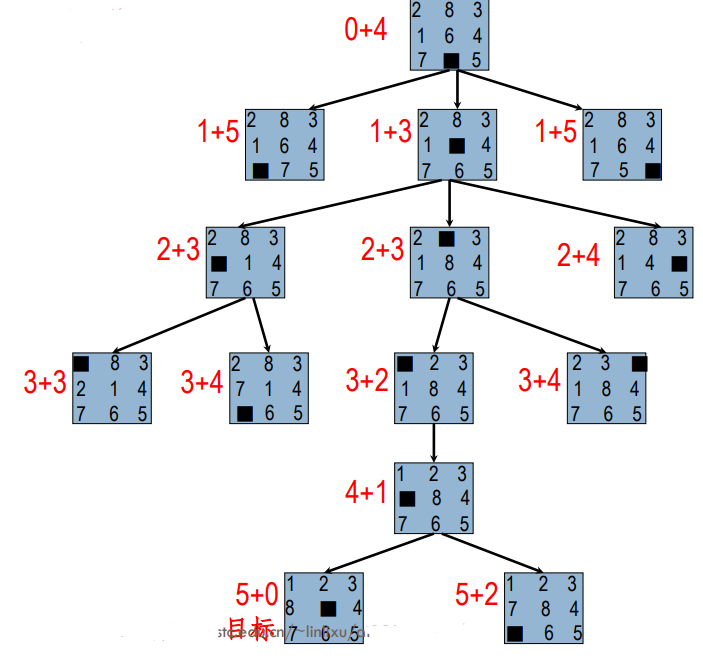
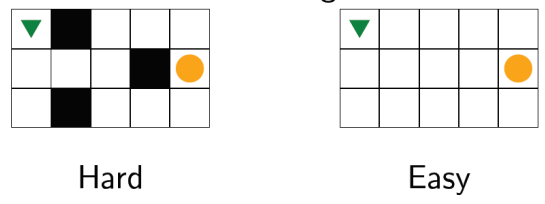

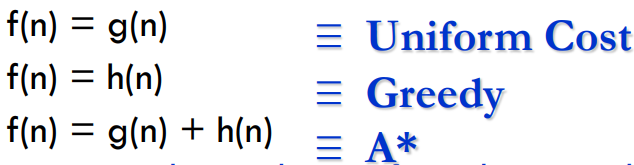 估计通过节点n的解决方案路径的总成本