Arrays类详解
文章结构概览
本文将按一下顺序,逐一介绍。
- Arrays类介绍
- Arrays方法分类
- 排序相关
- 查找相关
- 比较相关
- 打印相关
- 计算hashCode
- 拷贝相关
- 赋值相关
- 转化为集合List
1. Arrays类介绍
This class contains various methods for manipulating arrays (such as
sorting and searching). This class also contains a static factory
that allows arrays to be viewed as lists.
该类包含用于操作数组的各种方法(例如排序和搜索)。该类还包含一个静态工厂,允许将数组视为列表。
根据注释解释,可以知道该类是一个操作数组的工具类,里面封装了常用的数组操作方法。
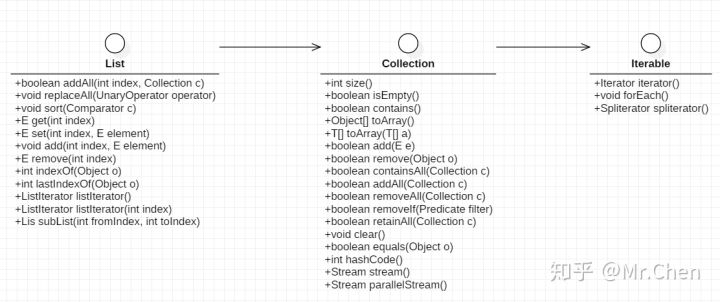
List相关类
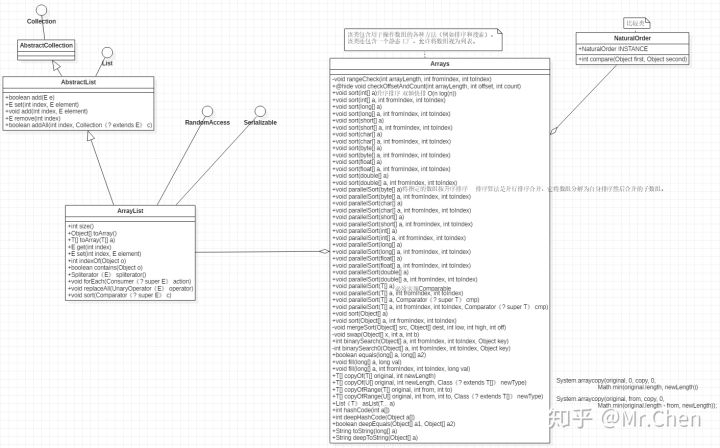
Arrays相关类图
2. Arrays方法分类
2.1 排序相关
2.1.1 普通排序
int[] numbers = new int[]{2, 8, 1};// 整体排序
System.out.println(Arrays.toString(numbers));
Arrays.sort(numbers);
System.out.println(Arrays.toString(numbers));// 指定位置排序
System.out.println(Arrays.toString(numbers));
Arrays.sort(numbers, 1, 2);
System.out.println(Arrays.toString(numbers));
主要是调用静态方法 sort() ,支持基本类型数组,引用类型数组必须实现 Comparable接口。
其中的排序算法用的是Dual-Pivot Quicksort(双轴快排),升序排序,时间复杂度为O(n log(n))。
/*** Sorts the specified range of the array using the given* workspace array slice if possible for merging** @param a the array to be sorted* @param left the index of the first element, inclusive, to be sorted* @param right the index of the last element, inclusive, to be sorted* @param work a workspace array (slice)* @param workBase origin of usable space in work array* @param workLen usable size of work array*/
static void sort(int[] a, int left, int right, int[] work, int workBase, int workLen) {// 对于小规模的数组,使用快排if (right - left < QUICKSORT_THRESHOLD) {sort(a, left, right, true);return;}/** Index run[i] is the start of i-th run* 索引从i开始* (升序或降序).*/int[] run = new int[MAX_RUN_COUNT + 1];int count = 0; run[0] = left;// 检查数组是否接近有序for (int k = left; k < right; run[count] = k) {if (a[k] < a[k + 1]) { // 升序while (++k <= right && a[k - 1] <= a[k]);} else if (a[k] > a[k + 1]) { // 降序while (++k <= right && a[k - 1] >= a[k]);for (int lo = run[count] - 1, hi = k; ++lo < --hi; ) {int t = a[lo]; a[lo] = a[hi]; a[hi] = t;}} else { // 相等for (int m = MAX_RUN_LENGTH; ++k <= right && a[k - 1] == a[k]; ) {if (--m == 0) {sort(a, left, right, true);return;}}}/** 如果数组的规模没有超过最大规模,* 应该使用快排,而不是归并排序*/if (++count == MAX_RUN_COUNT) {sort(a, left, right, true);return;}}// 检查特殊情况// Implementation note: variable "right" is increased by 1.if (run[count] == right++) { // 最后一次运行只包含一个元素run[++count] = right;} else if (count == 1) { // 数组已经有序return;}// Determine alternation base for mergebyte odd = 0;for (int n = 1; (n <<= 1) < count; odd ^= 1);// 创建或使用临时数组bint[] b;                 // temp array; alternates with aint ao, bo;              // array offsets from 'left' 相对于left的偏移int blen = right - left; // space needed for b  b所需要的空间if (work == null || workLen < blen || workBase + blen > work.length) {work = new int[blen];workBase = 0;}if (odd == 0) {System.arraycopy(a, left, work, workBase, blen);b = a;bo = 0;a = work;ao = workBase - left;} else {b = work;ao = 0;bo = workBase - left;}// 合并排序for (int last; count > 1; count = last) {for (int k = (last = 0) + 2; k <= count; k += 2) {int hi = run[k], mi = run[k - 1];for (int i = run[k - 2], p = i, q = mi; i < hi; ++i) {if (q >= hi || p < mi && a[p + ao] <= a[q + ao]) {b[i + bo] = a[p++ + ao];} else {b[i + bo] = a[q++ + ao];}}run[++last] = hi;}if ((count & 1) != 0) {for (int i = right, lo = run[count - 1]; --i >= lo;b[i + bo] = a[i + ao]);run[++last] = right;}int[] t = a; a = b; b = t;int o = ao; ao = bo; bo = o;}
}
2.1.2 并行排序
int[] numbers = new int[]{2, 8, 1};// 整体排序
System.out.println(Arrays.toString(numbers));
Arrays.parallelSort(numbers);
System.out.println(Arrays.toString(numbers));// 指定位置排序
System.out.println(Arrays.toString(numbers));
Arrays.parallelSort(numbers, 1, 2);
System.out.println(Arrays.toString(numbers));
主要是调用静态方法 parallelSort() ,支持基本数据类型数组,引用类型的数组需要实现Comparable接口,或者调用方法时传入指定的比较器。
这种排序方式,会去判断当前数组的大小是否 小于最小的并行排序长度 MIN_ARRAY_SORT_GRAN,或者并行池的数量为1,如果满足条件,还会调用Dual-Pivot Quicksort(双轴快排)方法来排序,否则才去执行并行排序。
public static void parallelSort(int[] a, int fromIndex, int toIndex) {rangeCheck(a.length, fromIndex, toIndex);int n = toIndex - fromIndex, p, g;if (n <= MIN_ARRAY_SORT_GRAN || (p = ForkJoinPool.getCommonPoolParallelism()) == 1) {DualPivotQuicksort.sort(a, fromIndex, toIndex - 1, null, 0, 0);} else {new ArraysParallelSortHelpers.FJInt.Sorter(null, a, new int[n], fromIndex, n, 0,((g = n / (p << 2)) <= MIN_ARRAY_SORT_GRAN) ?MIN_ARRAY_SORT_GRAN : g).invoke();}
}
2.2 查找相关
int[] numbers = new int[]{2, 8, 1};// 整体查找
int index =  Arrays.binarySearch(numbers, 8);
System.out.println("8的对应下标为 " + index);// 指定位置查找
int index2 =  Arrays.binarySearch(numbers, 8, 1, 2);
System.out.println("8的对应下标为 " + index2);
主要是调用静态方法 binarySearch() ,支持基本数据类型数组,引用类型的数组需要实现Comparable接口,或者调用方法时传入指定的比较器。
查找算法使用的是二分查找。
private static int binarySearch0(int[] a, int fromIndex, int toIndex, int key) {int low = fromIndex;int high = toIndex - 1;while (low <= high) {int mid = (low + high) >>> 1;int midVal = a[mid];if (midVal < key)low = mid + 1;else if (midVal > key)high = mid - 1;elsereturn mid; // key found}return -(low + 1);  // key not found.
}
2.3 比较相关
2.3.1 普通比较
比较数组是否相等:
int[] numbers1 = new int[]{2, 8, 1};
int[] numbers2 = new int[]{2, 6, 1};// 比较数组是否相等
boolean result =  Arrays.equals(numbers1, numbers2);
System.out.println("两个数组是否相等 " + result);
支持所有数据类型,其中引用类型会调用equals方法,如果没有重写,则比较的是地址值。
2.3.2 深度比较
针对引用类型,会比较该对象里的所有基本数据类型,如果全部相等,才对比成功。
class A {public int a;public A(int a){this.a = a;}
}A[] numbers1 = new A[]{new A(1), new A(8), new A(0)};
A[] numbers2 = new A[]{new A(2), new A(8), new A(0)};// 比较数组是否相等
boolean result =  Arrays.deepEquals(numbers1, numbers2);
System.out.println("两个数组是否相等 " + result);
2.4 打印相关
2.4.1 普通打印
将数组打印出来:
int[] numbers1 = new int[]{2, 8, 1};// 打印数组
System.out.println(Arrays.toString(numbers1));
支持所有数据类型,其中引用类型会调用 toString 方法。
2.4.2 深度打印
针对引用类型,会把该对象里的所有基本数据类型打印出来。
class A {public int a;public A(int a){this.a = a;}
}A[] numbers = new A[]{new A(1), new A(8), new A(0)};
// 打印数组
System.out.println(Arrays.deepToString(numbers));
2.5 计算hashCode
2.5.1 普通计算
int[] numbers1 = new int[]{2, 8, 1};// 打印数组的hash值
System.out.println("hashCode " + Arrays.hashCode(numbers1));
支持所有数据类型,其中引用类型会调用 hashCode 方法。
2.5.2 深度计算
针对引用类型,会计算该对象里的所有基本数据类型的hashCode。
class A {public int a;public A(int a){this.a = a;}
}A[] numbers = new A[]{new A(1), new A(8), new A(0)};
// 打印数组的hash值
System.out.println("hashCode " + Arrays.deepHashCode(numbers));
2.6 拷贝相关
// 整体拷贝
int[] numbers = new int[]{2, 8, 1};
int[] numbers2 = Arrays.copyOf(numbers, 8);
// 打印拷贝的数组
System.out.println(Arrays.toString(numbers2));// 局部拷贝
int[] numbers3 = Arrays.copyOfRange(numbers, 1, 8);
System.out.println(Arrays.toString(numbers3));
其中 copyOf 和 copyOfRange 都会调用 System的一个静态方法 arraycopy,如下所示。
public static void arraycopy(int[] src, int srcPos, int[] dst, int dstPos, int length) {if (src == null) {throw new NullPointerException("src == null");}if (dst == null) {throw new NullPointerException("dst == null");}if (srcPos < 0 || dstPos < 0 || length < 0 ||srcPos > src.length - length || dstPos > dst.length - length) {throw new ArrayIndexOutOfBoundsException("src.length=" + src.length + " srcPos=" + srcPos +" dst.length=" + dst.length + " dstPos=" + dstPos + " length=" + length);}if (length <= ARRAYCOPY_SHORT_INT_ARRAY_THRESHOLD) {// Copy int by int for shorter arrays.if (src == dst && srcPos < dstPos && dstPos < srcPos + length) {// Copy backward (to avoid overwriting elements before// they are copied in case of an overlap on the same// array.)for (int i = length - 1; i >= 0; --i) {dst[dstPos + i] = src[srcPos + i];}} else {// Copy forward.for (int i = 0; i < length; ++i) {dst[dstPos + i] = src[srcPos + i];}}} else {// Call the native version for longer arrays.arraycopyIntUnchecked(src, srcPos, dst, dstPos, length);}
}
2.7 赋值相关
可以为一个数组赋上初始值。
// 整体赋值
int[] numbers = new int[9];
Arrays.fill(numbers, 8);
System.out.println(Arrays.toString(numbers));// 局部赋值
int[] numbers2 = new int[9];
int value = 9;
Arrays.fill(numbers2, 5, 8, value);
System.out.println(Arrays.toString(numbers2));
2.8 转换为集合List
将一个数组转换成一个List。
class A {public int a;public A(int a){this.a = a;}
}A[] numbers = new A[]{new A(1), new A(2)};
List list = Arrays.asList(numbers);
需要注意的是 该List是 Arrays的一个内部类,并不是我们常用的 ArrayList。
并且其只实现了部分方法:
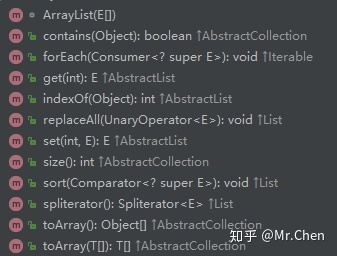
Arrays内部的List中实现的方法
调用其他方法 会抛出异常 UnsupportedOperationException。
本文来自互联网用户投稿,文章观点仅代表作者本人,不代表本站立场,不承担相关法律责任。如若转载,请注明出处。 如若内容造成侵权/违法违规/事实不符,请点击【内容举报】进行投诉反馈!