使用 LSSVM 的 Matlab 演示求解反常微分方程问题(Matlab代码实现)
💥💥💞💞欢迎来到本博客❤️❤️💥💥
🏆博主优势:🌞🌞🌞博客内容尽量做到思维缜密,逻辑清晰,为了方便读者。
⛳️座右铭:行百里者,半于九十。
📋📋📋本文目录如下:🎁🎁🎁
目录
💥1 概述
📚2 运行结果
🎉3 参考文献
🌈4 Matlab代码实现

💥1 概述
LSSVM的特性
1) 同样是对原始对偶问题进行求解,但是通过求解一个线性方程组(优化目标中的线性约束导致的)来代替SVM中的QP问题(简化求解过程),对于高维输入空间中的分类以及回归任务同样适用;
2) 实质上是求解线性矩阵方程的过程,与高斯过程(Gaussian processes),正则化网络(regularization networks)和费雪判别分析(Fisher discriminant analysis)的核版本相结合;
3) 使用了稀疏近似(用来克服使用该算法时的弊端)与稳健回归(稳健统计);
4) 使用了贝叶斯推断(Bayesian inference);
5) 可以拓展到非监督学习中:核主成分分析(kernel PCA)或密度聚类;
6) 可以拓展到递归神经网络中。
📚2 运行结果

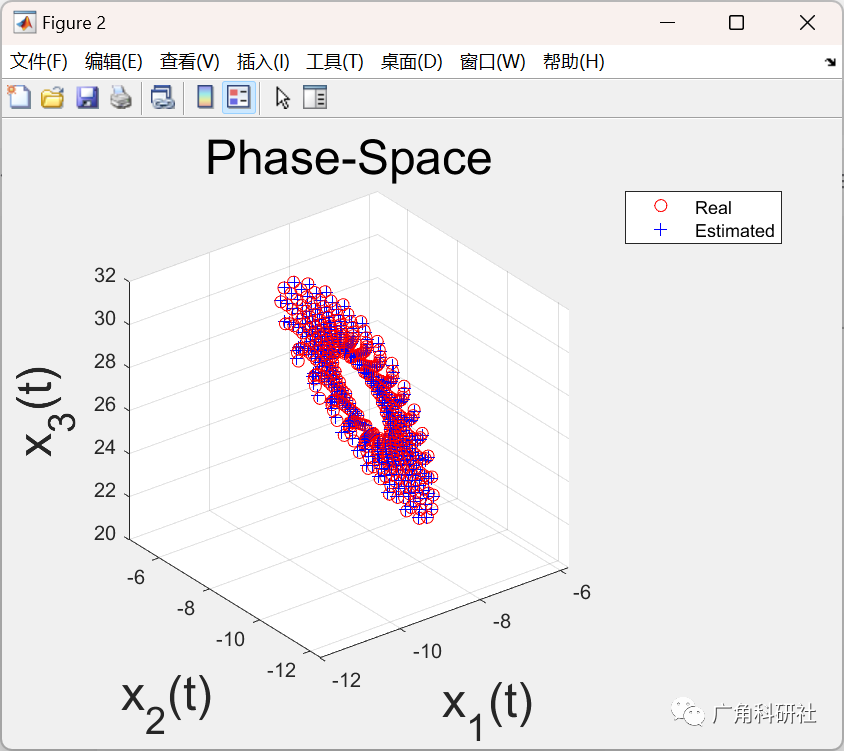
主函数部分代码:
% dot(x1) = a * (x_2 -x_1)
% dot(x_2) = x_1 * (b- x_3) - x_2
% dot(x_3) = x_1 * x_2 -c* x_3
% 0 <= t < = t_f
% Initial Condition
% x_1(0) = -9.42, x_2(0)= -9.34, x_3(0)=28.3
% Theta=[a, b, c] = [10, 28, 8/3]
clear all; close all; clc
t0=0;
tf=10;
sampling_time=0.05;
t=(t0:sampling_time:tf)';
initial=[-9.42 -9.34 28.3]; % initial values of the ODE used for generating simulated data
ExactTheta=[10; 28 ; 8/3]; % The exact parameters of the lorenz system used for generating simulated data
cprintf( [1 0.1 0],'**** Excat parameters of the Lorenz system ***** \n\n');
fprintf('True theta_1= %f \n', ExactTheta(1));
fprintf('True theta_2= %f \n', ExactTheta(2));
fprintf('True theta_3= %f \n\n', ExactTheta(3));
fprintf( '************************************* \n\n');
%% ========= Generating the simulation data ======================
options = odeset('RelTol',1e-5,'AbsTol',[1e-5 1e-5 1e-5]);
sol = ode45(@ridg,[t0 tf],initial,options,ExactTheta);
Y=deval(sol,t);
Y=Y';noise_level=0.01; % 0.03, 0.05, 0.07, 0.1
noise=noise_level*randn(size(t,1),1);
y1=Y(:,1)+noise;
y2=Y(:,2)+noise;
y3=Y(:,3)+noise;
🎉3 参考文献
部分理论来源于网络,如有侵权请联系删除。
[1]姜星宇. 基于动态粒子群算法的DPSO-LSSVM模型在短期电力负荷预测中的应用研究[D].沈阳农业大学,2022.DOI:10.27327/d.cnki.gshnu.2022.000596.
🌈4 Matlab代码实现
本文来自互联网用户投稿,文章观点仅代表作者本人,不代表本站立场,不承担相关法律责任。如若转载,请注明出处。 如若内容造成侵权/违法违规/事实不符,请点击【内容举报】进行投诉反馈!