VTM中YUV-PSNR的计算
名词解释
参见文章cnblogs-什么是SAD,SAE,SATD,SSD,SSE,MAD,MAE,MSD,MSE?
PSNR的计算
较为标准的MSE计算公式和PSNR计算公式如下:
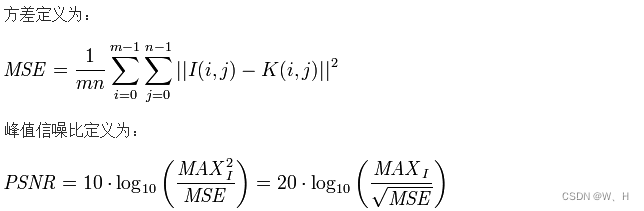
引用链接:CSDN-图像的峰值信噪比(PSNR)的计算方法
这里需要注意的是,PSNR的计算公式中,应该使用的是MAX(更标准),而不是常见的255,因为255是针对8bit的数据。
对于10bit的数据,不同的工具可能有不同的计算方式,大概在 2 10 − 1 2^{10}-1 210−1附近。
VTM中maxval的计算方式如下:
const uint32_t maxval                = /*useWPSNR ? (1 << maximumBitDepth) - 1 :*/ 255 << (maximumBitDepth - 8);
// fix with WPSNR: 1023 (4095) instead of 1020 (4080) for bit depth 10 (12)
对应的10bit是 255 ∗ 4 = 1020 255*4=1020 255∗4=1020
对应的12bit是 255 ∗ 16 = = 4080 255*16==4080 255∗16==4080
YUV-PSRN的计算
VTM中YUV-PSNR的计算并不是三个分量通过加权计算得到的,而是对各个分量的MSE进行加权计算得到的,进而计算得到YUV-PSNR。具体的权重计算分析见代码注释
void calculateCombinedValues(const ChromaFormat chFmt, double &PSNRyuv, double &MSEyuv, const BitDepths &bitDepths){MSEyuv    = 0;int scale = 0;//计算maximumBitDepthint maximumBitDepth = bitDepths.recon[CHANNEL_TYPE_LUMA];for (uint32_t channelTypeIndex = 1; channelTypeIndex < MAX_NUM_CHANNEL_TYPE; channelTypeIndex++){if (bitDepths.recon[channelTypeIndex] > maximumBitDepth){maximumBitDepth = bitDepths.recon[channelTypeIndex];}}
//计算maxval
#if ENABLE_QPAconst uint32_t maxval                = /*useWPSNR ? (1 << maximumBitDepth) - 1 :*/ 255 << (maximumBitDepth - 8); // fix with WPSNR: 1023 (4095) instead of 1020 (4080) for bit depth 10 (12)
#elseconst uint32_t maxval                = 255 << (maximumBitDepth - 8);
#endif//计算分量数const uint32_t numberValidComponents = getNumberValidComponents(chFmt);//遍历各个分量,计算对应的MSEfor (uint32_t comp=0; comp<numberValidComponents; comp++){const ComponentID compID        = ComponentID(comp);//下面会对函数getComponentScaleX部分单独const uint32_t        csx           = getComponentScaleX(compID, chFmt);const uint32_t        csy           = getComponentScaleY(compID, chFmt);const int         scaleChan     = (4>>(csx+csy));	//权重的计算//注意8bit和10bit的计算方式不同const uint32_t        bitDepthShift = 2 * (maximumBitDepth - bitDepths.recon[toChannelType(compID)]); //*2 because this is a squared number//计算分量对应的MSEconst double      channelMSE    = (m_MSEyuvframe[compID] * double(1 << bitDepthShift)) / double(getNumPic());//累加权重scale  += scaleChan;//加权MSEyuv += scaleChan * channelMSE;}//平均MSEyuv /= double(scale);  // i.e. divide by 6 for 4:2:0, 8 for 4:2:2 etc.//计算YUVPSNRyuv = (MSEyuv == 0) ? 999.99 : 10.0 * log10((maxval * maxval) / MSEyuv);}
对于权重的计算函数,参见:
static inline uint32_t        getComponentScaleX        (const ComponentID id, const ChromaFormat fmt) { return getChannelTypeScaleX(toChannelType(id), fmt);               }
static inline uint32_t        getComponentScaleY        (const ComponentID id, const ChromaFormat fmt) { return getChannelTypeScaleY(toChannelType(id), fmt);               }
深入调用
static inline uint32_t        getChannelTypeScaleX      (const ChannelType id, const ChromaFormat fmt) { return (isLuma(id) || (fmt==CHROMA_444)) ? 0 : 1;                  }
static inline uint32_t        getChannelTypeScaleY      (const ChannelType id, const ChromaFormat fmt) { return (isLuma(id) || (fmt!=CHROMA_420)) ? 0 : 1;
计算流程
SSD -> MSE -> PSNR
MSE的计算代码实现:
const uint32_t size = width * height;MSEyuvframe[comp] = (double)uiSSDtemp / size;
SSD的计算代码实现
const uint64_t uiSSDtemp = xFindDistortionPlane(recPB, orgPB, useWPSNR ? bitDepth : 0, ::getComponentScaleX(compID, format), ::getComponentScaleY(compID, format));uint64_t EncGOP::xFindDistortionPlane(const CPelBuf& pic0, const CPelBuf& pic1, const uint32_t rshift
#if ENABLE_QPA, const uint32_t chromaShiftHor /*= 0*/, const uint32_t chromaShiftVer /*= 0*/
#endif)
{uint64_t uiTotalDiff;const  Pel*  pSrc0 = pic0.bufAt(0, 0);const  Pel*  pSrc1 = pic1.bufAt(0, 0);TCHECK(pic0.width  != pic1.width , "Unspecified error");TCHECK(pic0.height != pic1.height, "Unspecified error");if( rshift > 0 ){
#if ENABLE_QPAconst   uint32_t  BD = rshift;      // image bit-depthif (BD >= 8){const uint32_t   W = pic0.width;  // image widthconst uint32_t   H = pic0.height; // image heightconst double     R = double(W * H) / (1920.0 * 1080.0);const uint32_t   B = Clip3<uint32_t>(0, 128 >> chromaShiftVer, 4 * uint32_t(16.0 * sqrt(R) + 0.5)); // WPSNR block size in integer multiple of 4 (for SIMD, = 64 at full-HD)uint32_t x, y;if (B < 4) // image is too small to use WPSNR, resort to traditional PSNR{uiTotalDiff = 0;for (y = 0; y < H; y++){for (x = 0; x < W; x++){const           int64_t iDiff = (int64_t)pSrc0[x] - (int64_t)pSrc1[x];uiTotalDiff += uint64_t(iDiff * iDiff);}pSrc0 += pic0.stride;pSrc1 += pic1.stride;}return uiTotalDiff;}double wmse = 0.0, sumAct = 0.0; // compute activity normalized SNR valuefor (y = 0; y < H; y += B){for (x = 0; x < W; x += B){wmse += calcWeightedSquaredError(pic1,   pic0,sumAct, BD,W,      H,x,      y,B,      B);}}// integer weighted distortionsumAct = 16.0 * sqrt ((3840.0 * 2160.0) / double((W << chromaShiftHor) * (H << chromaShiftVer))) * double(1 << BD);return (wmse <= 0.0) ? 0 : uint64_t(wmse * pow(sumAct, BETA) + 0.5);}
#endif // ENABLE_QPAuiTotalDiff = 0;for (int y = 0; y < pic0.height; y++){for (int x = 0; x < pic0.width; x++){Intermediate_Int iTemp = pSrc0[x] - pSrc1[x];uiTotalDiff += uint64_t((iTemp * iTemp) >> rshift);}pSrc0 += pic0.stride;pSrc1 += pic1.stride;}}else{uiTotalDiff = 0;for (int y = 0; y < pic0.height; y++){for (int x = 0; x < pic0.width; x++){Intermediate_Int iTemp = pSrc0[x] - pSrc1[x];uiTotalDiff += uint64_t(iTemp * iTemp);}pSrc0 += pic0.stride;pSrc1 += pic1.stride;}}return uiTotalDiff;
}
本文来自互联网用户投稿,文章观点仅代表作者本人,不代表本站立场,不承担相关法律责任。如若转载,请注明出处。 如若内容造成侵权/违法违规/事实不符,请点击【内容举报】进行投诉反馈!