PCL之ICP算法
转自:https://blog.csdn.net/u010696366/article/details/8941938?utm_medium=distribute.pc_relevant.none-task-blog-BlogCommendFromMachineLearnPai2-2.channel_param&depth_1-utm_source=distribute.pc_relevant.none-task-blog-BlogCommendFromMachineLearnPai2-2.channel_param
先上例子, 下面是用PCL中的icp配准两个点云:void PairwiseICP(const pcl::PointCloud::Ptr &cloud_target, const pcl::PointCloud::Ptr &cloud_source, pcl::PointCloud::Ptr &output )
{PointCloud::Ptr src(new PointCloud);PointCloud::Ptr tgt(new PointCloud);tgt = cloud_target;src = cloud_source;pcl::IterativeClosestPoint icp;icp.setMaxCorrespondenceDistance(0.1);icp.setTransformationEpsilon(1e-10);icp.setEuclideanFitnessEpsilon(0.01);icp.setMaximumIterations (100);icp.setInputSource (src);icp.setInputTarget (tgt);icp.align (*output);
// std::cout << "has converged:" << icp.hasConverged() << " score: " <resize(tgt->size()+output->size());for (int i=0;isize();i++){output->push_back(tgt->points[i]);}cout<<"After registration using ICP:"<size()<
源码pcl.h里给出了Usage example, 源码从github上下载之后可以在这个目录找到
.\pcl-master\registration\include\pcl\registration。
- 一是PCL的icp里的transformation estimation是基于SVD的, SVD是奇异值分解,Singular Value Decomposition,后面我们会提到;
- 二是使用之前要至少set三个参数:
- setMaximumIterations, 最大迭代次数,icp是一个迭代的方法,最多迭代这些次;
- setTransformationEpsilon, 前一个变换矩阵和当前变换矩阵的差异小于阈值时,就认为已经收敛了,是一条收敛条件;
- setEuclideanFitnessEpsilon, 还有一条收敛条件是均方误差和小于阈值, 停止迭代。
- setMaximumIterations, 最大迭代次数,icp是一个迭代的方法,最多迭代这些次;
/** \brief @b IterativeClosestPoint provides a base implementation of the Iterative Closest Point algorithm. * The transformation is estimated based on Singular Value Decomposition (SVD).** The algorithm has several termination criteria:** Number of iterations has reached the maximum user imposed number of iterations (via \ref setMaximumIterations) * The epsilon (difference) between the previous transformation and the current estimated transformation is smaller than an user imposed value (via \ref setTransformationEpsilon) * The sum of Euclidean squared errors is smaller than a user defined threshold (via \ref setEuclideanFitnessEpsilon) * * Usage example:* ...* \author Radu B. Rusu, Michael Dixon
**/运行上面的代码就能得到两个点云配准的结果了,先不管结果好不好,看看他内部做了什么,实际配准算法都在aign里实现。icp.h里看到IterativeClosestPoint类是Registration的子类,icp.h给出了icp类的定义,而align的具体实现在上面的registration文件夹下的impl下的icp.hpp里,都说align with initial guess,如果可以从一个好的初始猜想变换矩阵开始迭代,那么算法将会在比较少的迭代之后就收敛,配准结果也较好,当像我们这里没有指定初始guess时,就默认使用单位阵Matrix4::Identity() ,迭代部分就像下面这样:
// Repeat until convergencedo{// Get blob data if neededPCLPointCloud2::Ptr input_transformed_blob;if (need_source_blob_){input_transformed_blob.reset (new PCLPointCloud2);toPCLPointCloud2 (*input_transformed, *input_transformed_blob);}// Save the previously estimated transformationprevious_transformation_ = transformation_;// Set the source each iteration, to ensure the dirty flag is updatedcorrespondence_estimation_->setInputSource (input_transformed);if (correspondence_estimation_->requiresSourceNormals ())correspondence_estimation_->setSourceNormals (input_transformed_blob);// Estimate correspondencesif (use_reciprocal_correspondence_)correspondence_estimation_->determineReciprocalCorrespondences (*correspondences_, corr_dist_threshold_);elsecorrespondence_estimation_->determineCorrespondences (*correspondences_, corr_dist_threshold_);//...size_t cnt = correspondences_->size ();// Check whether we have enough correspondencesif (cnt < min_number_correspondences_){PCL_ERROR ("[pcl::%s::computeTransformation] Not enough correspondences found. Relax your threshold parameters.\n", getClassName ().c_str ());convergence_criteria_->setConvergenceState(pcl::registration::DefaultConvergenceCriteria::CONVERGENCE_CRITERIA_NO_CORRESPONDENCES);converged_ = false;break;}// Estimate the transformtransformation_estimation_->estimateRigidTransformation (*input_transformed, *target_, *correspondences_, transformation_);// Tranform the datatransformCloud (*input_transformed, *input_transformed, transformation_);// Obtain the final transformation final_transformation_ = transformation_ * final_transformation_;++nr_iterations_;converged_ = static_cast ((*convergence_criteria_));}while (!converged_);
这里的 transformation_estimation_->estimateRigidTransformation (*input_transformed, *target_, *correspondences_, transformation_);做了最重要的估计变换矩阵,
- 第一,SVD奇异值分解在pcl里是直接调用Eigen内部的Umeyama实现的,我看了一眼,太过数学,暂时跳过,在另一篇博客中提过,Eigen是专门处理矩阵运算的库,pcl用的3rdParty之一,pcl用了很多第三方,这也是为什么当初配环境如此痛苦的原因之一,毕竟pcl这个库最开始只是一个德国博士的毕业论文顺手写出来的; 另外还可以看到,这里的实现除了用SVD还有另一种方法,else里提到的是先算两个点云的3D Centeroid, 再getTransformationFromCorrelation. 后面我们再来提这种思路。
- 第二, final_transformation = current_transformation * final_transformation, 这和KinFu那篇论文提到的“变换矩阵不断叠加,最终得到唯一的全局摄像头位置(global camera pose)”是一致的。
template  inline void
pcl::registration::TransformationEstimationSVD::estimateRigidTransformation (ConstCloudIterator& source_it,ConstCloudIterator& target_it,Matrix4 &transformation_matrix) const
{// Convert to Eigen formatconst int npts = static_cast  (source_it.size ());if (use_umeyama_){Eigen::Matrix cloud_src (3, npts);Eigen::Matrix cloud_tgt (3, npts);for (int i = 0; i < npts; ++i){cloud_src (0, i) = source_it->x;cloud_src (1, i) = source_it->y;cloud_src (2, i) = source_it->z;++source_it;cloud_tgt (0, i) = target_it->x;cloud_tgt (1, i) = target_it->y;cloud_tgt (2, i) = target_it->z;++target_it;}// Call Umeyama directly from Eigen (PCL patched version until Eigen is released)transformation_matrix = pcl::umeyama (cloud_src, cloud_tgt, false);}else{source_it.reset (); target_it.reset ();//  is the source datasettransformation_matrix.setIdentity ();Eigen::Matrix centroid_src, centroid_tgt;// Estimate the centroids of source, targetcompute3DCentroid (source_it, centroid_src);compute3DCentroid (target_it, centroid_tgt);source_it.reset (); target_it.reset ();// Subtract the centroids from source, targetEigen::Matrix cloud_src_demean, cloud_tgt_demean;demeanPointCloud (source_it, centroid_src, cloud_src_demean);demeanPointCloud (target_it, centroid_tgt, cloud_tgt_demean);getTransformationFromCorrelation (cloud_src_demean, centroid_src, cloud_tgt_demean, centroid_tgt, transformation_matrix);}
}
到这里,pcl的算法基本上也捋清楚了,我们大概总结一下:首先icp是一步一步迭代得到较好的结果,解的过程其实是一个优化问题,并不能达到绝对正解。这个过程中求两个点云之间变换矩阵是最重要的,PCL里是用奇异值分解SVD实现的。
二. 各种ICP变种
ICP有很多变种,有point-to-point的,也有point-to-plain的,一般后者的计算速度快一些,是基于法向量的,需要输入数据有较好的法向量,而法向量估计目前我对于自己的输入数据还没有很好的解决,具体使用时建议根据自己的需要及可用的输入数据选择具体方法。
is an ICP variant that implements the generalized iterative closest point algorithm as described by Alex Segal et al.
pcl::IterativeClosestPoint< PointSource, PointTarget, Scalar >
provides a base implementation of the Iterative Closest Point algorithm.
pcl::IterativeClosestPointWithNormals< PointSource, PointTarget, Scalar >
is a special case of IterativeClosestPoint , that uses a transformation estimated based on Point to Plane distances by default.
pcl::IterativeClosestPointNonLinear< PointSource, PointTarget, Scalar >
is an ICP variant that uses Levenberg-Marquardt optimization backend.
pcl::JointIterativeClosestPoint< PointSource, PointTarget, Scalar >
extends ICP to multiple frames which share the same transform. pcl::registration::IncrementalICP< PointT, Scalar >
This class provides a way to register a stream of clouds where each cloud will be aligned to the previous cloud.
三. 广义配准Registration
Pairwise registration
两个点集的对应,输出通常是一个4×4刚性变换矩阵:代表旋转和平移,它应用于源数据集,结果是完全与目标数据集匹配。下图是“双对应”算法中一次迭代的步骤:
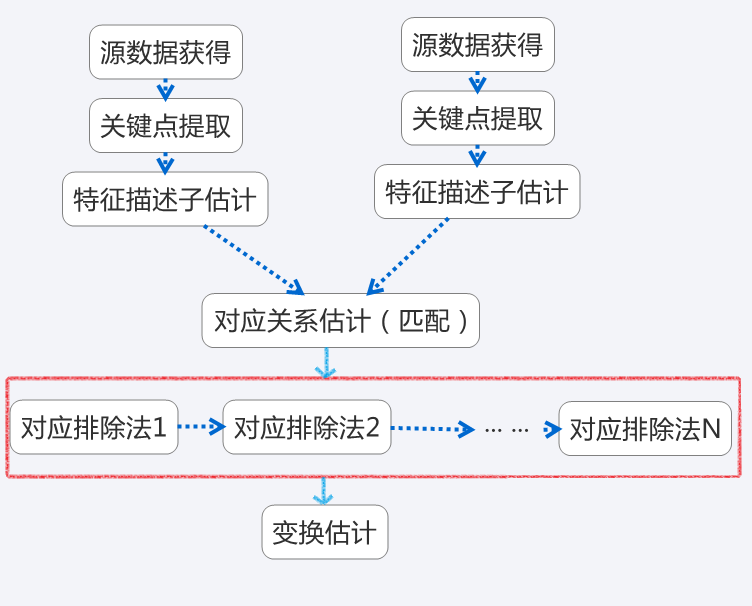
对两个数据源a,b匹配运算步骤如下:
- 从其中一个数据源a出发,分析其最能代表两个数据源场景共同点的关键点k
- 在每个关键点ki处,算出一个特征描述子fi
- 从这组特征描述子{fi}和他们在a和b中的XYZ坐标位置,基于fi和xyz的相似度,找出一组对应
- 由于实际数据源是有噪的,所以不是所有的对应都有效,这就需要一步一步排除对匹配起负作用的对应
- 从剩下的较好对应中,估计出一个变换
匹配过程中模块
Keypoints(关键点)
关键点是场景中有特殊性质的部分,一本书的边角,书上印的字母P都可以称作关键点。PCL中提供的关键点算法如NARF,SIFT,FAST。你可以选用所有点或者它的子集作为关键点,但需要考虑的是按毎帧有300k点来算,就有300k^2种对应组合。
Feature descriptors(特征描述子)
根据选取的关键点生成特征描述。把有用信息集合在向量里,进行比较。方法有:NARF, FPFH, BRIEF 或SIFT.
Correspondences estimation(对应关系估计)
已知从两个不同的扫描图中抽取的特征向量,找出相关特征,进而找出数据中重叠的部分。根据特征的类型,可以选用不同的方法。
点匹配(point matching, 用xyz坐标作为特征),无论数据有无重组,都有如下方法:
- brute force matching(强制匹配),
- kd-tree nearest neighbor search (FLANN)(kd树最近邻搜索),
- searching in the image space of organized data(在图像空间搜索有组织的数据),
- searching in the index space of organized data(按索引搜索有组织的数据).
特征匹配(feature matching, 用特征做为特征),只有下面两种方法:
- brute force matching (强制匹配)
- kd-tree nearest neighbor search (FLANN)(kd树最近邻搜索).
除了搜索法,还有两种著名对应估计:
- 直接估计对应关系(默认),对点云A中的每一点,搜索在B中的对应关系
- “Reciprocal” 相互对应关系估计,只用A,B重叠部分,先从A到B找对应,再从B到A找对应。
Correspondences rejection(剔除错误估计)
剔除错误估计,可用 RANSAC 算法,或减少数量,只用一部分对应关系。有一种特殊的一到多对应,即模型中一个点对应源中的一堆点。这种情况可以用最短路径对应或检查附近的其他匹配过滤掉。
Transformation estimation(最后一步,计算变换)
- 基于上述匹配评估错误测量值;
- 评估相机不同pose之间所作的刚性变换(运动估计),使错误测量值最小化;
- 优化点云结构;
- E.g, - SVD 运动估计; - Levenberg-Marquardt用不同内核作运动估计;
- 用刚性变换旋转/平移源数据到目标位置,可能需要对所有点/部分点/关键点内部运行ICP迭代循环;
- 迭代,直到满足某些收敛标准。
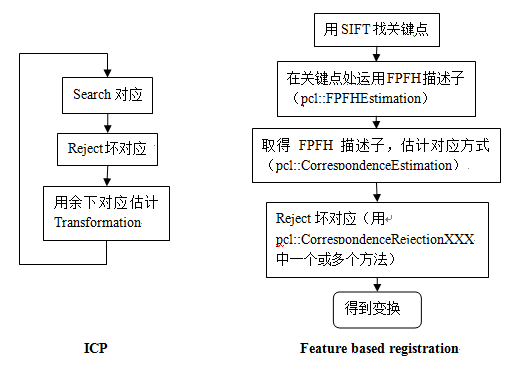
匹配流程总结
本文来自互联网用户投稿,文章观点仅代表作者本人,不代表本站立场,不承担相关法律责任。如若转载,请注明出处。 如若内容造成侵权/违法违规/事实不符,请点击【内容举报】进行投诉反馈!