程序运行的时间(C)
C语言计算程序运行的时间
1.概念
- 函数 clock():捕捉从程序开始运行到 clock() 被调用时所耗费的时间。这个时间的单位是clock tick,即“时钟打点”。(C语言提供的函数,使用时要引入头文件time.h 即#include
) - 常数 CLK_TCK:机器时钟每秒所走的始终打点数。具体数值多少因机器而异。
2.常用模板
#include3.以两种算法计算多项式值为例
利用clock()函数比较算法效率
此前,我们先来看一下下面两个公式。
f ( x ) = a 0 + a 1 x + … + a n − 1 x n − 1 + a n x n f ( x ) = a 0 + x ( a 1 + x ( … ( a n − 1 + x ( a n ) ) … ) ) \begin{array}{l} f(x)=a_{0}+a_{1} x+\ldots+a_{n-1} x^{n-1}+a_{n} x^{n} \\ f(x)=a_{0}+x\left(a_{1}+x\left(\ldots\left(a_{n-1}+x\left(a_{n}\right)\right) \ldots\right)\right) \end{array} f(x)=a0+a1x+…+an−1xn−1+anxnf(x)=a0+x(a1+x(…(an−1+x(an))…))
其对应的算法代码表示分别为:
//公式上
double f1(int n, double a[], double x)
{int i;double p = a[0];for (i = 1; i <= n; i++)p = p + (a[i] * pow(x,i));return p;
}
//公式下
double f2(int n, double a[], double x)
{int i;double p = a[n];for (i = n; i > 0; i--)p = a[i-1] + x*p;return p;
}
理解这两种算法后,再尝试下面的练习。

代码实现:
#include运行结果如图:
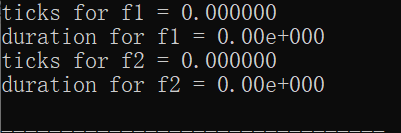
这是由于程序运行的太快,它的时间都可能达不到一个tick。这种情况我们需要换一种办法:让被测函数 重复运行 多次,使得测出的总的时钟打点间隔充分长,最后计算北侧函数平均每次运行的时间即可。
代码实现:
...
#define MAXK 1e7  //被测函数最大重复调用次数
...
int main()
{...start = clock();for (i = 0; i < MAXK; i++)  //函数运行MAXK次f1(MAXN-1, a, 1.1);stop = clock();//计算函数单次运行的时间duration = ((double)(stop - start)) / CLK_TCK / MAXK;...return 0;
}
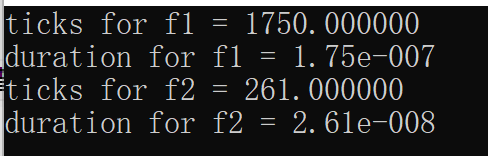
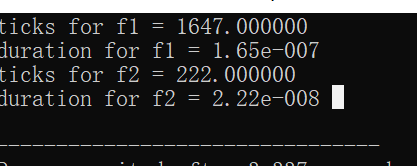
不难看出,在不同的机器上运行结果不同,但是数量级以及f1,f2的数量级差都是相同的。基于此,很容易比较出f2算法优于f1算法。
本文来自互联网用户投稿,文章观点仅代表作者本人,不代表本站立场,不承担相关法律责任。如若转载,请注明出处。 如若内容造成侵权/违法违规/事实不符,请点击【内容举报】进行投诉反馈!