tensorboard summary存储数据
利用summary存储数据
总共分为4步

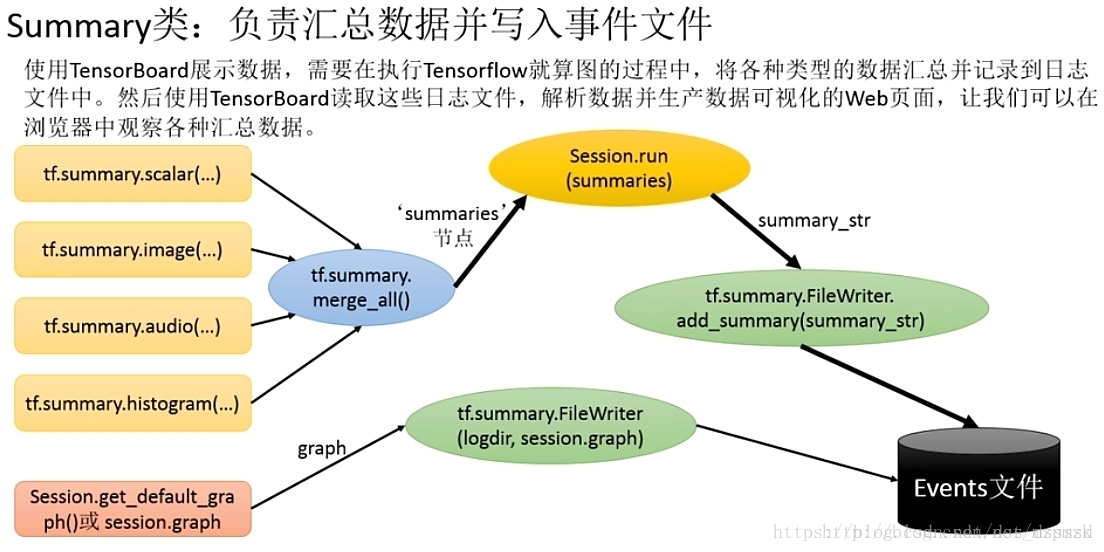
- 添加记录节点
tf.summary.scalar(name, tensor) - 汇总记录节点
summary_op = tf.summary.merge_all() - 运行汇总节点
summary_str = sess.run(summary, feed_dict=feed_dict) - 将数据存到文件中
- summary_write = tf.summary.FileWriter(logdir,
graph=sess.graph) - summary_write.add_summary(summary_str, global_step=global_step)
- summary_write = tf.summary.FileWriter(logdir,
可视化显示
tensorboard –logdir=绝对路径
然后在浏览器中打开相应网站,比如http://desktop-45es9ip:6006即可
注意,路径不需要加引号
几个注意事项
global_step 是tensorflow内部会自动维护的变量,在使用时,先用以下代码创建,trainable=False表明此 变量为非训练参数。
global_step = tf.Variable(0, name='global_step', trainable=False)然后将参数传递给optimizer.minimize中的默认参数global_step中,每训练一次,global_step会+1,之后在别的需要此参数的函数调用即可
optimizer = tf.train.GradientDescentOptimizer(learning_rate)train_op = optimizer.minimize(cost, global_step=global_step)# 在后边add_summary函数中调用summary_write.add_summary(summary_str, global_step=sess.run(global_step))以下代码不可以写在for循环中
summary_write = tf.summary.FileWriter(logdir,graph=sess.graph)
例子
接下来有一个例子,用逻辑回归和三层的神经网络结构来在mnist识别手写体,并将这两天的知识点包含在其中了。
import tensorflow as tffrom tensorflow.examples.tutorials.mnist import input_datadata_dir = 'temp'mnist = input_data.read_data_sets(data_dir, one_hot=True)# import pickle# def load_from_pickle(data_type):# file_name = '{}.pickle'.format(data_type)# with open(file_name, 'rb') as f:# return pickle.load(f)## # load data from disk# train = load_from_pickle('train')# validation = load_from_pickle('validation')# test = load_from_pickle('test')# train_image, train_label = train['image'], train['label']# validation_image, validation_label = validation['image'], validation['label']# test_image, test_label = test['image'], test['label']def layer(input, weight_shape, bias_shape):# how to set stddev ?# the variance of weights in a network should be 2 / n_in,# n_in is the nummber inputs coming into the neuronweight_stddev = (2.0 / weight_shape[0]) ** 0.5w_innit = tf.random_normal_initializer(stddev=weight_stddev)bias_init = tf.constant_initializer(value=0.)W = tf.get_variable('W', weight_shape, initializer=w_innit)b = tf.get_variable('b', bias_shape, initializer=bias_init)return tf.nn.relu(tf.matmul(input, W) + b)def inference(x, model=0):''':param x::param model: 0 --> logistic regression 1--> multilayer neural network:return:'''if model == 0:init = tf.constant_initializer(value=0)W = tf.get_variable('W', [784, 10], initializer=init)b = tf.get_variable('b', [10], initializer=init)output = tf.nn.softmax(tf.matmul(x, W)) + breturn outputelif model == 1:with tf.variable_scope("hidden_1"):hidden_1 = layer(x, [784, 256], [256])with tf.variable_scope("hidden_2"):hidden_2 = layer(hidden_1, [256, 256], [256])with tf.variable_scope("hidden_3"):output = layer(hidden_2, [256, 10], [10])return outputdef loss(output, y, choice=0):''':param output::param y::param choice: 0 --> implement by self 1--> call tf implementation:return:'''# implemented by selfif choice == 0:# cross_entropydot_product = y * tf.log(output)# sum in rowxentropy = -tf.reduce_sum(dot_product, axis=1)# tf implementationelif choice == 1:xentropy = tf.nn.softmax_cross_entropy_with_logits(labels=y,logits=output)# mean on every itemloss = tf.reduce_mean(xentropy)return lossdef training(cost, global_step, learning_rate):# add to summary# summary records data used for tensorboardtf.summary.scalar('cost', cost) # !!!!!!!! 1optimizer = tf.train.GradientDescentOptimizer(learning_rate)train_op = optimizer.minimize(cost, global_step=global_step)return train_opdef evaluate(output, y):correct_prediction = tf.equal(tf.argmax(output, axis=1),tf.argmax(y, axis=1))accuracy = tf.reduce_mean(tf.cast(correct_prediction, tf.float32))return accuracy# python script# parameterslearning_rate = 0.01training_epochs = 10batch_size = 1000display_step = 1with tf.Graph().as_default():# mnist data image of shape 28 * 28 = 784x = tf.placeholder(dtype=tf.float32, shape=[None, 784])# 0~9 digits recognition => 10 classesy = tf.placeholder(dtype=tf.float32, shape=[None, 10])output = inference(x, model=1)cost = loss(output, y, choice=1)# create a not trainable variable to record train stepglobal_step = tf.Variable(0, name='global_step', trainable=False)train_op = training(cost, global_step, learning_rate)eval_op = evaluate(output, y)# record datasummary_op = tf.summary.merge_all() # !!!!!! 2saver = tf.train.Saver()with tf.Session() as sess:summary_write = tf.summary.FileWriter("logs",graph=sess.graph) # !!!!!!!!!!!! 3init_op = tf.global_variables_initializer()sess.run(init_op)# training cyclefor epoch in range(training_epochs):avg_cost = 0.total_batch = int(mnist.train.num_examples / batch_size)# loop over all batchesfor i in range(total_batch):mbatch_x, mbatch_y = mnist.train.next_batch(batch_size)# fit training using batch datafeed_dict = {x: mbatch_x, y: mbatch_y}sess.run(train_op, feed_dict=feed_dict)# compute average lossminibatch_cost = sess.run(cost, feed_dict=feed_dict)avg_cost += minibatch_cost / total_batch# display logs every 1 epoch stepif epoch % display_step == 0:val_feed_dict = {x: mnist.validation.images,y: mnist.validation.labels}accuracy = sess.run(eval_op, feed_dict=val_feed_dict)print("Validation error: {}".format(1 - accuracy))## !!!!!!!!!!!!!!! 4summary_str = sess.run(summary_op, feed_dict=feed_dict)summary_write.add_summary(summary_str, global_step=sess.run(global_step))last_global_step = sess.run(global_step)print("训练次数:", last_global_step)# saver.save(sess, 'logistic_logs/model-checkpoint', global_step=global_step)print('optimization finished')test_feed_dict = {x: mnist.test.images,y: mnist.test.labels}accuracy = sess.run(eval_op, feed_dict=test_feed_dict)print("Test Accuracy:{}".format(accuracy))summary_write.close()本文来自互联网用户投稿,文章观点仅代表作者本人,不代表本站立场,不承担相关法律责任。如若转载,请注明出处。 如若内容造成侵权/违法违规/事实不符,请点击【内容举报】进行投诉反馈!