crossentropy java_Pytorch中的CrossEntropyLoss()函数案例解读和结合one-hot编码计算Loss
使用Pytorch框架进行深度学习任务,特别是分类任务时,经常会用到如下:
import torch.nn as nn
criterion = nn.CrossEntropyLoss().cuda()
loss = criterion(output, target)
即使用torch.nn.CrossEntropyLoss()作为损失函数。
那nn.CrossEntropyLoss()内部到底是啥??
nn.CrossEntropyLoss()是torch.nn中包装好的一个类,对应torch.nn.functional中的cross_entropy。
此外,nn.CrossEntropyLoss()是nn.logSoftmax()和nn.NLLLoss()的整合(将两者结合到一个类中)。
nn.logSoftmax()
定义如下:
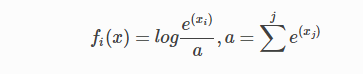
从公式看,其实就是先softmax在log。
nn.NLLLoss()
定义如下:

此loss期望的target是类别的索引 (0 to N-1, where N = number of classes)。
例子1:
import torch.nn as nn
m = nn.LogSoftmax()
loss = nn.NLLLoss()
# input is of size nBatch x nClasses = 3 x 5
input = autograd.Variable(torch.randn(3, 5), requires_grad=True)
# each element in target has to have 0 <= value < nclasses
target = autograd.Variable(torch.LongTensor([1, 0, 4]))
output = loss(m(input), target)
可以看到,nn.NLLLoss的输入target是类别值,并不是one-hot编码格式,这个要注意!!
nn.CrossEntropyLoss()
定义如下:

仔细看看公式,发现其实它就是nn.LogSoftmax() + nn.NLLLoss()
调用时输入参数如下:
input : 模型输出,包含每个类的得分,2-D tensor,shape为 batch * n类
target: 大小为 n 的 1—D tensor,包含类别的索引(0到 n-1)。
注意CrossEntropyLoss()的target输入也是类别值,不是one-hot编码格式
例子2:
import torch.nn as nn
loss = nn.CrossEntropyLoss()
# input is of size nBatch x nClasses = 3 x 5
input = autograd.Variable(torch.randn(3, 5), requires_grad=True)
# each element in target has to have 0 <= value < nclasses
target = autograd.Variable(torch.LongTensor([1, 0, 4]))
output = loss(input, target)
例子1和例子2结果等价
如果是one-hot编码该怎么计算loss?
for images, target in train_loader:
images, target = images.cuda(), target .cuda()
N = target .size(0)
# N 是batch-size大小
# C is the number of classes.
labels = torch.full(size=(N, C), fill_value=0).cuda()
labels.scatter_(dim=1, index=torch.unsqueeze(target, dim=1), value=1)
score = model(images)
log_prob = torch.nn.functional.log_softmax(score, dim=1)
loss = -torch.sum(log_prob * labels) / N
optimizer.zero_grad()
loss.backward()
optimizer.step()
其中N是类别数目,labels是one-hot编码格式的二维向量(2-D tensor)。
需要先将例子1,2的target转为one-hot形式labels。
该loss计算可以替代例子1和例子2的loss计算方式
上述计算案例如下:
import torch.nn as nn
import torch
from torch import autograd
import torch.nn.functional as F
# logsoft-max + NLLLoss
m = nn.LogSoftmax()
loss = nn.NLLLoss()
input = autograd.Variable(torch.randn(3, 5), requires_grad=True)
target = autograd.Variable(torch.LongTensor([1, 0, 4]))
output = loss(m(input), target)
print('logsoftmax + nllloss output is {}'.format(output))
# crossentripyloss
loss = nn.CrossEntropyLoss()
# input = autograd.Variable(torch.randn(3, 5), requires_grad=True)
target = autograd.Variable(torch.LongTensor([1, 0, 4]))
output = loss(input, target)
print('crossentropy output is {}'.format(output))
# one hot label loss
C = 5
target = autograd.Variable(torch.LongTensor([1, 0, 4]))
print('target is {}'.format(target))
N = target .size(0)
# N 是batch-size大小
# C is the number of classes.
labels = torch.full(size=(N, C), fill_value=0)
print('labels shape is {}'.format(labels.shape))
labels.scatter_(dim=1, index=torch.unsqueeze(target, dim=1), value=1)
print('labels is {}'.format(labels))
log_prob = torch.nn.functional.log_softmax(input, dim=1)
loss = -torch.sum(log_prob * labels) / N
print('N is {}'.format(N))
print('one-hot loss is {}'.format(loss))
结果如下:
logsoftmax + nllloss output is 3.005390167236328
crossentropy output is 3.005390167236328
target is tensor([1, 0, 4])
labels shape is torch.Size([3, 5])
labels is tensor([[0., 1., 0., 0., 0.],
[1., 0., 0., 0., 0.],
[0., 0., 0., 0., 1.]])
N is 3
one-hot loss is 3.005390167236328
可知相同的输入下全部等价。
补充:
以及关于cross entropy有关的函数及在torch.nn和torch.nn.functional中对应关系如下:
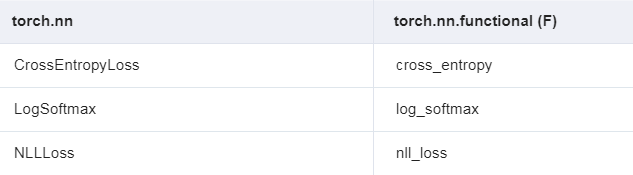
torch.nn和torch.nn.functional的区别在于torch.nn中对应的函数其实就是对F里的函数进行包装的类。
参考
原文链接:https://blog.csdn.net/c2250645962/article/details/106014693
本文来自互联网用户投稿,文章观点仅代表作者本人,不代表本站立场,不承担相关法律责任。如若转载,请注明出处。 如若内容造成侵权/违法违规/事实不符,请点击【内容举报】进行投诉反馈!