Linux ARM64 SMP系统PSCI启动方式ATF固件处理分析
在之前一篇文章Linux ARM64 spin-table启动方式实现Hiberate功能_Dingjun798077632的博客-CSDN博客中尝试了使用spin-table启动方式实现Hiberate功能,原本应该采用PSIC启动方式,所以学习了一下PSIC启动方式,这里分析下PSIC启动
时涉及到的ATF Bl31固件代码。
关于PSIC启动的介绍可以参考linux cpu管理(三) psci启动 - 知乎
我们知道PSIC启动方式,主cpu启动secondary cpu时,最后是主CPU通过SMC陷入EL3的BL31固件中,调用bl31中电源管理相关服务的接口,完成secondary cpu的启动。psci接口规定了命令对应的function_id、接口的输入参数以及返回值。 其中输入参数可通过x0–x7寄存器传递,而返回值通过x0–x4寄存器传递。通过function_id,Linux内核指定调用BL31或者BL32(如果存在)的相关服务。
首先分析BL31的异常处理相关代码,这里用到ATF固件代码是从NXP官网下载的,对应NXP imx8系列。
一、BL31启动入口与异常向量入口配置
从BL31 中的bl31.ld.S 中SECTIONS定义可以知道,bl31的入口在文件bl31_entrypoint.s中,并且入口函数就是bl31_entrypoint。
bl31.ld.S代码如下:
OUTPUT_FORMAT(PLATFORM_LINKER_FORMAT)
OUTPUT_ARCH(PLATFORM_LINKER_ARCH)
//!指定了BL31入口函数
ENTRY(bl31_entrypoint)
......
MEMORY {RAM (rwx): ORIGIN = BL31_BASE, LENGTH = BL31_LIMIT - BL31_BASE
#if SEPARATE_NOBITS_REGIONNOBITS (rw!a): ORIGIN = BL31_NOBITS_BASE, LENGTH = BL31_NOBITS_LIMIT - BL31_NOBITS_BASE
#else
#define NOBITS RAM
#endif
......
SECTIONS
{. = BL31_BASE;ASSERT(. == ALIGN(PAGE_SIZE),"BL31_BASE address is not aligned on a page boundary.")__BL31_START__ = .;#if SEPARATE_CODE_AND_RODATA.text . : {__TEXT_START__ = .;
//指定了BL31入口文件*bl31_entrypoint.o(.text*)*(SORT_BY_ALIGNMENT(SORT(.text*)))*(.vectors). = ALIGN(PAGE_SIZE);__TEXT_END__ = .;
} >RAM......
}
在文件bl31\aarch64\bl31_entrypoint.S 中找到入口函数bl31_entrypoint代码如下:
func bl31_entrypoint
#if (defined COCKPIT_A53) || (defined COCKPIT_A72)/** running on cluster Cortex-A53:* => proceed to bl31 with errata*/mrs	x20, mpidr_el1ands	x20, x20, #MPIDR_CLUSTER_MASK	/* Test Affinity 1 */beq	bl31_entrypoint_proceed_errata/** running on cluster Cortex-A72:* => trampoline to 0xC00000xx* where bl31 version for A72 stands*/mov	x20, #0xC0000000add	x20, x20, #bl31_entrypoint_proceed - bl31_entrypointbr	x20
bl31_entrypoint_proceed_errata:
#endif
#if (defined COCKPIT_A53) || (defined COCKPIT_A72)
bl31_entrypoint_proceed:
#endif/* ---------------------------------------------------------------* Stash the previous bootloader arguments x0 - x3 for later use.* ---------------------------------------------------------------*/mov	x20, x0mov	x21, x1mov	x22, x2mov	x23, x3#if !RESET_TO_BL31
... ...
#else/* ---------------------------------------------------------------------* For RESET_TO_BL31 systems which have a programmable reset address,* bl31_entrypoint() is executed only on the cold boot path so we can* skip the warm boot mailbox mechanism.* ---------------------------------------------------------------------*/el3_entrypoint_common					\_init_sctlr=1					\_warm_boot_mailbox=!PROGRAMMABLE_RESET_ADDRESS	\_secondary_cold_boot=!COLD_BOOT_SINGLE_CPU	\_init_memory=1					\_init_c_runtime=1				\_exception_vectors=runtime_exceptions		\_pie_fixup_size=BL31_LIMIT - BL31_BASE/* ---------------------------------------------------------------------* For RESET_TO_BL31 systems, BL31 is the first bootloader to run so* there's no argument to relay from a previous bootloader. Zero the* arguments passed to the platform layer to reflect that.* ---------------------------------------------------------------------*/mov	x20, 0mov	x21, 0mov	x22, 0mov	x23, 0
#endif /* RESET_TO_BL31 *//* --------------------------------------------------------------------* Perform BL31 setup* --------------------------------------------------------------------*/mov	x0, x20mov	x1, x21mov	x2, x22mov	x3, x23bl	bl31_setup#if ENABLE_PAUTH/* --------------------------------------------------------------------* Program APIAKey_EL1 and enable pointer authentication* --------------------------------------------------------------------*/bl	pauth_init_enable_el3
#endif /* ENABLE_PAUTH *//* --------------------------------------------------------------------* Jump to main function* --------------------------------------------------------------------*/bl	bl31_main/* --------------------------------------------------------------------* Clean the .data & .bss sections to main memory. This ensures* that any global data which was initialised by the primary CPU* is visible to secondary CPUs before they enable their data* caches and participate in coherency.* --------------------------------------------------------------------*/adrp	x0, __DATA_START__add	x0, x0, :lo12:__DATA_START__adrp	x1, __DATA_END__add	x1, x1, :lo12:__DATA_END__sub	x1, x1, x0bl	clean_dcache_rangeadrp	x0, __BSS_START__add	x0, x0, :lo12:__BSS_START__adrp	x1, __BSS_END__add	x1, x1, :lo12:__BSS_END__sub	x1, x1, x0bl	clean_dcache_rangeb	el3_exit
endfunc bl31_entrypoint代码用到了一个宏el3_entrypoint_common配置el3的异常向量及地址。在文件include\arch\aarch64\el3_common_macros.S中,可以看到宏el3_entrypoint_common的定义如下:
	.macro el3_entrypoint_common					\_init_sctlr, _warm_boot_mailbox, _secondary_cold_boot,	\_init_memory, _init_c_runtime, _exception_vectors,	\_pie_fixup_size.if \_init_sctlr/* -------------------------------------------------------------* This is the initialisation of SCTLR_EL3 and so must ensure* that all fields are explicitly set rather than relying on hw.* Some fields reset to an IMPLEMENTATION DEFINED value and* others are architecturally UNKNOWN on reset.** SCTLR.EE: Set the CPU endianness before doing anything that*  might involve memory reads or writes. Set to zero to select*  Little Endian.** SCTLR_EL3.WXN: For the EL3 translation regime, this field can*  force all memory regions that are writeable to be treated as*  XN (Execute-never). Set to zero so that this control has no*  effect on memory access permissions.** SCTLR_EL3.SA: Set to zero to disable Stack Alignment check.** SCTLR_EL3.A: Set to zero to disable Alignment fault checking.** SCTLR.DSSBS: Set to zero to disable speculation store bypass*  safe behaviour upon exception entry to EL3.* -------------------------------------------------------------*/mov_imm	x0, (SCTLR_RESET_VAL & ~(SCTLR_EE_BIT | SCTLR_WXN_BIT \| SCTLR_SA_BIT | SCTLR_A_BIT | SCTLR_DSSBS_BIT))msr	sctlr_el3, x0isb.endif /* _init_sctlr */#if DISABLE_MTPMUbl	mtpmu_disable
#endif.if \_warm_boot_mailbox/* -------------------------------------------------------------* This code will be executed for both warm and cold resets.* Now is the time to distinguish between the two.* Query the platform entrypoint address and if it is not zero* then it means it is a warm boot so jump to this address.* -------------------------------------------------------------*/bl	plat_get_my_entrypointcbz	x0, do_cold_bootbr	x0do_cold_boot:.endif /* _warm_boot_mailbox */.if \_pie_fixup_size
#if ENABLE_PIE/** ------------------------------------------------------------* If PIE is enabled fixup the Global descriptor Table only* once during primary core cold boot path.** Compile time base address, required for fixup, is calculated* using "pie_fixup" label present within first page.* ------------------------------------------------------------*/pie_fixup:ldr	x0, =pie_fixupand	x0, x0, #~(PAGE_SIZE_MASK)mov_imm	x1, \_pie_fixup_sizeadd	x1, x1, x0bl	fixup_gdt_reloc
#endif /* ENABLE_PIE */.endif /* _pie_fixup_size *//* ---------------------------------------------------------------------* Set the exception vectors. * ---------------------------------------------------------------------*/adr	x0, \_exception_vectorsmsr	vbar_el3, x0Isb
......
二、BL31 ATF固件异常处理流程分析
接上文,在宏定义el3_entrypoint_common中,通过下面两行代码
adr x0, \_exception_vectors
msr vbar_el3, x0
配置了el3的异常向量及地址为runtime_exceptions。arm64位与32位架构不同,arm64的异常向量表地址不固定,在启动的时候由软件将异常向量表的地址设置到专用寄存器VBAR(Vector Base Address Register)中。
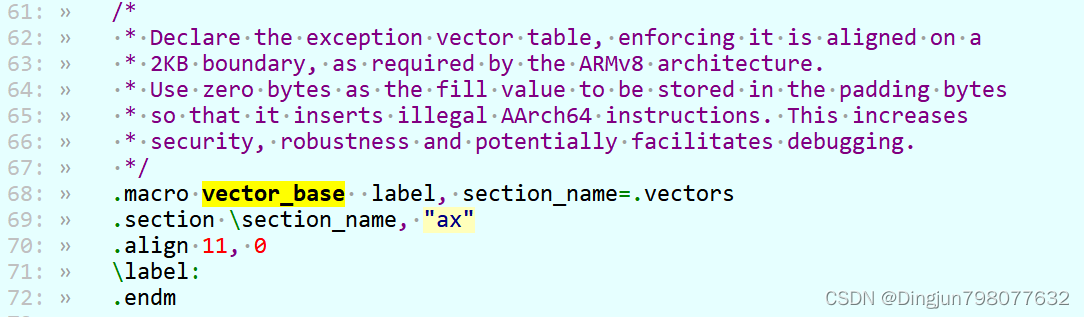
runtime_exceptions在文件bl31\aarch64\runtime_exceptions.S中,Linux内核通过SMC指令陷入到el3,对应的el异常处理入口就在该文件中。这里又涉及到另一个宏vector_base,在文件include/arch/aarch64/asm_macros.S。 宏 vector_base 将向量表放到了 .vectors 段中并且配置ax属性(可执行)等,至于.vectors 段,这里就不在分析了。
include/arch/aarch64/asm_macros.S代码,宏vector_base
bl31\aarch64\runtime_exceptions.S代码
vector_base runtime_exceptions/* ---------------------------------------------------------------------* Current EL with SP_EL0 : 0x0 - 0x200* ---------------------------------------------------------------------*/
vector_entry sync_exception_sp_el0
#ifdef MONITOR_TRAPSstp x29, x30, [sp, #-16]!mrs	x30, esr_el3ubfx	x30, x30, #ESR_EC_SHIFT, #ESR_EC_LENGTH/* Check for BRK */cmp	x30, #EC_BRKb.eq	brk_handlerldp x29, x30, [sp], #16
#endif /* MONITOR_TRAPS *//* We don't expect any synchronous exceptions from EL3 */b	report_unhandled_exception
end_vector_entry sync_exception_sp_el0vector_entry irq_sp_el0/** EL3 code is non-reentrant. Any asynchronous exception is a serious* error. Loop infinitely.*/b	report_unhandled_interrupt
end_vector_entry irq_sp_el0vector_entry fiq_sp_el0b	report_unhandled_interrupt
end_vector_entry fiq_sp_el0vector_entry serror_sp_el0no_ret	plat_handle_el3_ea
end_vector_entry serror_sp_el0/* ---------------------------------------------------------------------* Current EL with SP_ELx: 0x200 - 0x400* ---------------------------------------------------------------------*/
vector_entry sync_exception_sp_elx/** This exception will trigger if anything went wrong during a previous* exception entry or exit or while handling an earlier unexpected* synchronous exception. There is a high probability that SP_EL3 is* corrupted.*/b	report_unhandled_exception
end_vector_entry sync_exception_sp_elxvector_entry irq_sp_elxb	report_unhandled_interrupt
end_vector_entry irq_sp_elxvector_entry fiq_sp_elxb	report_unhandled_interrupt
end_vector_entry fiq_sp_elxvector_entry serror_sp_elx
#if !RAS_EXTENSIONcheck_if_serror_from_EL3
#endifno_ret	plat_handle_el3_ea
end_vector_entry serror_sp_elx/* ---------------------------------------------------------------------* Lower EL using AArch64 : 0x400 - 0x600* ---------------------------------------------------------------------*/
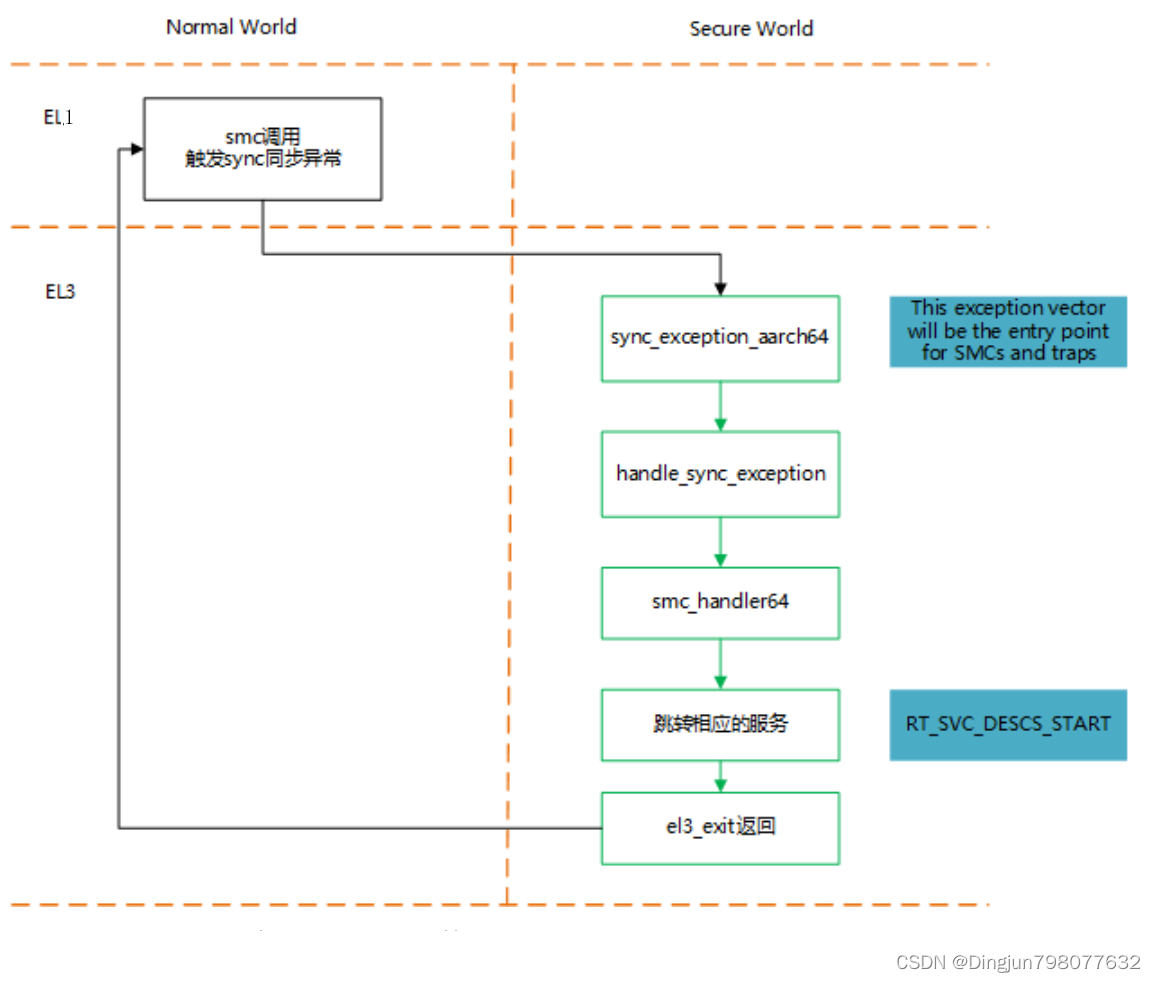
vector_entry sync_exception_aarch64/** This exception vector will be the entry point for SMCs and traps* that are unhandled at lower ELs most commonly. SP_EL3 should point* to a valid cpu context where the general purpose and system register* state can be saved.*/apply_at_speculative_wacheck_and_unmask_eahandle_sync_exception
end_vector_entry sync_exception_aarch64vector_entry irq_aarch64apply_at_speculative_wacheck_and_unmask_eahandle_interrupt_exception irq_aarch64
end_vector_entry irq_aarch64vector_entry fiq_aarch64apply_at_speculative_wacheck_and_unmask_eahandle_interrupt_exception fiq_aarch64
end_vector_entry fiq_aarch64vector_entry serror_aarch64apply_at_speculative_wa
#if RAS_EXTENSIONmsr	daifclr, #DAIF_ABT_BITb	enter_lower_el_async_ea
#elsehandle_async_ea
#endif
end_vector_entry serror_aarch64/* ---------------------------------------------------------------------* Lower EL using AArch32 : 0x600 - 0x800* ---------------------------------------------------------------------*/
vector_entry sync_exception_aarch32/** This exception vector will be the entry point for SMCs and traps* that are unhandled at lower ELs most commonly. SP_EL3 should point* to a valid cpu context where the general purpose and system register* state can be saved.*/apply_at_speculative_wacheck_and_unmask_eahandle_sync_exception
end_vector_entry sync_exception_aarch32vector_entry irq_aarch32apply_at_speculative_wacheck_and_unmask_eahandle_interrupt_exception irq_aarch32
end_vector_entry irq_aarch32vector_entry fiq_aarch32apply_at_speculative_wacheck_and_unmask_eahandle_interrupt_exception fiq_aarch32
end_vector_entry fiq_aarch32vector_entry serror_aarch32apply_at_speculative_wa
#if RAS_EXTENSIONmsr	daifclr, #DAIF_ABT_BITb	enter_lower_el_async_ea
#elsehandle_async_ea
#endif
end_vector_entry serror_aarch32在handle_sync_exception中,

mrs x30, esr_el3
ubfx x30, x30, #ESR_EC_SHIFT, #ESR_EC_LENGTH
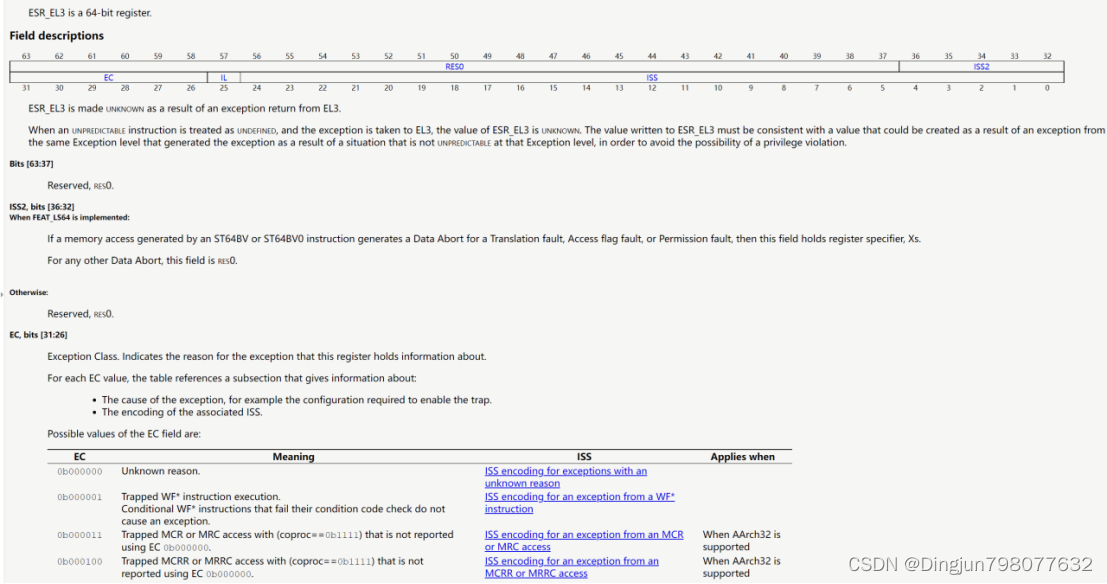
将esr_el3读取到x30寄存器,ubfx x30, x30, #ESR_EC_SHIFT, #ESR_EC_LENGTH 相当于x30=(x30 >> ESR_EC_SHIFT) & (1 << ESR_EC_LENGTH -1),
实际就是取出esr_el3的26-31位,即获取异常原因。esr_el3寄存器是异常综合寄存器,当smc陷入el3时,该寄存器ec域(esr_el3[31:26])保存触发异常的原因,esr_el3具体定义如下:

上面获取异常原因,接下来做相应的处理,对应的代码
cmp x30, #EC_AARCH32_SMC
b.eq smc_handler32
cmp x30, #EC_AARCH64_SMC
b.eq smc_handler64
/* Synchronous exceptions other than the above are assumed to be EA */
ldr x30, [sp, #CTX_GPREGS_OFFSET + CTX_GPREG_LR]
b enter_lower_el_sync_ea
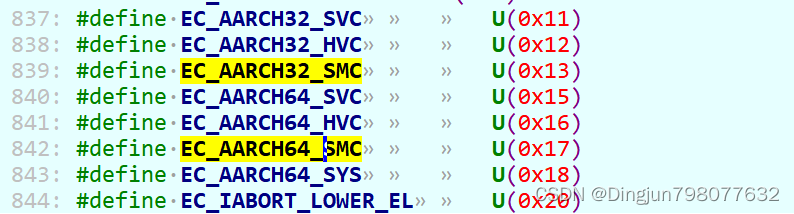
EC_AARCH64_SMC的值位0x17,就是对应的上面esr_el3的ec域SMC instruction execution in AArch64 state。上面的代码就很好理解了,AARCH64状态下触发异常smc异常,调用smc_handler64。AARCH32状态下触发异常smc异常,调用smc_handler32(AARCH64和AARCH32状态下smc的异常入口是不一样的,上面有说明,但是sync_exception_aarch64和sync_exception_aarch32都使用了handle_sync_exception,所以这需要区分EC_AARCH32_SMC和EC_AARCH64_SMC)。
smc_handler64代码如下:
smc_handler64:/* NOTE: The code below must preserve x0-x4 *//** Save general purpose and ARMv8.3-PAuth registers (if enabled).* If Secure Cycle Counter is not disabled in MDCR_EL3 when* ARMv8.5-PMU is implemented, save PMCR_EL0 and disable Cycle Counter.*/bl	save_gp_pmcr_pauth_regs#if ENABLE_PAUTH/* Load and program APIAKey firmware key */bl	pauth_load_bl31_apiakey
#endif/** Populate the parameters for the SMC handler.* We already have x0-x4 in place. x5 will point to a cookie (not used* now). x6 will point to the context structure (SP_EL3) and x7 will* contain flags we need to pass to the handler.*/mov	x5, xzrmov	x6, sp/** Restore the saved C runtime stack value which will become the new* SP_EL0 i.e. EL3 runtime stack. It was saved in the 'cpu_context'* structure prior to the last ERET from EL3.*/ldr	x12, [x6, #CTX_EL3STATE_OFFSET + CTX_RUNTIME_SP]/* Switch to SP_EL0 */msr	spsel, #MODE_SP_EL0/** Save the SPSR_EL3, ELR_EL3, & SCR_EL3 in case there is a world* switch during SMC handling.* TODO: Revisit if all system registers can be saved later.*/mrs	x16, spsr_el3mrs	x17, elr_el3mrs	x18, scr_el3stp	x16, x17, [x6, #CTX_EL3STATE_OFFSET + CTX_SPSR_EL3]str	x18, [x6, #CTX_EL3STATE_OFFSET + CTX_SCR_EL3]/* Clear flag register */mov	x7, xzr#if ENABLE_RME/* Copy SCR_EL3.NSE bit to the flag to indicate caller's security */ubfx	x7, x18, #SCR_NSE_SHIFT, 1/** Shift copied SCR_EL3.NSE bit by 5 to create space for* SCR_EL3.NS bit. Bit 5 of the flag correspondes to* the SCR_EL3.NSE bit.*/lsl	x7, x7, #5
#endif /* ENABLE_RME *//* Copy SCR_EL3.NS bit to the flag to indicate caller's security */bfi	x7, x18, #0, #1mov	sp, x12/* Get the unique owning entity number */ubfx	x16, x0, #FUNCID_OEN_SHIFT, #FUNCID_OEN_WIDTHubfx	x15, x0, #FUNCID_TYPE_SHIFT, #FUNCID_TYPE_WIDTHorr	x16, x16, x15, lsl #FUNCID_OEN_WIDTH/* Load descriptor index from array of indices */adrp	x14, rt_svc_descs_indicesadd	x14, x14, :lo12:rt_svc_descs_indicesldrb	w15, [x14, x16]/* Any index greater than 127 is invalid. Check bit 7. */tbnz	w15, 7, smc_unknown/** Get the descriptor using the index* x11 = (base + off), w15 = index** handler = (base + off) + (index << log2(size))*/adr	x11, (__RT_SVC_DESCS_START__ + RT_SVC_DESC_HANDLE)lsl	w10, w15, #RT_SVC_SIZE_LOG2ldr	x15, [x11, w10, uxtw]/** Call the Secure Monitor Call handler and then drop directly into* el3_exit() which will program any remaining architectural state* prior to issuing the ERET to the desired lower EL.*/
#if DEBUGcbz	x15, rt_svc_fw_critical_error
#endifblr	x15b	el3_exitsmc_unknown:/** Unknown SMC call. Populate return value with SMC_UNK and call* el3_exit() which will restore the remaining architectural state* i.e., SYS, GP and PAuth registers(if any) prior to issuing the ERET* to the desired lower EL.*/mov	x0, #SMC_UNKstr	x0, [x6, #CTX_GPREGS_OFFSET + CTX_GPREG_X0]b	el3_exit
函数 smc_handler64主要做了下面事情:
1. 保存Non-Secure world中的 spsr_el3 、elr_el3、scr_el3到栈中;
2. 切换sp到SP_EL0;
3. 根据 function_id 找到对应的 runtime service, 查找方法:
Index = (function_id >> 24 & 0x3f) | ((function_id >> 31) << 6);
Handler=__RT_SVC_DESCS_START__+RT_SVC_DESC_HANDLE+ rt_svc_descs_indices[Index] << 5
__RT_SVC_DESCS_START__ 为 rt_svc_descs 的起始地址,RT_SVC_DESC_HANDLE 为服务处理函数 handle 在结构体rt_svc_desc 中的偏移,左移5,是因为结构体 rt_svc_desc 大小为 32字节。
4. 跳转到 runtime service 的处理函数 handle 中执行。
5. 最后退出el3
接下来需要结合Linux PSCI相关代码分析,先简单分析Linux PSCI SMC调用处理。
三、Linux PSCI启动方式SMC调用分析
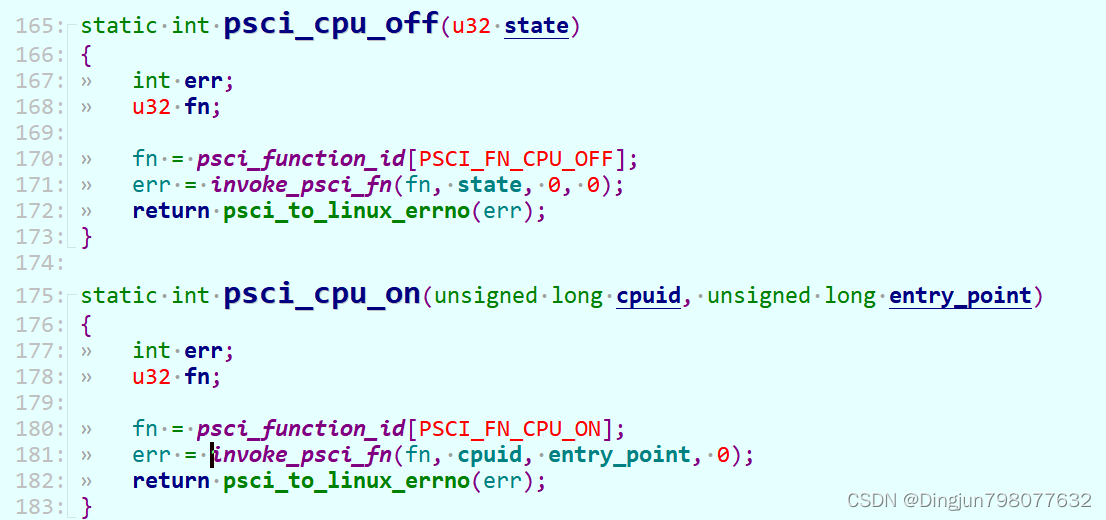
PSIC启动方式,主cpu启动secondary cpu时,最后是主cpu调用到下面的psci_cpu_on接口(至于为什么调用到psci_cpu_on接口,相关文章很多,篇幅有限,这里略过)。
Linux代码drivers\firmware\psci.c
设置invoke_psci_fn的代码如下:
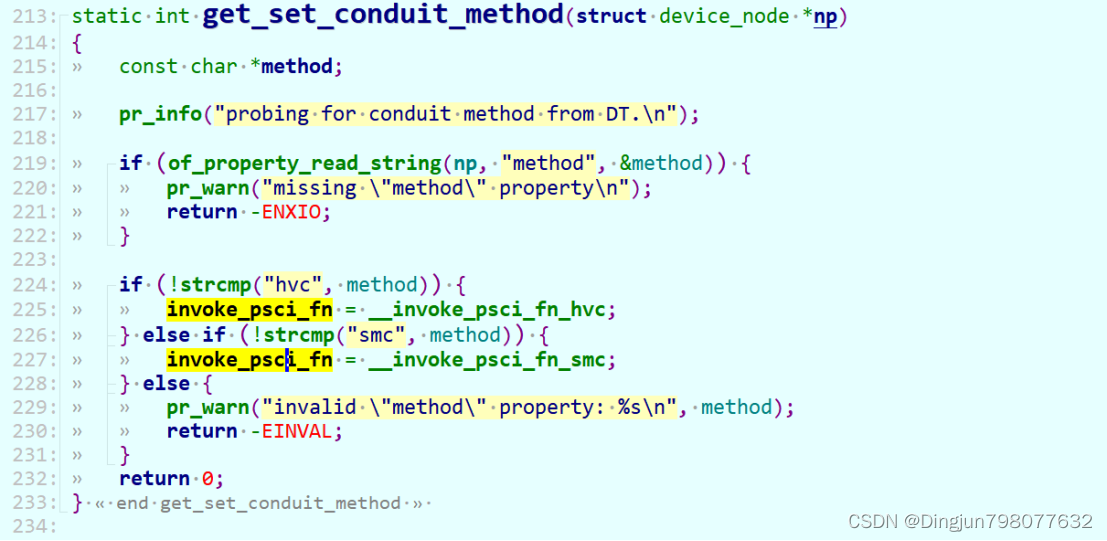 该接口中invoke_psci_fn指向__invoke_psci_fn_smc也就是smc调用(部分soc可能没有实现el3,采用hvc切换到el2,不在本文讨论范围),fn是本地调用的function_id,参数cpuid是需要启动的cpu(一般主cpuid为0,secondary cpu为1、2、3...),entry_point则指向secondary cpu在linux内核的入口地址。
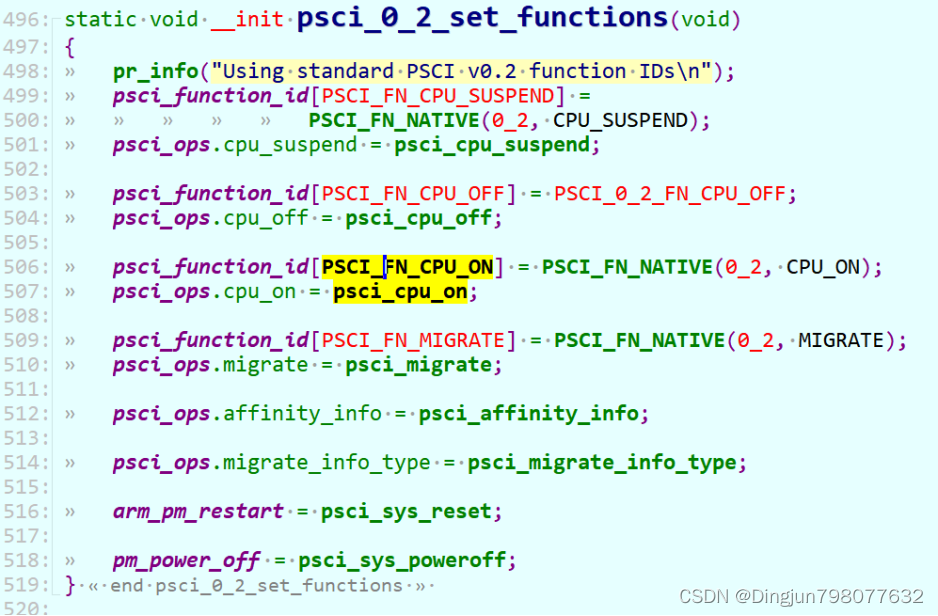

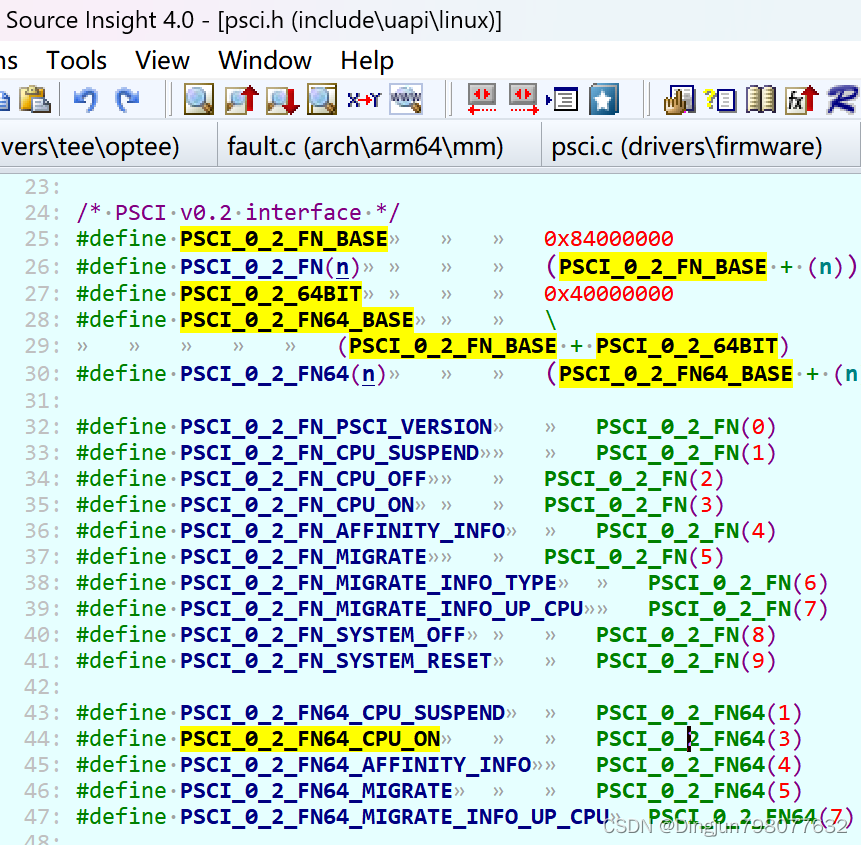
以PSCI0.2为例,PSCI_FN_CPU_ON对应的function_id为PSCI_0_2_FN64_CPU_ON,也就是0x84000000 + 0x40000000 + 0x03 = 0xC4000003,也就是psci_cpu_on中smc调用的第一个参数fn为0xC4000003。
__invoke_psci_fn_smc的具体实现如下:


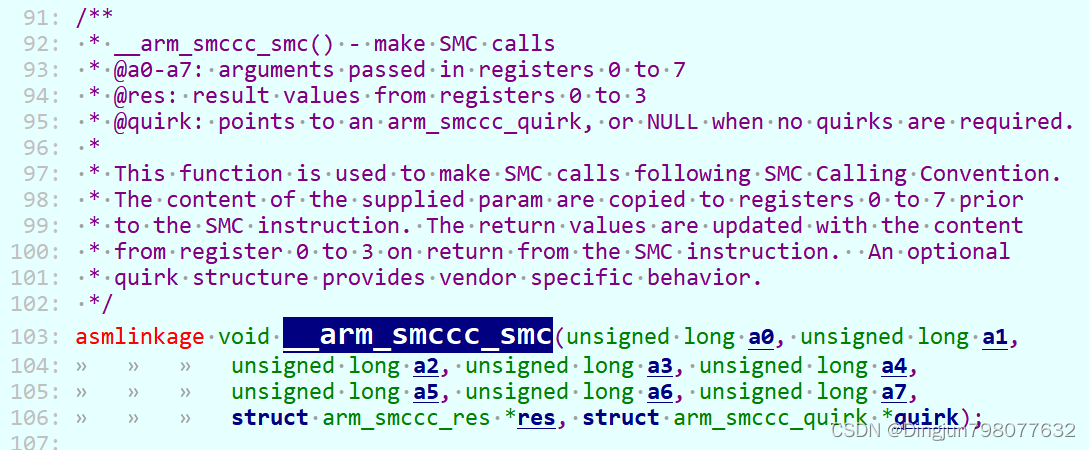
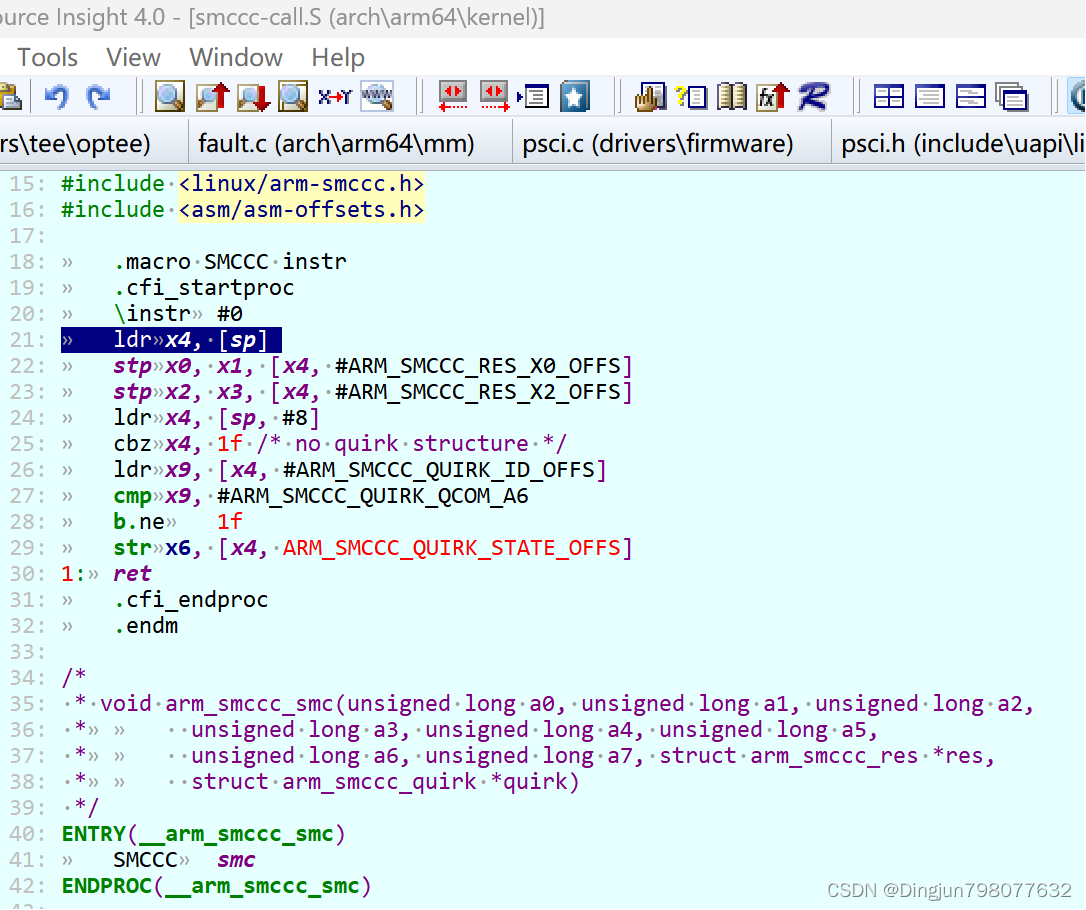 __invoke_psci_fn_smc最终通过汇编代码smc #0陷入到BL31(el3),也就是上文的vector_entry sync_exception_aarch64,这里fn(function_id)、cpuid、entry_point放入通用寄存器x0、x1、x2中,作为参数传递到了BL31。
四、BL31 SMC服务分析
SMC调用的function_id有相应的规范,相关定义如下图,也可以参考文章
【转】ATF中SMC深入理解_arm smc_Hkcoco的博客-CSDN博客
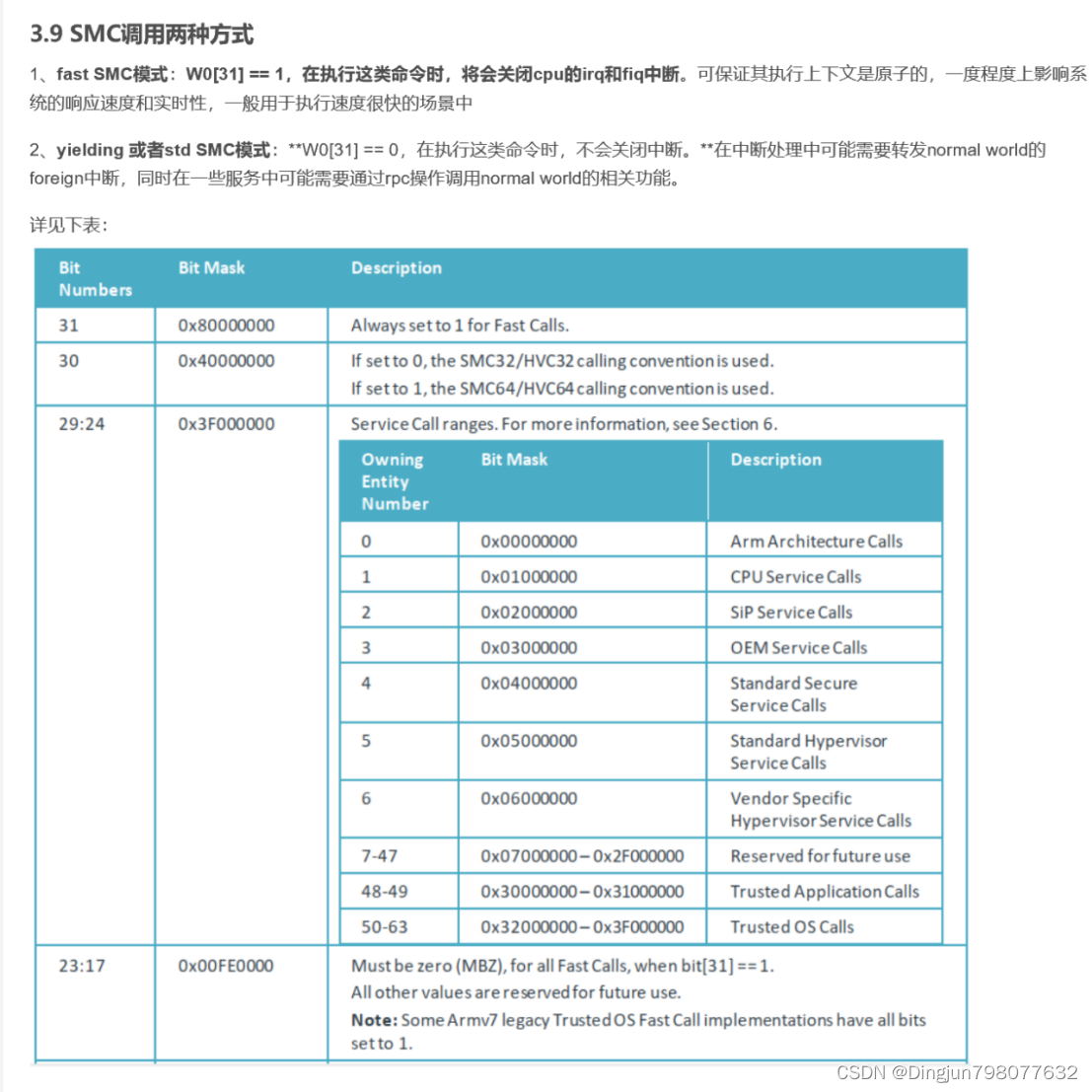
上面的代码中smc_handler64中,把相关宏定义也列出来,加上注释分析这段代码
#define FUNCID_TYPE_SHIFT		U(31)
#define FUNCID_TYPE_MASK		U(0x1)
#define FUNCID_TYPE_WIDTH		U(1)#define FUNCID_CC_SHIFT			U(30)
#define FUNCID_CC_MASK			U(0x1)
#define FUNCID_CC_WIDTH			U(1)#define FUNCID_OEN_SHIFT		U(24)
#define FUNCID_OEN_MASK			U(0x3f)
#define FUNCID_OEN_WIDTH		U(6)#define FUNCID_NUM_SHIFT		U(0)
#define FUNCID_NUM_MASK			U(0xffff)
#define FUNCID_NUM_WIDTH		U(16)....../* Get the unique owning entity number */
//上文已分析,x0保存的是function_id,具体值0xC4000003,这里取出了function_id的OEN保存到x16,OEN值为4ubfx	x16, x0, #FUNCID_OEN_SHIFT, #FUNCID_OEN_WIDTH
//取出smc调用类型,	x15为1ubfx	x15, x0, #FUNCID_TYPE_SHIFT, #FUNCID_TYPE_WIDTH
//x16 = (x15 << 6) | x16,将OEN作为低6位,type作为第7位组合成已数字indexorr	x16, x16, x15, lsl #FUNCID_OEN_WIDTH/*上面的代码相当于Index = (function_id >> 24 & 0x3f) | ((function_id >> 31) << 6),
接下来的代码查找function_id对应的Handler ,
Handler = __RT_SVC_DESCS_START__ + RT_SVC_DESC_HANDLE + rt_svc_descs_indices[Index] << 5
这里__RT_SVC_DESCS_START__中 *//* Load descriptor index from array of indices */adrp	x14, rt_svc_descs_indicesadd	x14, x14, :lo12:rt_svc_descs_indicesldrb	w15, [x14, x16]/* Any index greater than 127 is invalid. Check bit 7. */tbnz	w15, 7, smc_unknown/** Get the descriptor using the index* x11 = (base + off), w15 = index** handler = (base + off) + (index << log2(size))*/adr	x11, (__RT_SVC_DESCS_START__ + RT_SVC_DESC_HANDLE)lsl	w10, w15, #RT_SVC_SIZE_LOG2ldr	x15, [x11, w10, uxtw]/** Call the Secure Monitor Call handler and then drop directly into* el3_exit() which will program any remaining architectural state* prior to issuing the ERET to the desired lower EL.*/
#if DEBUGcbz	x15, rt_svc_fw_critical_error
#endifblr	x15b	el3_exit
根据 x0中保存的function_id ,找到对应的 runtime service, 查找方法:
Index = (function_id >> 24 & 0x3f) | ((function_id >> 31) << 6);
Handler=__RT_SVC_DESCS_START__+RT_SVC_DESC_HANDLE+ rt_svc_descs_indices[Index] << 5
__RT_SVC_DESCS_START__ 为 rt_svc_descs 的起始地址,RT_SVC_DESC_HANDLE 为服务处理函数 handle 在结构体rt_svc_desc 中的偏移,左移5,是因为结构体 rt_svc_desc 大小为 32字节。查找handle 的方法需要结合rt_svc_descs_indices初始化代码分析。
rt_svc_descs_indices初始化在文件common/runtime_svc.c中,代码如下:
void __init runtime_svc_init(void)
{int rc = 0;uint8_t index, start_idx, end_idx;rt_svc_desc_t *rt_svc_descs;
... .../* Initialise internal variables to invalid state */(void)memset(rt_svc_descs_indices, -1, sizeof(rt_svc_descs_indices));rt_svc_descs = (rt_svc_desc_t *) RT_SVC_DESCS_START;for (index = 0U; index < RT_SVC_DECS_NUM; index++) {rt_svc_desc_t *service = &rt_svc_descs[index];
... ...if (service->init != NULL) {rc = service->init();if (rc != 0) {ERROR("Error initializing runtime service %s\n",service->name);continue;}}/** Fill the indices corresponding to the start and end* owning entity numbers with the index of the* descriptor which will handle the SMCs for this owning* entity range.*/start_idx = (uint8_t)get_unique_oen(service->start_oen,service->call_type);end_idx = (uint8_t)get_unique_oen(service->end_oen,service->call_type);assert(start_idx <= end_idx);assert(end_idx < MAX_RT_SVCS);for (; start_idx <= end_idx; start_idx++)rt_svc_descs_indices[start_idx] = index;}
}
上面RT_SVC_DESCS_START就是__section("rt_svc_descs")的首地址,__section("rt_svc_descs")保存这个各rt_svc_desc_t结构体。
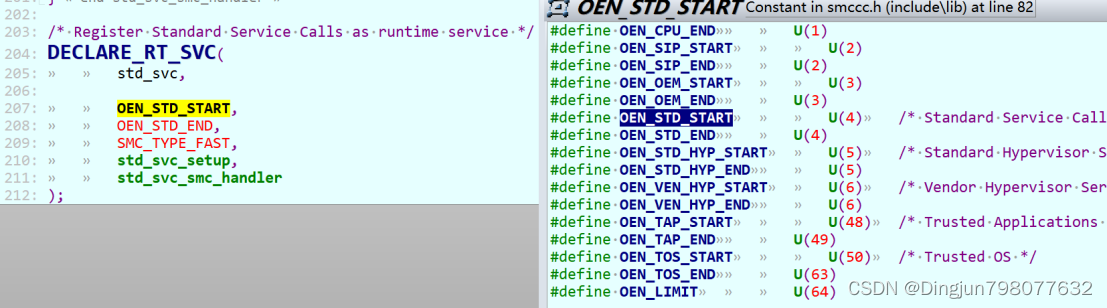

 可以看到,所有OEN为4的fast SMC都由std_svc_smc_handler处理。
static uintptr_t std_svc_smc_handler(uint32_t smc_fid,u_register_t x1,u_register_t x2,u_register_t x3,u_register_t x4,void *cookie,void *handle,u_register_t flags)
{if (((smc_fid >> FUNCID_CC_SHIFT) & FUNCID_CC_MASK) == SMC_32) {/* 32-bit SMC function, clear top parameter bits */x1 &= UINT32_MAX;x2 &= UINT32_MAX;x3 &= UINT32_MAX;x4 &= UINT32_MAX;}/** Dispatch PSCI calls to PSCI SMC handler and return its return* value*/if (is_psci_fid(smc_fid)) {uint64_t ret;#if ENABLE_RUNTIME_INSTRUMENTATION/** Flush cache line so that even if CPU power down happens* the timestamp update is reflected in memory.*/PMF_WRITE_TIMESTAMP(rt_instr_svc,RT_INSTR_ENTER_PSCI,PMF_CACHE_MAINT,get_cpu_data(cpu_data_pmf_ts[CPU_DATA_PMF_TS0_IDX]));
#endifret = psci_smc_handler(smc_fid, x1, x2, x3, x4,cookie, handle, flags);#if ENABLE_RUNTIME_INSTRUMENTATIONPMF_CAPTURE_TIMESTAMP(rt_instr_svc,RT_INSTR_EXIT_PSCI,PMF_NO_CACHE_MAINT);
#endifSMC_RET1(handle, ret);}
... ...
}
u_register_t psci_smc_handler(uint32_t smc_fid,u_register_t x1,u_register_t x2,u_register_t x3,u_register_t x4,void *cookie,void *handle,u_register_t flags)
{u_register_t ret;if (is_caller_secure(flags))return (u_register_t)SMC_UNK;/* Check the fid against the capabilities */if ((psci_caps & define_psci_cap(smc_fid)) == 0U)return (u_register_t)SMC_UNK;if (((smc_fid >> FUNCID_CC_SHIFT) & FUNCID_CC_MASK) == SMC_32) {/* 32-bit PSCI function, clear top parameter bits */
... ...} else {/* 64-bit PSCI function */switch (smc_fid) {case PSCI_CPU_SUSPEND_AARCH64:ret = (u_register_t)psci_cpu_suspend((unsigned int)x1, x2, x3);break;case PSCI_CPU_ON_AARCH64:ret = (u_register_t)psci_cpu_on(x1, x2, x3);break;case PSCI_AFFINITY_INFO_AARCH64:ret = (u_register_t)psci_affinity_info(x1, (unsigned int)x2);break;case PSCI_MIG_AARCH64:ret = (u_register_t)psci_migrate(x1);break;case PSCI_MIG_INFO_UP_CPU_AARCH64:ret = psci_migrate_info_up_cpu();break;case PSCI_NODE_HW_STATE_AARCH64:ret = (u_register_t)psci_node_hw_state(x1, (unsigned int) x2);break;case PSCI_SYSTEM_SUSPEND_AARCH64:ret = (u_register_t)psci_system_suspend(x1, x2);break;#if ENABLE_PSCI_STATcase PSCI_STAT_RESIDENCY_AARCH64:ret = psci_stat_residency(x1, (unsigned int) x2);break;case PSCI_STAT_COUNT_AARCH64:ret = psci_stat_count(x1, (unsigned int) x2);break;
#endifcase PSCI_MEM_CHK_RANGE_AARCH64:ret = psci_mem_chk_range(x1, x2);break;case PSCI_SYSTEM_RESET2_AARCH64:/* We should never return from psci_system_reset2() */ret = psci_system_reset2((uint32_t) x1, x2);break;default:WARN("Unimplemented PSCI Call: 0x%x\n", smc_fid);ret = (u_register_t)SMC_UNK;break;}}return ret;
}对于PSCI启动方式CPU_ON,显然会走
case PSCI_CPU_ON_AARCH64:
ret = (u_register_t)psci_cpu_on(x1, x2, x3);
int psci_cpu_on(u_register_t target_cpu,uintptr_t entrypoint,u_register_t context_id){int rc;entry_point_info_t ep;/* Determine if the cpu exists of not */rc = psci_validate_mpidr(target_cpu);if (rc != PSCI_E_SUCCESS)return PSCI_E_INVALID_PARAMS;/* Validate the entry point and get the entry_point_info */rc = psci_validate_entry_point(&ep, entrypoint, context_id);if (rc != PSCI_E_SUCCESS)return rc;/** To turn this cpu on, specify which power* levels need to be turned on*/return psci_cpu_on_start(target_cpu, &ep);
}
接下来的流程大致如下
->psci_cpu_on() //lib/psci/psci_main.c->psci_validate_entry_point() //验证入口地址有效性并 保存入口点到一个结构ep中->psci_cpu_on_start(target_cpu, &ep) //ep入口地址->psci_plat_pm_ops->pwr_domain_on(target_cpu)->qemu_pwr_domain_on //实现核上电(平台实现)/* Store the re-entry information for the non-secure world. */->cm_init_context_by_index() //重点: 会通过cpu的编号找到 cpu上下文(cpu_context_t),存在cpu寄存器的值,异常返回的时候写写到对应的寄存器中,然后eret,旧返回到了el1!!!->cm_setup_context() //设置cpu上下文-> write_ctx_reg(state, CTX_SCR_EL3, scr_el3); //lib/el3_runtime/aarch64/context_mgmt.cwrite_ctx_reg(state, CTX_ELR_EL3, ep->pc); //注: 异常返回时执行此地址 于是完成了cpu的启动!!!write_ctx_reg(state, CTX_SPSR_EL3, ep->spsr);在psci_cpu_on中调用了psci_validate_entry_point和psci_cpu_on_start。
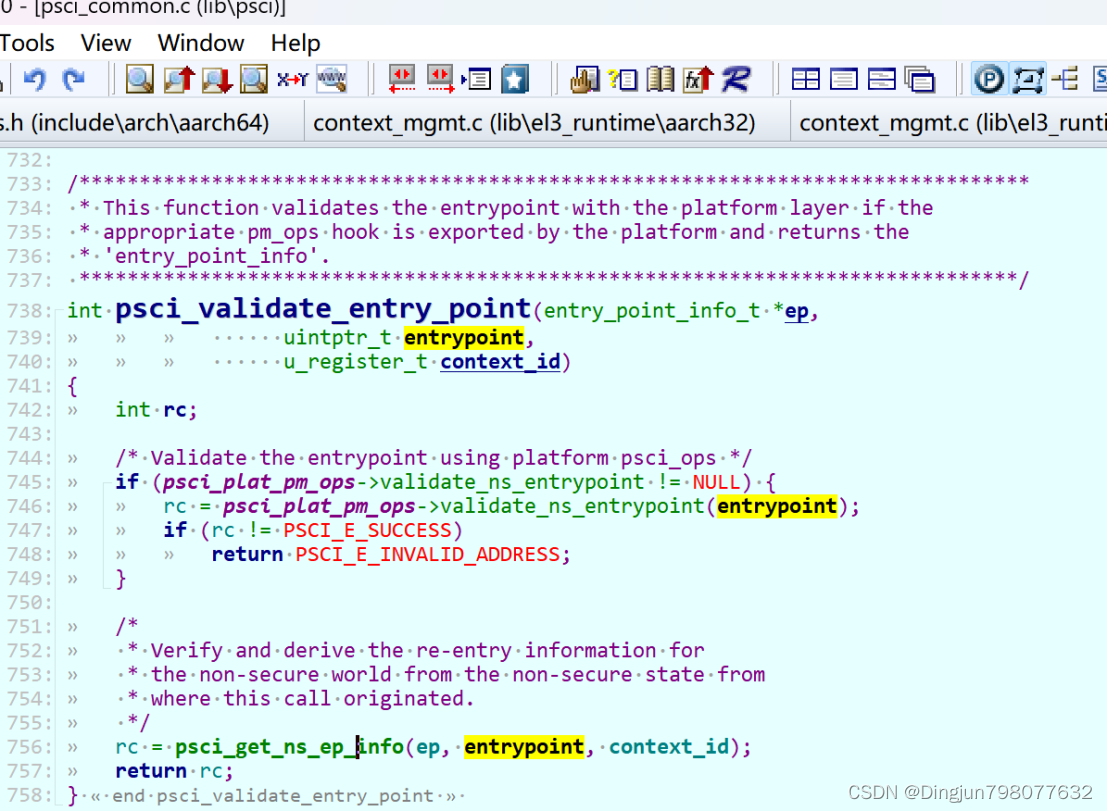
psci_validate_entry_point调用了psci_get_ns_ep_info将Linux SMC调用是x1寄存器保存的entry_point(secondary cpu在linux入口地址)保存到了ep->pc, 并且生成了ep->spsr。
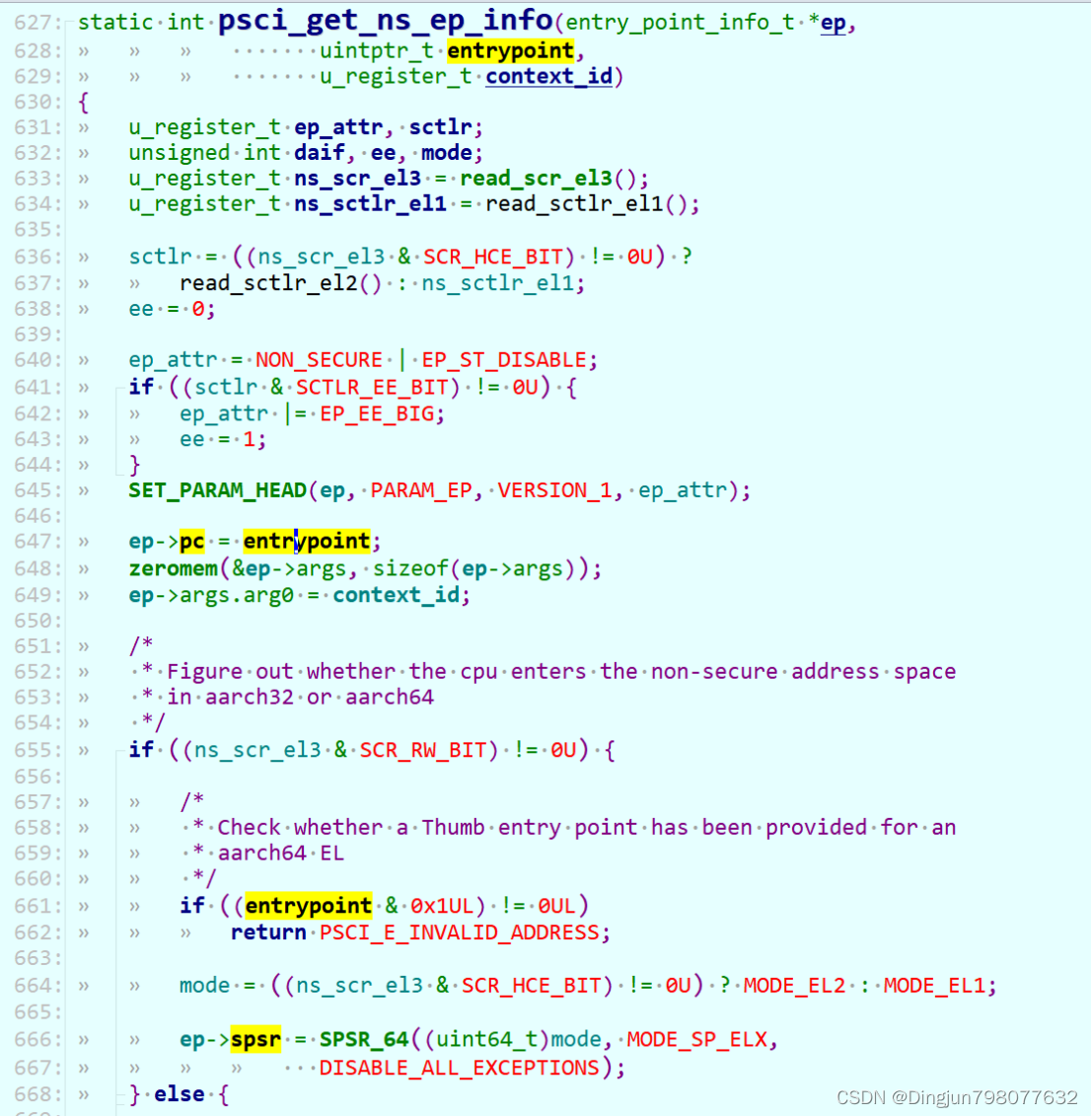
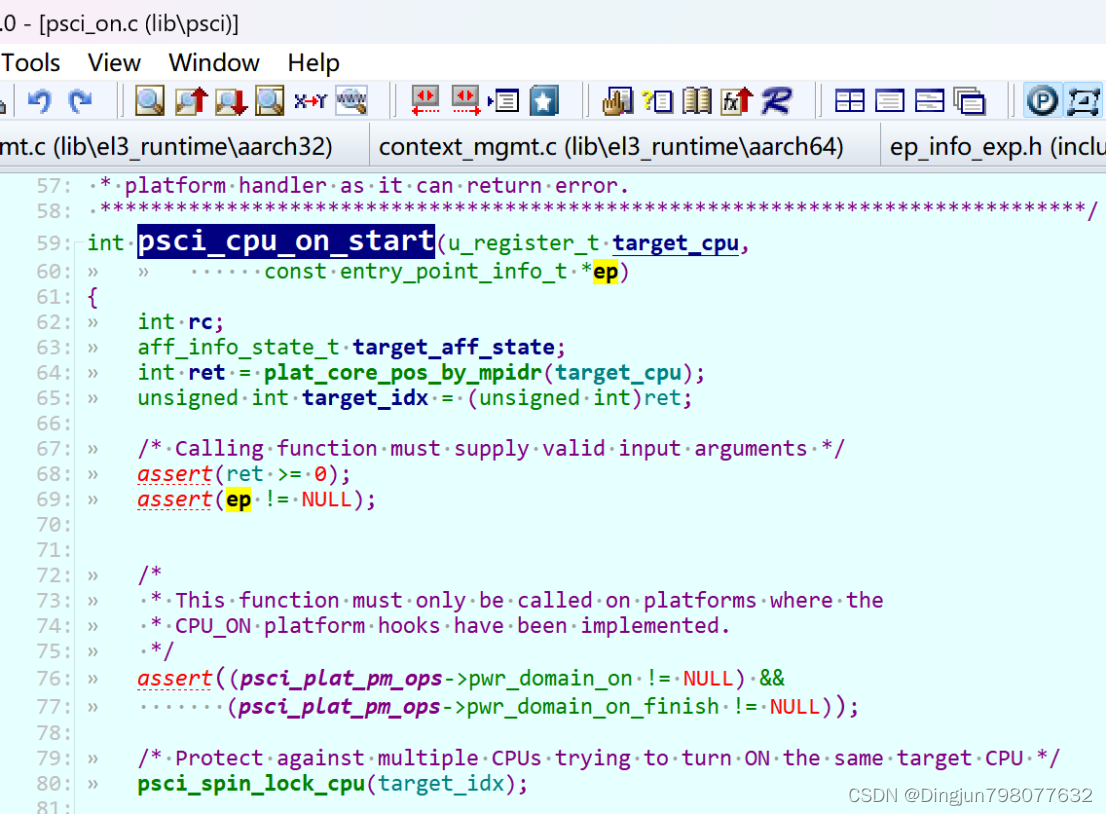
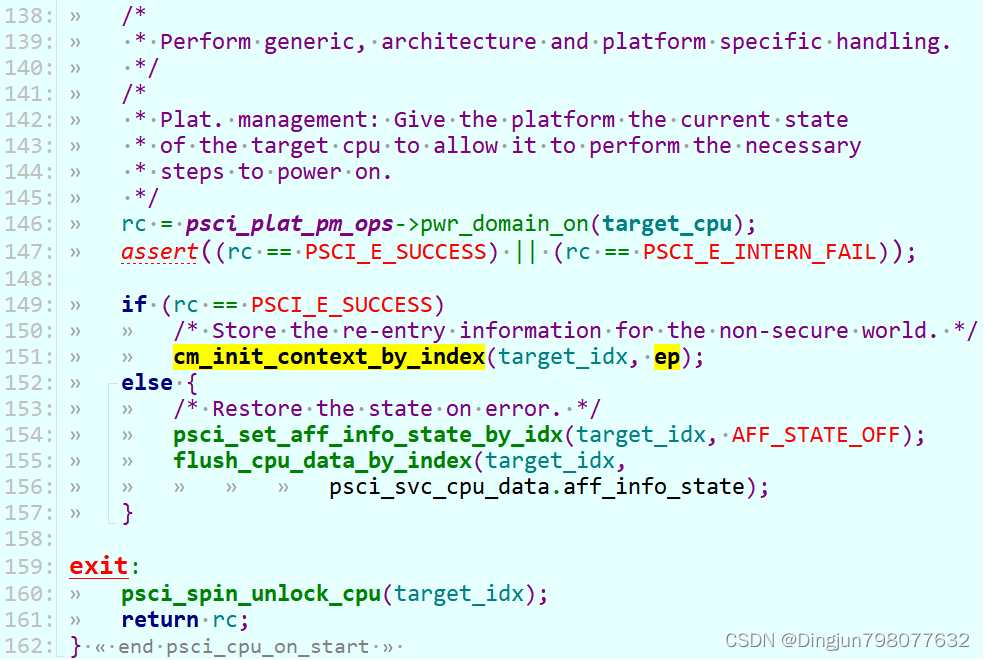
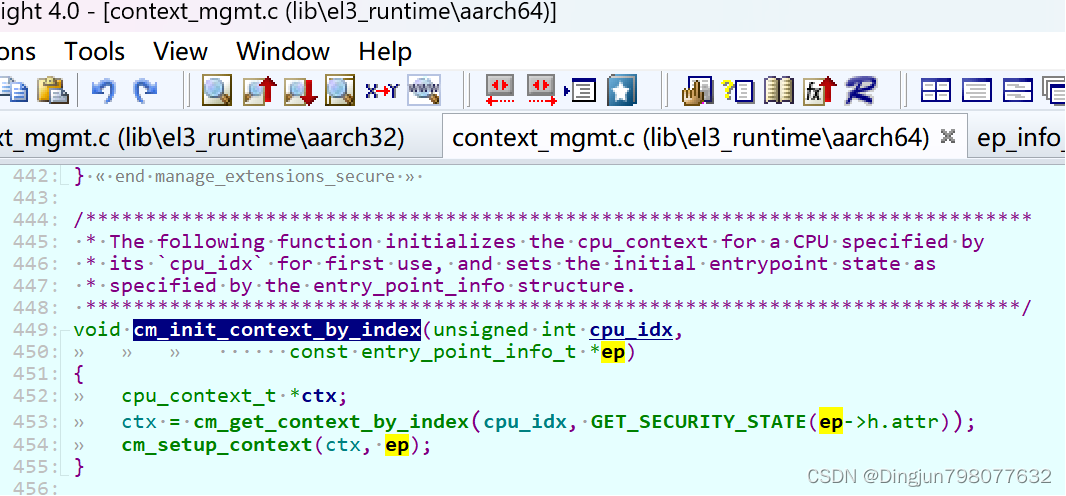
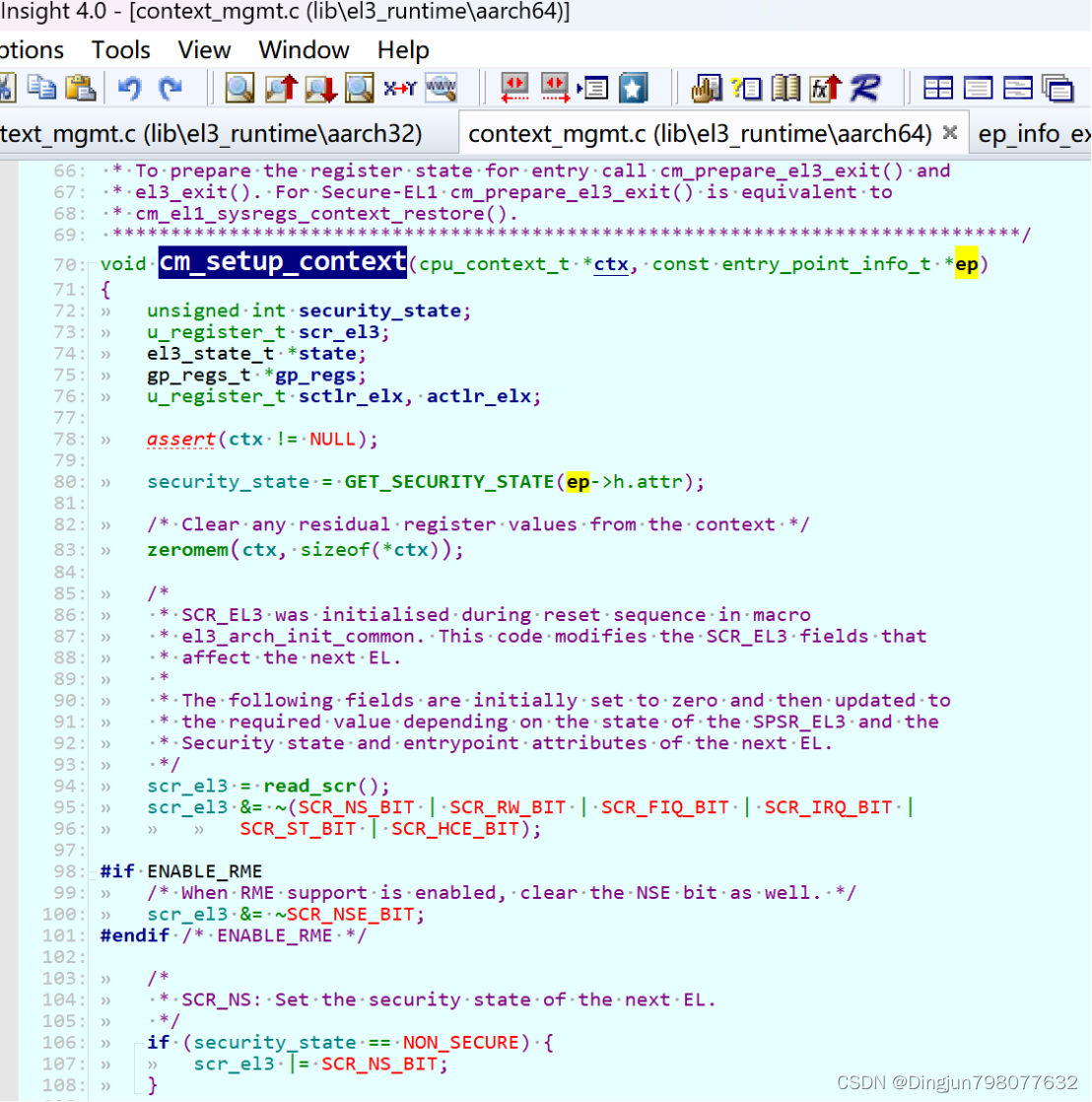
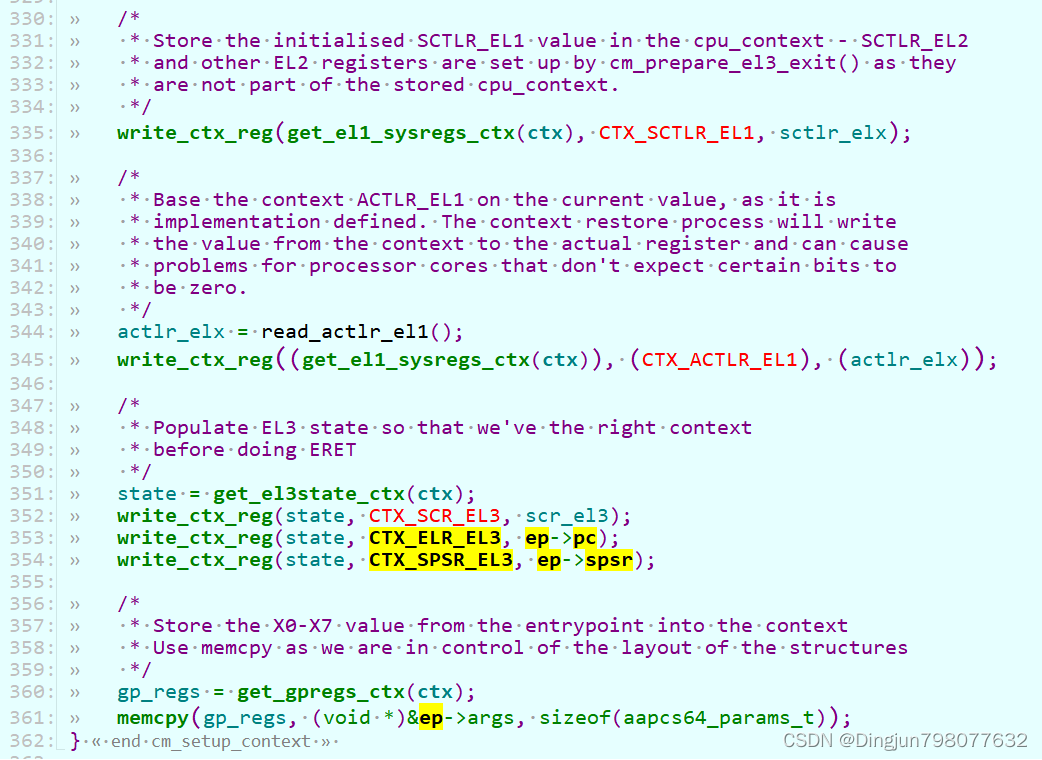 把ep->pc、 ep->spsr保存到contex后,return后回到smc_handler64,接着调用el3_exit, el3_exit最终会调用eret回到el1,也就是Linxu内核中。
这里给出一张SMC调用的大致流程图如下:
五、PSIC启动secondary cpu的处理
好像上文整个流程,secondary cpu就启动完成了,实际不是的。 上面的过程都是主CPU在处理,主处理器通过smc进入el3请求开核服务,atf中会响应这种请求,通过平台的开核操作来启动secondary cpu,并且设置从处理的一些寄存器如:scr_el3、spsr_el3、elr_el3,然后主处理器,恢复现场,eret再次回到el1(Linux内核)。psci_cpu_on主要完成开核的工作,然后会设置一些异常返回后寄存器的值(eg:从el1 -> el3 -> el1),重点关注 ep->pc写到cpu_context结构的CTX_ELR_EL3偏移处(从处理器启动后会从这个地址取指执行)。
而secondary cpu开核之后会从bl31_warm_entrypoint开始执行,在plat_setup_psci_ops中会设置(每个平台都有自己的启动地址寄存器,通过写这个寄存器来获得上电后执行的指令地址)。
bl31_warm_entrypoint代码如下,在el3_exit中会使用之前保存cpu_context结构中的数据,写入到cscr_el3、spsr_el3、elr_el3,最后通过eret指令使自己进入到Linxu内核。
	 */
func bl31_warm_entrypoint
#if ENABLE_RUNTIME_INSTRUMENTATION/** This timestamp update happens with cache off.  The next* timestamp collection will need to do cache maintenance prior* to timestamp update.*/pmf_calc_timestamp_addr rt_instr_svc, RT_INSTR_EXIT_HW_LOW_PWRmrs	x1, cntpct_el0str	x1, [x0]
#endif/** On the warm boot path, most of the EL3 initialisations performed by* 'el3_entrypoint_common' must be skipped:**  - Only when the platform bypasses the BL1/BL31 entrypoint by*    programming the reset address do we need to initialise SCTLR_EL3.*    In other cases, we assume this has been taken care by the*    entrypoint code.**  - No need to determine the type of boot, we know it is a warm boot.**  - Do not try to distinguish between primary and secondary CPUs, this*    notion only exists for a cold boot.**  - No need to initialise the memory or the C runtime environment,*    it has been done once and for all on the cold boot path.*/el3_entrypoint_common					\_init_sctlr=PROGRAMMABLE_RESET_ADDRESS		\_warm_boot_mailbox=0				\_secondary_cold_boot=0				\_init_memory=0					\_init_c_runtime=0				\_exception_vectors=runtime_exceptions		\_pie_fixup_size=0/** We're about to enable MMU and participate in PSCI state coordination.** The PSCI implementation invokes platform routines that enable CPUs to* participate in coherency. On a system where CPUs are not* cache-coherent without appropriate platform specific programming,* having caches enabled until such time might lead to coherency issues* (resulting from stale data getting speculatively fetched, among* others). Therefore we keep data caches disabled even after enabling* the MMU for such platforms.** On systems with hardware-assisted coherency, or on single cluster* platforms, such platform specific programming is not required to* enter coherency (as CPUs already are); and there's no reason to have* caches disabled either.*/
#if HW_ASSISTED_COHERENCY || WARMBOOT_ENABLE_DCACHE_EARLYmov	x0, xzr
#elsemov	x0, #DISABLE_DCACHE
#endifbl	bl31_plat_enable_mmu#if ENABLE_RME/** At warm boot GPT data structures have already been initialized in RAM* but the sysregs for this CPU need to be initialized. Note that the GPT* accesses are controlled attributes in GPCCR and do not depend on the* SCR_EL3.C bit.*/bl	gpt_enablecbz	x0, 1fno_ret plat_panic_handler
1:
#endif#if ENABLE_PAUTH/* --------------------------------------------------------------------* Program APIAKey_EL1 and enable pointer authentication* --------------------------------------------------------------------*/bl	pauth_init_enable_el3
#endif /* ENABLE_PAUTH */bl	psci_warmboot_entrypoint#if ENABLE_RUNTIME_INSTRUMENTATIONpmf_calc_timestamp_addr rt_instr_svc, RT_INSTR_EXIT_PSCImov	x19, x0/** Invalidate before updating timestamp to ensure previous timestamp* updates on the same cache line with caches disabled are properly* seen by the same core. Without the cache invalidate, the core might* write into a stale cache line.*/mov	x1, #PMF_TS_SIZEmov	x20, x30bl	inv_dcache_rangemov	x30, x20mrs	x0, cntpct_el0str	x0, [x19]
#endifb	el3_exit
endfunc bl31_warm_entrypoint
本文来自互联网用户投稿,文章观点仅代表作者本人,不代表本站立场,不承担相关法律责任。如若转载,请注明出处。 如若内容造成侵权/违法违规/事实不符,请点击【内容举报】进行投诉反馈!