hisi3531 valgrind 交叉编译移植
valgrind 神器不用我多说,linux平台开发利器。
一、 安装
1. autoconf
# wget http://ftp.gnu.org/gnu/autoconf/autoconf-2.69.tar.gz
# tar -zxvf autoconf-2.69.tar.gz
# cd autoconf-2.69
# ./configure
# make; make install
2. automake
# wget http://ftp.gnu.org/gnu/automake/automake-1.14.tar.gz
# tar -zxvf automake-1.14.tar.gz
# cd automake-1.14
# ./bootstrap.sh
# ./configure
# make; make install
3. valgrind
# wget http://valgrind.org/downloads/valgrind-3.11.0.tar.bz2
# tar -jxvf valgrind-3.11.0.tar.bz2
# cd valgrind-3.11.0
# ./autogen.sh
#./autogen.sh 缺少这步会导致failed to start tool 'memcheck' for platform 'amd64-linux'
修改configure脚本armv7*) 改为armv7* | arm )
arm-hisiv200-linux... 这些命令要在环境变量下哦,不用多说。
./configure --host=arm-linux CC=arm-none-linux-gnueabi-gcc CPP=arm-none-linux-gnueabi-cpp CXX=arm-none-linux-gnueabi-g++ --prefix=/home/dcj/valgrind
./configure \--prefix="$PWD/install" \CC=/opt/hisi-linux/x86-arm/aarch64-himix100-linux/bin/aarch64-himix100-linux-gcc \CXX=/opt/hisi-linux/x86-arm/aarch64-himix100-linux/bin/aarch64-himix100-linux-g++ \CPP=/opt/hisi-linux/x86-arm/aarch64-himix100-linux/bin/aarch64-himix100-linux-cpp \AR=/opt/hisi-linux/x86-arm/aarch64-himix100-linux/bin/aarch64-himix100-linux-ar \--target=aarch64-himix100-linux \--host=aarch64-himix100-linux \--program-prefix=hisi-# sudo make#sudo make install
–prefix=/home/dcj/valgrind指定的目录要与开发板上放置的目录一致,不然运行valgrind时可能会出现“valgrind: failed to start tool ‘memcheck’ for platform ‘arm-linux’: No such file or directory”错误。
解决方案:可以看到lib下面还有一层目录valgrind,这时候我们在开发板/etc/profile文件中添加一行
export VALGRIND_LIB=/opt/valgrind-3.12.0/lib/valgrind
可执行文件生成在源码路径
4. 将install/bin目录下的可执行文件hisi-valgrind拷贝到海思板子上,将install/lib目录下的valgrind目录也拷贝到海思板子上,此目录下包含了执行hisi-valgrind时需要的库,然后依次执行如下命令,结果如下图所示:
export VALGRIND_LIB=valgrind/
./hisi-valgrind --version

- 测试代码main.cpp如下:
#include
#include namespace {void func1() {int* p1 = new int[10];
}void func2() {int* p2 = new int[5];
}} // namespaceint main()
{fprintf(stdout, "test start\n");func1();func2();fprintf(stdout, "test finish\n");
} - 执行如下命令,生成可执行文件main:
/opt/hisi-linux/x86-arm/aarch64-himix100-linux/bin/aarch64-himix100-linux-g++ -g -o main main.cpp
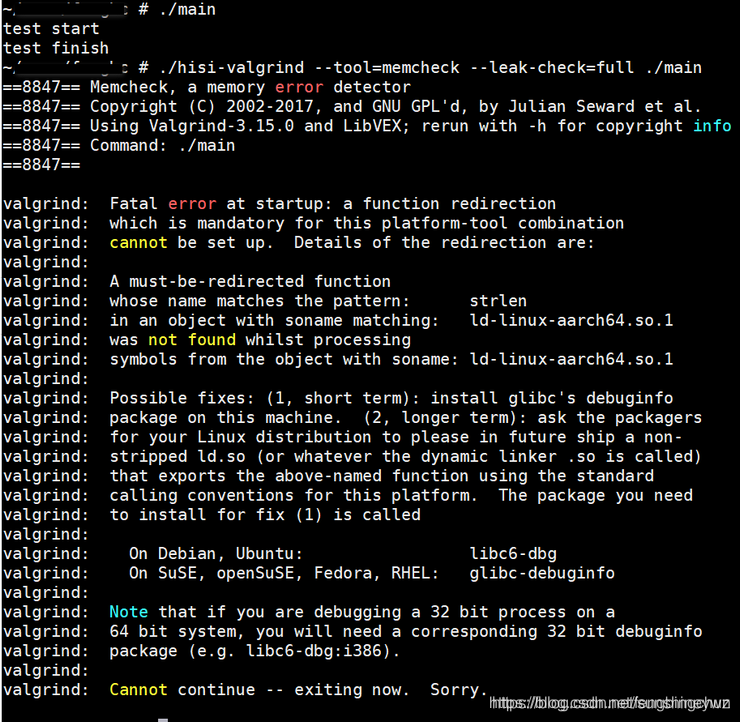
7. 将可执行文件main拷贝到海思板子上,执行如下命令 ,结果如下图所示:
./hisi-valgrind --tool=memcheck --leak-check=full ./main
configure.in
##------------------------------------------------------------##
#
# The multiple-architecture stuff in this file is pretty
# cryptic.  Read docs/internals/multiple-architectures.txt
# for at least a partial explanation of what is going on.
#
##------------------------------------------------------------### Process this file with autoconf to produce a configure script.
AC_INIT([Valgrind],[3.11.0],[valgrind-users@lists.sourceforge.net])
AC_CONFIG_SRCDIR(coregrind/m_main.c)
AC_CONFIG_HEADERS([config.h])
AM_INIT_AUTOMAKE([foreign subdir-objects])AM_MAINTAINER_MODE#----------------------------------------------------------------------------
# Do NOT modify these flags here. Except in feature tests in which case
# the original values must be properly restored.
#----------------------------------------------------------------------------
CFLAGS="$CFLAGS"
CXXFLAGS="$CXXFLAGS"#----------------------------------------------------------------------------
# Checks for various programs.
#----------------------------------------------------------------------------AC_PROG_LN_S
AC_PROG_CC
AM_PROG_CC_C_O
AC_PROG_CPP
AC_PROG_CXX
# AC_PROG_OBJC apparently causes problems on older Linux distros (eg. with
# autoconf 2.59).  If we ever have any Objective-C code in the Valgrind code
# base (eg. most likely as Darwin-specific tests) we'll need one of the
# following:
# - put AC_PROG_OBJC in a Darwin-specific part of this file
# - Use AC_PROG_OBJC here and up the minimum autoconf version
# - Use the following, which is apparently equivalent:
#     m4_ifdef([AC_PROG_OBJC],
#        [AC_PROG_OBJC],
#        [AC_CHECK_TOOL([OBJC], [gcc])
#         AC_SUBST([OBJC])
#         AC_SUBST([OBJCFLAGS])
#        ])
AC_PROG_RANLIB
# provide a very basic definition for AC_PROG_SED if it's not provided by
# autoconf (as e.g. in autoconf 2.59).
m4_ifndef([AC_PROG_SED],[AC_DEFUN([AC_PROG_SED],[AC_ARG_VAR([SED])AC_CHECK_PROGS([SED],[gsed sed])])])
AC_PROG_SED# If no AR variable was specified, look up the name of the archiver. Otherwise
# do not touch the AR variable.
if test "x$AR" = "x"; thenAC_PATH_PROGS([AR], [`echo $LD | $SED 's/ld$/ar/'` "ar"], [ar])
fi
AC_ARG_VAR([AR],[Archiver command])# Check for the compiler support
if test "${GCC}" != "yes" ; thenAC_MSG_ERROR([Valgrind relies on GCC to be compiled])
fi# figure out where perl lives
AC_PATH_PROG(PERL, perl)# figure out where gdb lives
AC_PATH_PROG(GDB, gdb, "/no/gdb/was/found/at/configure/time")
AC_DEFINE_UNQUOTED(GDB_PATH, "$GDB", [path to GDB])# some older automake's don't have it so try something on our own
ifdef([AM_PROG_AS],[AM_PROG_AS],
[
AS="${CC}"
AC_SUBST(AS)ASFLAGS=""
AC_SUBST(ASFLAGS)
])# Check if 'diff' supports -u (universal diffs) and use it if possible.AC_MSG_CHECKING([for diff -u])
AC_SUBST(DIFF)# Comparing two identical files results in 0.
tmpfile="tmp-xxx-yyy-zzz"
touch $tmpfile;
if diff -u $tmpfile $tmpfile ; thenAC_MSG_RESULT([yes])DIFF="diff -u"
elseAC_MSG_RESULT([no])DIFF="diff"
fi
rm $tmpfile# We don't want gcc < 3.0
AC_MSG_CHECKING([for a supported version of gcc])# Obtain the compiler version.
#
# A few examples of how the ${CC} --version output looks like:
#
# ######## gcc variants ########
# Arch Linux: i686-pc-linux-gnu-gcc (GCC) 4.6.2
# Debian Linux: gcc (Debian 4.3.2-1.1) 4.3.2
# openSUSE: gcc (SUSE Linux) 4.5.1 20101208 [gcc-4_5-branch revision 167585]
# Exherbo Linux: x86_64-pc-linux-gnu-gcc (Exherbo gcc-4.6.2) 4.6.2
# MontaVista Linux for ARM: arm-none-linux-gnueabi-gcc (Sourcery G++ Lite 2009q1-203) 4.3.3
# OS/X 10.6: i686-apple-darwin10-gcc-4.2.1 (GCC) 4.2.1 (Apple Inc. build 5666) (dot 3)
# OS/X 10.7: i686-apple-darwin11-llvm-gcc-4.2 (GCC) 4.2.1 (Based on Apple Inc. build 5658) (LLVM build 2335.15.00)
#
# ######## clang variants ########
# Clang: clang version 2.9 (tags/RELEASE_29/final)
# Apple clang: Apple clang version 3.1 (tags/Apple/clang-318.0.58) (based on LLVM 3.1svn)
# FreeBSD clang: FreeBSD clang version 3.1 (branches/release_31 156863) 20120523
#
# ######## Apple LLVM variants ########
# Apple LLVM version 5.1 (clang-503.0.40) (based on LLVM 3.4svn)
# Apple LLVM version 6.0 (clang-600.0.51) (based on LLVM 3.5svn)
#
[
if test "x`${CC} --version | $SED -n -e 's/.*\Apple \(LLVM\) version.*clang.*/\1/p'`" = "xLLVM" ;
thenis_clang="applellvm"gcc_version=`${CC} --version | $SED -n -e 's/.*LLVM version \([0-9.]*\).*$/\1/p'`
elif test "x`${CC} --version | $SED -n -e 's/.*\(clang\) version.*/\1/p'`" = "xclang" ;
thenis_clang="clang"# Don't use -dumpversion with clang: it will always produce "4.2.1".gcc_version=`${CC} --version | $SED -n -e 's/.*clang version \([0-9.]*\).*$/\1/p'`
elif test "x`${CC} --version | $SED -n -e 's/icc.*\(ICC\).*/\1/p'`" = "xICC" ;
thenis_clang="icc"gcc_version=`${CC} -dumpversion 2>/dev/null`
elseis_clang="notclang"gcc_version=`${CC} -dumpversion 2>/dev/null`if test "x$gcc_version" = x; thengcc_version=`${CC} --version | $SED -n -e 's/[^ ]*gcc[^ ]* ([^)]*) \([0-9.]*\).*$/\1/p'`fi
fi
]
AM_CONDITIONAL(COMPILER_IS_CLANG, test $is_clang = clang -o $is_clang = applellvm)
AM_CONDITIONAL(COMPILER_IS_ICC, test $is_clang = icc)# Note: m4 arguments are quoted with [ and ] so square brackets in shell
# statements have to be quoted.
case "${is_clang}-${gcc_version}" inapplellvm-5.1|applellvm-6.*|applellvm-7.*)AC_MSG_RESULT([ok (Apple LLVM version ${gcc_version})]);;icc-1[[3-9]].*)AC_MSG_RESULT([ok (ICC version ${gcc_version})]);;notclang-[[3-9]].*|notclang-[[1-9][0-9]]*)AC_MSG_RESULT([ok (${gcc_version})]);;clang-2.9|clang-[[3-9]].*|clang-[[1-9][0-9]]*)AC_MSG_RESULT([ok (clang-${gcc_version})]);;*)AC_MSG_RESULT([no (${gcc_version})])AC_MSG_ERROR([please use gcc >= 3.0 or clang >= 2.9 or icc >= 13.0]);;
esac#----------------------------------------------------------------------------
# Arch/OS/platform tests.
#----------------------------------------------------------------------------
# We create a number of arch/OS/platform-related variables.  We prefix them
# all with "VGCONF_" which indicates that they are defined at
# configure-time, and distinguishes them from the VGA_*/VGO_*/VGP_*
# variables used when compiling C files.AC_CANONICAL_HOSTAC_MSG_CHECKING([for a supported CPU])# ARCH_MAX reflects the most that this CPU can do: for example if it
# is a 64-bit capable PowerPC, then it must be set to ppc64 and not ppc32.
# Ditto for amd64.  It is used for more configuration below, but is not used
# outside this file.
#
# Power PC returns powerpc for Big Endian.  This was not changed when Little
# Endian support was added to the 64-bit architecture.  The 64-bit Little
# Endian systems explicitly state le in the host_cpu.  For clarity in the
# Valgrind code, the ARCH_MAX name will state LE or BE for the endianess of
# the 64-bit system.  Big Endian is the only mode supported on 32-bit Power PC.
# The abreviation PPC or ppc refers to 32-bit and 64-bit systems with either
# Endianess.  The name PPC64 or ppc64 to 64-bit systems of either Endianess.
# The names ppc64be or PPC64BE refer to only 64-bit systems that are Big
# Endian.  Similarly, ppc64le or PPC64LE refer to only 64-bit systems that are
# Little Endian.case "${host_cpu}" ini?86) AC_MSG_RESULT([ok (${host_cpu})])ARCH_MAX="x86";;x86_64) AC_MSG_RESULT([ok (${host_cpu})])ARCH_MAX="amd64";;powerpc64)# this only referrs to 64-bit Big EndianAC_MSG_RESULT([ok (${host_cpu})])ARCH_MAX="ppc64be";;powerpc64le)# this only referrs to 64-bit Little EndianAC_MSG_RESULT([ok (${host_cpu})])ARCH_MAX="ppc64le";;powerpc)# On Linux this means only a 32-bit capable CPU.AC_MSG_RESULT([ok (${host_cpu})])ARCH_MAX="ppc32";;s390x)AC_MSG_RESULT([ok (${host_cpu})])ARCH_MAX="s390x";;armv7*)AC_MSG_RESULT([ok (${host_cpu})])ARCH_MAX="arm";;aarch64*)AC_MSG_RESULT([ok (${host_cpu})])ARCH_MAX="arm64";;mips)AC_MSG_RESULT([ok (${host_cpu})])ARCH_MAX="mips32";;mipsel)AC_MSG_RESULT([ok (${host_cpu})])ARCH_MAX="mips32";;mipsisa32r2)AC_MSG_RESULT([ok (${host_cpu})])ARCH_MAX="mips32";;mips64*)AC_MSG_RESULT([ok (${host_cpu})])ARCH_MAX="mips64";;mipsisa64*)AC_MSG_RESULT([ok (${host_cpu})])ARCH_MAX="mips64";;tilegx)AC_MSG_RESULT([ok (${host_cpu})])ARCH_MAX="tilegx";;*) AC_MSG_RESULT([no (${host_cpu})])AC_MSG_ERROR([Unsupported host architecture. Sorry]);;
esac#----------------------------------------------------------------------------# Sometimes it's convenient to subvert the bi-arch build system and
# just have a single build even though the underlying platform is
# capable of both.  Hence handle --enable-only64bit and
# --enable-only32bit.  Complain if both are issued :-)
# [Actually, if either of these options are used, I think both get built,
# but only one gets installed.  So if you use an in-place build, both can be
# used. --njn]# Check if a 64-bit only build has been requested
AC_CACHE_CHECK([for a 64-bit only build], vg_cv_only64bit,[AC_ARG_ENABLE(only64bit, [  --enable-only64bit      do a 64-bit only build],[vg_cv_only64bit=$enableval],[vg_cv_only64bit=no])])# Check if a 32-bit only build has been requested
AC_CACHE_CHECK([for a 32-bit only build], vg_cv_only32bit,[AC_ARG_ENABLE(only32bit, [  --enable-only32bit      do a 32-bit only build],[vg_cv_only32bit=$enableval],[vg_cv_only32bit=no])])# Stay sane
if test x$vg_cv_only64bit = xyes -a x$vg_cv_only32bit = xyes; thenAC_MSG_ERROR([Nonsensical: both --enable-only64bit and --enable-only32bit.])
fi#----------------------------------------------------------------------------# VGCONF_OS is the primary build OS, eg. "linux".  It is passed in to
# compilation of many C files via -VGO_$(VGCONF_OS) and
# -VGP_$(VGCONF_ARCH_PRI)_$(VGCONF_OS).
AC_MSG_CHECKING([for a supported OS])
AC_SUBST(VGCONF_OS)DEFAULT_SUPP=""case "${host_os}" in*linux*)AC_MSG_RESULT([ok (${host_os})])VGCONF_OS="linux"# Ok, this is linux. Check the kernel versionAC_MSG_CHECKING([for the kernel version])kernel=`uname -r`case "${kernel}" in0.*|1.*|2.0.*|2.1.*|2.2.*|2.3.*|2.4.*|2.5.*) AC_MSG_RESULT([unsupported (${kernel})])AC_MSG_ERROR([Valgrind needs a Linux kernel >= 2.6]);;*)AC_MSG_RESULT([2.6 or later (${kernel})]);;esac;;*darwin*)AC_MSG_RESULT([ok (${host_os})])VGCONF_OS="darwin"AC_DEFINE([DARWIN_10_5], 100500, [DARWIN_VERS value for Mac OS X 10.5])AC_DEFINE([DARWIN_10_6], 100600, [DARWIN_VERS value for Mac OS X 10.6])AC_DEFINE([DARWIN_10_7], 100700, [DARWIN_VERS value for Mac OS X 10.7])AC_DEFINE([DARWIN_10_8], 100800, [DARWIN_VERS value for Mac OS X 10.8])AC_DEFINE([DARWIN_10_9], 100900, [DARWIN_VERS value for Mac OS X 10.9])AC_DEFINE([DARWIN_10_10], 101000, [DARWIN_VERS value for Mac OS X 10.10])AC_DEFINE([DARWIN_10_11], 101100, [DARWIN_VERS value for Mac OS X 10.11])AC_MSG_CHECKING([for the kernel version])kernel=`uname -r`# Nb: for Darwin we set DEFAULT_SUPP here.  That's because Darwin# has only one relevant version, the OS version. The `uname` check# is a good way to get that version (i.e. "Darwin 9.6.0" is Mac OS# X 10.5.6, and "Darwin 10.x" is Mac OS X 10.6.x Snow Leopard,# and possibly "Darwin 11.x" is Mac OS X 10.7.x Lion), # and we don't know of an macros similar to __GLIBC__ to get that info.## XXX: `uname -r` won't do the right thing for cross-compiles, but# that's not a problem yet.## jseward 21 Sept 2011: I seriously doubt whether V 3.7.0 will work# on OS X 10.5.x; I haven't tested yet, and only plan to test 3.7.0# on 10.6.8 and 10.7.1.  Although tempted to delete the configure# time support for 10.5 (the 9.* pattern just below), I'll leave it# in for now, just in case anybody wants to give it a try.  But I'm# assuming that 3.7.0 is a Snow Leopard and Lion-only release.case "${kernel}" in9.*)AC_MSG_RESULT([Darwin 9.x (${kernel}) / Mac OS X 10.5 Leopard])AC_DEFINE([DARWIN_VERS], DARWIN_10_5, [Darwin / Mac OS X version])DEFAULT_SUPP="darwin9.supp ${DEFAULT_SUPP}"DEFAULT_SUPP="darwin9-drd.supp ${DEFAULT_SUPP}";;10.*)AC_MSG_RESULT([Darwin 10.x (${kernel}) / Mac OS X 10.6 Snow Leopard])AC_DEFINE([DARWIN_VERS], DARWIN_10_6, [Darwin / Mac OS X version])DEFAULT_SUPP="darwin10.supp ${DEFAULT_SUPP}"DEFAULT_SUPP="darwin10-drd.supp ${DEFAULT_SUPP}";;11.*)AC_MSG_RESULT([Darwin 11.x (${kernel}) / Mac OS X 10.7 Lion])AC_DEFINE([DARWIN_VERS], DARWIN_10_7, [Darwin / Mac OS X version])DEFAULT_SUPP="darwin11.supp ${DEFAULT_SUPP}"DEFAULT_SUPP="darwin10-drd.supp ${DEFAULT_SUPP}";;12.*)AC_MSG_RESULT([Darwin 12.x (${kernel}) / Mac OS X 10.8 Mountain Lion])AC_DEFINE([DARWIN_VERS], DARWIN_10_8, [Darwin / Mac OS X version])DEFAULT_SUPP="darwin12.supp ${DEFAULT_SUPP}"DEFAULT_SUPP="darwin10-drd.supp ${DEFAULT_SUPP}";;13.*)AC_MSG_RESULT([Darwin 13.x (${kernel}) / Mac OS X 10.9 Mavericks])AC_DEFINE([DARWIN_VERS], DARWIN_10_9, [Darwin / Mac OS X version])DEFAULT_SUPP="darwin13.supp ${DEFAULT_SUPP}"DEFAULT_SUPP="darwin10-drd.supp ${DEFAULT_SUPP}";;14.*)AC_MSG_RESULT([Darwin 14.x (${kernel}) / Mac OS X 10.10 Yosemite])AC_DEFINE([DARWIN_VERS], DARWIN_10_10, [Darwin / Mac OS X version])DEFAULT_SUPP="darwin14.supp ${DEFAULT_SUPP}"DEFAULT_SUPP="darwin10-drd.supp ${DEFAULT_SUPP}";;15.*)AC_MSG_RESULT([Darwin 15.x (${kernel}) / Mac OS X 10.11 El Capitan])AC_DEFINE([DARWIN_VERS], DARWIN_10_11, [Darwin / Mac OS X version])DEFAULT_SUPP="darwin15.supp ${DEFAULT_SUPP}"DEFAULT_SUPP="darwin10-drd.supp ${DEFAULT_SUPP}";;*) AC_MSG_RESULT([unsupported (${kernel})])AC_MSG_ERROR([Valgrind works on Darwin 10.x, 11.x, 12.x, 13.x, 14.x and 15.x (Mac OS X 10.6/7/8/9/10/11)]);;esac;;solaris2.11*)AC_MSG_RESULT([ok (${host_os})])VGCONF_OS="solaris"DEFAULT_SUPP="solaris11.supp ${DEFAULT_SUPP}";;solaris2.12*)AC_MSG_RESULT([ok (${host_os})])VGCONF_OS="solaris"DEFAULT_SUPP="solaris12.supp ${DEFAULT_SUPP}";;*) AC_MSG_RESULT([no (${host_os})])AC_MSG_ERROR([Valgrind is operating system specific. Sorry.]);;
esac#----------------------------------------------------------------------------# If we are building on a 64 bit platform test to see if the system
# supports building 32 bit programs and disable 32 bit support if it
# does not support building 32 bit programscase "$ARCH_MAX-$VGCONF_OS" inamd64-linux|ppc64be-linux|arm64-linux|amd64-solaris)AC_MSG_CHECKING([for 32 bit build support])safe_CFLAGS=$CFLAGSCFLAGS="-m32"AC_LINK_IFELSE([AC_LANG_PROGRAM([[]], [[return 0;]])], [AC_MSG_RESULT([yes])], [vg_cv_only64bit="yes"AC_MSG_RESULT([no])])CFLAGS=$safe_CFLAGS;;
esacif test x$vg_cv_only64bit = xyes -a x$vg_cv_only32bit = xyes; thenAC_MSG_ERROR([--enable-only32bit was specified but system does not support 32 bit builds])
fi#----------------------------------------------------------------------------# VGCONF_ARCH_PRI is the arch for the primary build target, eg. "amd64".  By
# default it's the same as ARCH_MAX.  But if, say, we do a build on an amd64
# machine, but --enable-only32bit has been requested, then ARCH_MAX (see
# above) will be "amd64" since that reflects the most that this cpu can do,
# but VGCONF_ARCH_PRI will be downgraded to "x86", since that reflects the
# arch corresponding to the primary build (VGCONF_PLATFORM_PRI_CAPS).  It is
# passed in to compilation of many C files via -VGA_$(VGCONF_ARCH_PRI) and
# -VGP_$(VGCONF_ARCH_PRI)_$(VGCONF_OS).
AC_SUBST(VGCONF_ARCH_PRI)# VGCONF_ARCH_SEC is the arch for the secondary build target, eg. "x86".
# It is passed in to compilation of many C files via -VGA_$(VGCONF_ARCH_SEC)
# and -VGP_$(VGCONF_ARCH_SEC)_$(VGCONF_OS), if there is a secondary target.
# It is empty if there is no secondary target.
AC_SUBST(VGCONF_ARCH_SEC)# VGCONF_PLATFORM_PRI_CAPS is the primary build target, eg. "AMD64_LINUX".
# The entire system, including regression and performance tests, will be
# built for this target.  The "_CAPS" indicates that the name is in capital
# letters, and it also uses '_' rather than '-' as a separator, because it's
# used to create various Makefile variables, which are all in caps by
# convention and cannot contain '-' characters.  This is in contrast to
# VGCONF_ARCH_PRI and VGCONF_OS which are not in caps.
AC_SUBST(VGCONF_PLATFORM_PRI_CAPS)# VGCONF_PLATFORM_SEC_CAPS is the secondary build target, if there is one.
# Valgrind and tools will also be built for this target, but not the
# regression or performance tests.
#
# By default, the primary arch is the same as the "max" arch, as commented
# above (at the definition of ARCH_MAX).  We may choose to downgrade it in
# the big case statement just below here, in the case where we're building
# on a 64 bit machine but have been requested only to do a 32 bit build.
AC_SUBST(VGCONF_PLATFORM_SEC_CAPS)AC_MSG_CHECKING([for a supported CPU/OS combination])# NB.  The load address for a given platform may be specified in more
# than one place, in some cases, depending on whether we're doing a biarch,
# 32-bit only or 64-bit only build.  eg see case for amd64-linux below.
# Be careful to give consistent values in all subcases.  Also, all four
# valt_load_addres_{pri,sec}_{norml,inner} values must always be set,
# even if it is to "0xUNSET".
#
case "$ARCH_MAX-$VGCONF_OS" inx86-linux)VGCONF_ARCH_PRI="x86"VGCONF_ARCH_SEC=""VGCONF_PLATFORM_PRI_CAPS="X86_LINUX"VGCONF_PLATFORM_SEC_CAPS=""valt_load_address_pri_norml="0x38000000"valt_load_address_pri_inner="0x28000000"valt_load_address_sec_norml="0xUNSET"valt_load_address_sec_inner="0xUNSET"AC_MSG_RESULT([ok (${ARCH_MAX}-${VGCONF_OS})]);;amd64-linux)valt_load_address_sec_norml="0xUNSET"valt_load_address_sec_inner="0xUNSET"if test x$vg_cv_only64bit = xyes; thenVGCONF_ARCH_PRI="amd64"VGCONF_ARCH_SEC=""VGCONF_PLATFORM_PRI_CAPS="AMD64_LINUX"VGCONF_PLATFORM_SEC_CAPS=""valt_load_address_pri_norml="0x38000000"valt_load_address_pri_inner="0x28000000"elif test x$vg_cv_only32bit = xyes; thenVGCONF_ARCH_PRI="x86"VGCONF_ARCH_SEC=""VGCONF_PLATFORM_PRI_CAPS="X86_LINUX"VGCONF_PLATFORM_SEC_CAPS=""valt_load_address_pri_norml="0x38000000"valt_load_address_pri_inner="0x28000000"elseVGCONF_ARCH_PRI="amd64"VGCONF_ARCH_SEC="x86"VGCONF_PLATFORM_PRI_CAPS="AMD64_LINUX"VGCONF_PLATFORM_SEC_CAPS="X86_LINUX"valt_load_address_pri_norml="0x38000000"valt_load_address_pri_inner="0x28000000"valt_load_address_sec_norml="0x38000000"valt_load_address_sec_inner="0x28000000"fiAC_MSG_RESULT([ok (${ARCH_MAX}-${VGCONF_OS})]);;ppc32-linux)VGCONF_ARCH_PRI="ppc32"VGCONF_ARCH_SEC=""VGCONF_PLATFORM_PRI_CAPS="PPC32_LINUX"VGCONF_PLATFORM_SEC_CAPS=""valt_load_address_pri_norml="0x38000000"valt_load_address_pri_inner="0x28000000"valt_load_address_sec_norml="0xUNSET"valt_load_address_sec_inner="0xUNSET"AC_MSG_RESULT([ok (${ARCH_MAX}-${VGCONF_OS})]);;ppc64be-linux)valt_load_address_sec_norml="0xUNSET"valt_load_address_sec_inner="0xUNSET"if test x$vg_cv_only64bit = xyes; thenVGCONF_ARCH_PRI="ppc64be"VGCONF_ARCH_SEC=""VGCONF_PLATFORM_PRI_CAPS="PPC64BE_LINUX"VGCONF_PLATFORM_SEC_CAPS=""valt_load_address_pri_norml="0x38000000"valt_load_address_pri_inner="0x28000000"elif test x$vg_cv_only32bit = xyes; thenVGCONF_ARCH_PRI="ppc32"VGCONF_ARCH_SEC=""VGCONF_PLATFORM_PRI_CAPS="PPC32_LINUX"VGCONF_PLATFORM_SEC_CAPS=""valt_load_address_pri_norml="0x38000000"valt_load_address_pri_inner="0x28000000"elseVGCONF_ARCH_PRI="ppc64be"VGCONF_ARCH_SEC="ppc32"VGCONF_PLATFORM_PRI_CAPS="PPC64BE_LINUX"VGCONF_PLATFORM_SEC_CAPS="PPC32_LINUX"valt_load_address_pri_norml="0x38000000"valt_load_address_pri_inner="0x28000000"valt_load_address_sec_norml="0x38000000"valt_load_address_sec_inner="0x28000000"fiAC_MSG_RESULT([ok (${ARCH_MAX}-${VGCONF_OS})]);;ppc64le-linux)# Little Endian is only supported on PPC64valt_load_address_sec_norml="0xUNSET"valt_load_address_sec_inner="0xUNSET"VGCONF_ARCH_PRI="ppc64le"VGCONF_ARCH_SEC=""VGCONF_PLATFORM_PRI_CAPS="PPC64LE_LINUX"VGCONF_PLATFORM_SEC_CAPS=""valt_load_address_pri_norml="0x38000000"valt_load_address_pri_inner="0x28000000"AC_MSG_RESULT([ok (${ARCH_MAX}-${VGCONF_OS})]);;# Darwin gets identified as 32-bit even when it supports 64-bit.# (Not sure why, possibly because 'uname' returns "i386"?)  Just about# all Macs support both 32-bit and 64-bit, so we just build both.  If# someone has a really old 32-bit only machine they can (hopefully?)# build with --enable-only32bit.  See bug 243362.x86-darwin|amd64-darwin)ARCH_MAX="amd64"valt_load_address_sec_norml="0xUNSET"valt_load_address_sec_inner="0xUNSET"if test x$vg_cv_only64bit = xyes; thenVGCONF_ARCH_PRI="amd64"VGCONF_ARCH_SEC=""VGCONF_PLATFORM_PRI_CAPS="AMD64_DARWIN"VGCONF_PLATFORM_SEC_CAPS=""valt_load_address_pri_norml="0x138000000"valt_load_address_pri_inner="0x128000000"elif test x$vg_cv_only32bit = xyes; thenVGCONF_ARCH_PRI="x86"VGCONF_ARCH_SEC=""VGCONF_PLATFORM_PRI_CAPS="X86_DARWIN"VGCONF_PLATFORM_SEC_CAPS=""VGCONF_ARCH_PRI_CAPS="x86"valt_load_address_pri_norml="0x38000000"valt_load_address_pri_inner="0x28000000"elseVGCONF_ARCH_PRI="amd64"VGCONF_ARCH_SEC="x86"VGCONF_PLATFORM_PRI_CAPS="AMD64_DARWIN"VGCONF_PLATFORM_SEC_CAPS="X86_DARWIN"valt_load_address_pri_norml="0x138000000"valt_load_address_pri_inner="0x128000000"valt_load_address_sec_norml="0x38000000"valt_load_address_sec_inner="0x28000000"fiAC_MSG_RESULT([ok (${ARCH_MAX}-${VGCONF_OS})]);;arm-linux) VGCONF_ARCH_PRI="arm"VGCONF_PLATFORM_PRI_CAPS="ARM_LINUX"VGCONF_PLATFORM_SEC_CAPS=""valt_load_address_pri_norml="0x38000000"valt_load_address_pri_inner="0x28000000"valt_load_address_sec_norml="0xUNSET"valt_load_address_sec_inner="0xUNSET"AC_MSG_RESULT([ok (${host_cpu}-${host_os})]);;arm64-linux)valt_load_address_sec_norml="0xUNSET"valt_load_address_sec_inner="0xUNSET"if test x$vg_cv_only64bit = xyes; thenVGCONF_ARCH_PRI="arm64"VGCONF_ARCH_SEC=""VGCONF_PLATFORM_PRI_CAPS="ARM64_LINUX"VGCONF_PLATFORM_SEC_CAPS=""valt_load_address_pri_norml="0x38000000"valt_load_address_pri_inner="0x28000000"elif test x$vg_cv_only32bit = xyes; thenVGCONF_ARCH_PRI="arm"VGCONF_ARCH_SEC=""VGCONF_PLATFORM_PRI_CAPS="ARM_LINUX"VGCONF_PLATFORM_SEC_CAPS=""valt_load_address_pri_norml="0x38000000"valt_load_address_pri_inner="0x28000000"elseVGCONF_ARCH_PRI="arm64"VGCONF_ARCH_SEC="arm"VGCONF_PLATFORM_PRI_CAPS="ARM64_LINUX"VGCONF_PLATFORM_SEC_CAPS="ARM_LINUX"valt_load_address_pri_norml="0x38000000"valt_load_address_pri_inner="0x28000000"valt_load_address_sec_norml="0x38000000"valt_load_address_sec_inner="0x28000000"fiAC_MSG_RESULT([ok (${ARCH_MAX}-${VGCONF_OS})]);;s390x-linux)VGCONF_ARCH_PRI="s390x"VGCONF_ARCH_SEC=""VGCONF_PLATFORM_PRI_CAPS="S390X_LINUX"VGCONF_PLATFORM_SEC_CAPS=""# To improve branch prediction hit rate we want to have# the generated code close to valgrind (host) codevalt_load_address_pri_norml="0x800000000"valt_load_address_pri_inner="0x810000000"valt_load_address_sec_norml="0xUNSET"valt_load_address_sec_inner="0xUNSET"AC_MSG_RESULT([ok (${ARCH_MAX}-${VGCONF_OS})]);;mips32-linux) VGCONF_ARCH_PRI="mips32"VGCONF_PLATFORM_PRI_CAPS="MIPS32_LINUX"VGCONF_PLATFORM_SEC_CAPS=""valt_load_address_pri_norml="0x38000000"valt_load_address_pri_inner="0x28000000"valt_load_address_sec_norml="0xUNSET"valt_load_address_sec_inner="0xUNSET"AC_MSG_RESULT([ok (${ARCH_MAX}-${VGCONF_OS})]);;mips64-linux)VGCONF_ARCH_PRI="mips64"VGCONF_PLATFORM_PRI_CAPS="MIPS64_LINUX"VGCONF_PLATFORM_SEC_CAPS=""valt_load_address_pri_norml="0x38000000"valt_load_address_pri_inner="0x28000000"valt_load_address_sec_norml="0xUNSET"valt_load_address_sec_inner="0xUNSET"AC_MSG_RESULT([ok (${ARCH_MAX}-${VGCONF_OS})]);;tilegx-linux)VGCONF_ARCH_PRI="tilegx"VGCONF_ARCH_SEC=""VGCONF_PLATFORM_PRI_CAPS="TILEGX_LINUX"VGCONF_PLATFORM_SEC_CAPS=""valt_load_address_pri_norml="0x38000000"valt_load_address_pri_inner="0x28000000"valt_load_address_sec_norml="0xUNSET"valt_load_address_sec_inner="0xUNSET"AC_MSG_RESULT([ok (${ARCH_MAX}-${VGCONF_OS})]);;x86-solaris)VGCONF_ARCH_PRI="x86"VGCONF_ARCH_SEC=""VGCONF_PLATFORM_PRI_CAPS="X86_SOLARIS"VGCONF_PLATFORM_SEC_CAPS=""valt_load_address_pri_norml="0x38000000"valt_load_address_pri_inner="0x28000000"valt_load_address_sec_norml="0xUNSET"valt_load_address_sec_inner="0xUNSET"AC_MSG_RESULT([ok (${ARCH_MAX}-${VGCONF_OS})]);;amd64-solaris)valt_load_address_sec_norml="0xUNSET"valt_load_address_sec_inner="0xUNSET"if test x$vg_cv_only64bit = xyes; thenVGCONF_ARCH_PRI="amd64"VGCONF_ARCH_SEC=""VGCONF_PLATFORM_PRI_CAPS="AMD64_SOLARIS"VGCONF_PLATFORM_SEC_CAPS=""valt_load_address_pri_norml="0x38000000"valt_load_address_pri_inner="0x28000000"elif test x$vg_cv_only32bit = xyes; thenVGCONF_ARCH_PRI="x86"VGCONF_ARCH_SEC=""VGCONF_PLATFORM_PRI_CAPS="X86_SOLARIS"VGCONF_PLATFORM_SEC_CAPS=""valt_load_address_pri_norml="0x38000000"valt_load_address_pri_inner="0x28000000"elseVGCONF_ARCH_PRI="amd64"VGCONF_ARCH_SEC="x86"VGCONF_PLATFORM_PRI_CAPS="AMD64_SOLARIS"VGCONF_PLATFORM_SEC_CAPS="X86_SOLARIS"valt_load_address_pri_norml="0x38000000"valt_load_address_pri_inner="0x28000000"valt_load_address_sec_norml="0x38000000"valt_load_address_sec_inner="0x28000000"fiAC_MSG_RESULT([ok (${ARCH_MAX}-${VGCONF_OS})]);;*)VGCONF_ARCH_PRI="unknown"VGCONF_ARCH_SEC="unknown"VGCONF_PLATFORM_PRI_CAPS="UNKNOWN"VGCONF_PLATFORM_SEC_CAPS="UNKNOWN"valt_load_address_pri_norml="0xUNSET"valt_load_address_pri_inner="0xUNSET"valt_load_address_sec_norml="0xUNSET"valt_load_address_sec_inner="0xUNSET"AC_MSG_RESULT([no (${ARCH_MAX}-${VGCONF_OS})])AC_MSG_ERROR([Valgrind is platform specific. Sorry. Please consider doing a port.]);;
esac#----------------------------------------------------------------------------# Set up VGCONF_ARCHS_INCLUDE_.  Either one or two of these become
# defined.
AM_CONDITIONAL(VGCONF_ARCHS_INCLUDE_X86,   test x$VGCONF_PLATFORM_PRI_CAPS = xX86_LINUX \-o x$VGCONF_PLATFORM_SEC_CAPS = xX86_LINUX \-o x$VGCONF_PLATFORM_PRI_CAPS = xX86_DARWIN \-o x$VGCONF_PLATFORM_SEC_CAPS = xX86_DARWIN \-o x$VGCONF_PLATFORM_PRI_CAPS = xX86_SOLARIS \-o x$VGCONF_PLATFORM_SEC_CAPS = xX86_SOLARIS )
AM_CONDITIONAL(VGCONF_ARCHS_INCLUDE_AMD64, test x$VGCONF_PLATFORM_PRI_CAPS = xAMD64_LINUX \-o x$VGCONF_PLATFORM_PRI_CAPS = xAMD64_DARWIN \-o x$VGCONF_PLATFORM_PRI_CAPS = xAMD64_SOLARIS )
AM_CONDITIONAL(VGCONF_ARCHS_INCLUDE_PPC32, test x$VGCONF_PLATFORM_PRI_CAPS = xPPC32_LINUX \ -o x$VGCONF_PLATFORM_SEC_CAPS = xPPC32_LINUX )
AM_CONDITIONAL(VGCONF_ARCHS_INCLUDE_PPC64, test x$VGCONF_PLATFORM_PRI_CAPS = xPPC64BE_LINUX \-o x$VGCONF_PLATFORM_PRI_CAPS = xPPC64LE_LINUX )
AM_CONDITIONAL(VGCONF_ARCHS_INCLUDE_ARM,   test x$VGCONF_PLATFORM_PRI_CAPS = xARM_LINUX \-o x$VGCONF_PLATFORM_SEC_CAPS = xARM_LINUX )
AM_CONDITIONAL(VGCONF_ARCHS_INCLUDE_ARM64, test x$VGCONF_PLATFORM_PRI_CAPS = xARM64_LINUX )
AM_CONDITIONAL(VGCONF_ARCHS_INCLUDE_S390X,test x$VGCONF_PLATFORM_PRI_CAPS = xS390X_LINUX )
AM_CONDITIONAL(VGCONF_ARCHS_INCLUDE_MIPS32,test x$VGCONF_PLATFORM_PRI_CAPS = xMIPS32_LINUX )
AM_CONDITIONAL(VGCONF_ARCHS_INCLUDE_MIPS64,test x$VGCONF_PLATFORM_PRI_CAPS = xMIPS64_LINUX )
AM_CONDITIONAL(VGCONF_ARCHS_INCLUDE_TILEGX,test x$VGCONF_PLATFORM_PRI_CAPS = xTILEGX_LINUX )# Set up VGCONF_PLATFORMS_INCLUDE_.  Either one or two of these
# become defined.
AM_CONDITIONAL(VGCONF_PLATFORMS_INCLUDE_X86_LINUX,   test x$VGCONF_PLATFORM_PRI_CAPS = xX86_LINUX \-o x$VGCONF_PLATFORM_SEC_CAPS = xX86_LINUX)
AM_CONDITIONAL(VGCONF_PLATFORMS_INCLUDE_AMD64_LINUX, test x$VGCONF_PLATFORM_PRI_CAPS = xAMD64_LINUX)
AM_CONDITIONAL(VGCONF_PLATFORMS_INCLUDE_PPC32_LINUX, test x$VGCONF_PLATFORM_PRI_CAPS = xPPC32_LINUX \ -o x$VGCONF_PLATFORM_SEC_CAPS = xPPC32_LINUX)
AM_CONDITIONAL(VGCONF_PLATFORMS_INCLUDE_PPC64BE_LINUX,test x$VGCONF_PLATFORM_PRI_CAPS = xPPC64BE_LINUX)
AM_CONDITIONAL(VGCONF_PLATFORMS_INCLUDE_PPC64LE_LINUX,test x$VGCONF_PLATFORM_PRI_CAPS = xPPC64LE_LINUX)
AM_CONDITIONAL(VGCONF_PLATFORMS_INCLUDE_ARM_LINUX, test x$VGCONF_PLATFORM_PRI_CAPS = xARM_LINUX \-o x$VGCONF_PLATFORM_SEC_CAPS = xARM_LINUX)
AM_CONDITIONAL(VGCONF_PLATFORMS_INCLUDE_ARM64_LINUX, test x$VGCONF_PLATFORM_PRI_CAPS = xARM64_LINUX)
AM_CONDITIONAL(VGCONF_PLATFORMS_INCLUDE_S390X_LINUX,test x$VGCONF_PLATFORM_PRI_CAPS = xS390X_LINUX \-o x$VGCONF_PLATFORM_SEC_CAPS = xS390X_LINUX)
AM_CONDITIONAL(VGCONF_PLATFORMS_INCLUDE_MIPS32_LINUX,test x$VGCONF_PLATFORM_PRI_CAPS = xMIPS32_LINUX)
AM_CONDITIONAL(VGCONF_PLATFORMS_INCLUDE_MIPS64_LINUX,test x$VGCONF_PLATFORM_PRI_CAPS = xMIPS64_LINUX)
AM_CONDITIONAL(VGCONF_PLATFORMS_INCLUDE_TILEGX_LINUX,test x$VGCONF_PLATFORM_PRI_CAPS = xTILEGX_LINUX)
AM_CONDITIONAL(VGCONF_PLATFORMS_INCLUDE_X86_DARWIN,   test x$VGCONF_PLATFORM_PRI_CAPS = xX86_DARWIN \-o x$VGCONF_PLATFORM_SEC_CAPS = xX86_DARWIN)
AM_CONDITIONAL(VGCONF_PLATFORMS_INCLUDE_AMD64_DARWIN, test x$VGCONF_PLATFORM_PRI_CAPS = xAMD64_DARWIN)
AM_CONDITIONAL(VGCONF_PLATFORMS_INCLUDE_X86_SOLARIS,test x$VGCONF_PLATFORM_PRI_CAPS = xX86_SOLARIS \-o x$VGCONF_PLATFORM_SEC_CAPS = xX86_SOLARIS)
AM_CONDITIONAL(VGCONF_PLATFORMS_INCLUDE_AMD64_SOLARIS,test x$VGCONF_PLATFORM_PRI_CAPS = xAMD64_SOLARIS)# Similarly, set up VGCONF_OS_IS_.  Exactly one of these becomes defined.
# Relies on the assumption that the primary and secondary targets are
# for the same OS, so therefore only necessary to test the primary.
AM_CONDITIONAL(VGCONF_OS_IS_LINUX,test x$VGCONF_PLATFORM_PRI_CAPS = xX86_LINUX \-o x$VGCONF_PLATFORM_PRI_CAPS = xAMD64_LINUX \-o x$VGCONF_PLATFORM_PRI_CAPS = xPPC32_LINUX \-o x$VGCONF_PLATFORM_PRI_CAPS = xPPC64BE_LINUX \-o x$VGCONF_PLATFORM_PRI_CAPS = xPPC64LE_LINUX \-o x$VGCONF_PLATFORM_PRI_CAPS = xARM_LINUX \-o x$VGCONF_PLATFORM_PRI_CAPS = xARM64_LINUX \-o x$VGCONF_PLATFORM_PRI_CAPS = xS390X_LINUX \-o x$VGCONF_PLATFORM_PRI_CAPS = xMIPS32_LINUX \-o x$VGCONF_PLATFORM_PRI_CAPS = xMIPS64_LINUX \-o x$VGCONF_PLATFORM_PRI_CAPS = xTILEGX_LINUX)
AM_CONDITIONAL(VGCONF_OS_IS_DARWIN,test x$VGCONF_PLATFORM_PRI_CAPS = xX86_DARWIN \-o x$VGCONF_PLATFORM_PRI_CAPS = xAMD64_DARWIN)
AM_CONDITIONAL(VGCONF_OS_IS_SOLARIS,test x$VGCONF_PLATFORM_PRI_CAPS = xX86_SOLARIS \-o x$VGCONF_PLATFORM_PRI_CAPS = xAMD64_SOLARIS)# Sometimes, in the Makefile.am files, it's useful to know whether or not
# there is a secondary target.
AM_CONDITIONAL(VGCONF_HAVE_PLATFORM_SEC,test x$VGCONF_PLATFORM_SEC_CAPS != x)dnl automake-1.10 does not have AM_COND_IF (added in 1.11), so we supply a
dnl fallback definition
dnl The macro is courtesy of Dave Hart:
dnl   https://lists.gnu.org/archive/html/automake/2010-12/msg00045.html
m4_ifndef([AM_COND_IF], [AC_DEFUN([AM_COND_IF], [
if test -z "$$1_TRUE"; then :m4_n([$2])[]dnl
m4_ifval([$3],
[else$3
])dnl
fi[]dnl
])])#----------------------------------------------------------------------------
# Inner Valgrind?
#----------------------------------------------------------------------------# Check if this should be built as an inner Valgrind, to be run within
# another Valgrind.  Choose the load address accordingly.
AC_SUBST(VALT_LOAD_ADDRESS_PRI)
AC_SUBST(VALT_LOAD_ADDRESS_SEC)
AC_CACHE_CHECK([for use as an inner Valgrind], vg_cv_inner,[AC_ARG_ENABLE(inner, [  --enable-inner          enables self-hosting],[vg_cv_inner=$enableval],[vg_cv_inner=no])])
if test "$vg_cv_inner" = yes; thenAC_DEFINE([ENABLE_INNER], 1, [configured to run as an inner Valgrind])VALT_LOAD_ADDRESS_PRI=$valt_load_address_pri_innerVALT_LOAD_ADDRESS_SEC=$valt_load_address_sec_inner
elseVALT_LOAD_ADDRESS_PRI=$valt_load_address_pri_normlVALT_LOAD_ADDRESS_SEC=$valt_load_address_sec_norml
fi#----------------------------------------------------------------------------
# Undefined behaviour sanitiser
#----------------------------------------------------------------------------
# Check whether we should build with the undefined beahviour sanitiser.AC_CACHE_CHECK([for using the undefined behaviour sanitiser], vg_cv_ubsan,[AC_ARG_ENABLE(ubsan, [  --enable-ubsan          enables the undefined behaviour sanitiser],[vg_cv_ubsan=$enableval],[vg_cv_ubsan=no])])#----------------------------------------------------------------------------
# Define MIPS_PAGE_SHIFT (--with-pagesize)
#----------------------------------------------------------------------------
AC_ARG_WITH(pagesize,[  --with-pagesize=        override detected page size (4, 16 or 64)],[psize=$withval],[psize=0]
)if test "$psize" = "0"; thenpsizer=`getconf PAGESIZE`psize=$((${psizer}/1024))
fiif test "$psize" = "4"; thenAC_DEFINE([MIPS_PAGE_SHIFT], 12, [configured page size 4k])
elif test "$psize" = "16"; thenAC_DEFINE([MIPS_PAGE_SHIFT], 14, [configured page size 16k])
elif test "$psize" = "64"; thenAC_DEFINE([MIPS_PAGE_SHIFT], 16, [configured page size 64k])
elseAC_DEFINE([MIPS_PAGE_SHIFT], 12, [configured default page size 4k])
fi
AC_MSG_RESULT([checking for Pagesize... ${psize}k])#----------------------------------------------------------------------------
# Extra fine-tuning of installation directories
#----------------------------------------------------------------------------
AC_ARG_WITH(tmpdir,[  --with-tmpdir=PATH      Specify path for temporary files],tmpdir="$withval",tmpdir="/tmp")
AC_DEFINE_UNQUOTED(VG_TMPDIR, "$tmpdir", [Temporary files directory])
AC_SUBST(VG_TMPDIR, [$tmpdir])#----------------------------------------------------------------------------
# Libc and suppressions
#----------------------------------------------------------------------------
# This variable will collect the suppression files to be used.
AC_SUBST(DEFAULT_SUPP)AC_CHECK_HEADER([features.h])if test x$ac_cv_header_features_h = xyes; thenrm -f conftest.$ac_extcat <<_ACEOF >conftest.$ac_ext
#include
#if defined(__GNU_LIBRARY__) && defined(__GLIBC__) && defined(__GLIBC_MINOR__)
glibc version is: __GLIBC__ __GLIBC_MINOR__
#endif
_ACEOFGLIBC_VERSION="`$CPP -P conftest.$ac_ext | $SED -n 's/^glibc version is: //p' | $SED 's/ /./g'`"
fi# not really a version check
AC_EGREP_CPP([DARWIN_LIBC], [
#include
#if defined(__DARWIN_VERS_1050)DARWIN_LIBC
#endif
],
GLIBC_VERSION="darwin")# not really a version check
AC_EGREP_CPP([BIONIC_LIBC], [
#if defined(__ANDROID__)BIONIC_LIBC
#endif
],
GLIBC_VERSION="bionic")# there is only one version of libc on Solaris
if test x$VGCONF_PLATFORM_PRI_CAPS = xX86_SOLARIS \-o x$VGCONF_PLATFORM_PRI_CAPS = xAMD64_SOLARIS; thenGLIBC_VERSION="solaris"
fiAC_MSG_CHECKING([the glibc version])case "${GLIBC_VERSION}" in2.2)AC_MSG_RESULT(${GLIBC_VERSION} family)DEFAULT_SUPP="glibc-2.2.supp ${DEFAULT_SUPP}"DEFAULT_SUPP="glibc-2.2-LinuxThreads-helgrind.supp ${DEFAULT_SUPP}"DEFAULT_SUPP="glibc-2.X-drd.supp ${DEFAULT_SUPP}";;2.[[3-6]])AC_MSG_RESULT(${GLIBC_VERSION} family)DEFAULT_SUPP="glibc-${GLIBC_VERSION}.supp ${DEFAULT_SUPP}"DEFAULT_SUPP="glibc-2.34567-NPTL-helgrind.supp ${DEFAULT_SUPP}"DEFAULT_SUPP="glibc-2.X-drd.supp ${DEFAULT_SUPP}";;2.[[7-9]])AC_MSG_RESULT(${GLIBC_VERSION} family)DEFAULT_SUPP="glibc-2.X.supp ${DEFAULT_SUPP}"DEFAULT_SUPP="glibc-2.34567-NPTL-helgrind.supp ${DEFAULT_SUPP}"DEFAULT_SUPP="glibc-2.X-drd.supp ${DEFAULT_SUPP}";;2.10|2.11)AC_MSG_RESULT(${GLIBC_VERSION} family)AC_DEFINE([GLIBC_MANDATORY_STRLEN_REDIRECT], 1,[Define to 1 if strlen() has been optimized heavily (amd64 glibc >= 2.10)])DEFAULT_SUPP="glibc-2.X.supp ${DEFAULT_SUPP}"DEFAULT_SUPP="glibc-2.34567-NPTL-helgrind.supp ${DEFAULT_SUPP}"DEFAULT_SUPP="glibc-2.X-drd.supp ${DEFAULT_SUPP}";;2.*)AC_MSG_RESULT(${GLIBC_VERSION} family)AC_DEFINE([GLIBC_MANDATORY_STRLEN_REDIRECT], 1,[Define to 1 if strlen() has been optimized heavily (amd64 glibc >= 2.10)])AC_DEFINE([GLIBC_MANDATORY_INDEX_AND_STRLEN_REDIRECT], 1,[Define to 1 if index() and strlen() have been optimized heavily (x86 glibc >= 2.12)])DEFAULT_SUPP="glibc-2.X.supp ${DEFAULT_SUPP}"DEFAULT_SUPP="glibc-2.34567-NPTL-helgrind.supp ${DEFAULT_SUPP}"DEFAULT_SUPP="glibc-2.X-drd.supp ${DEFAULT_SUPP}";;darwin)AC_MSG_RESULT(Darwin)AC_DEFINE([DARWIN_LIBC], 1, [Define to 1 if you're using Darwin])# DEFAULT_SUPP set by kernel version check above.;;bionic)AC_MSG_RESULT(Bionic)AC_DEFINE([BIONIC_LIBC], 1, [Define to 1 if you're using Bionic])DEFAULT_SUPP="bionic.supp ${DEFAULT_SUPP}";;solaris)AC_MSG_RESULT(Solaris)# DEFAULT_SUPP set in host_os switch-case above.# No other suppression file is used.;;2.0|2.1|*)AC_MSG_RESULT([unsupported version ${GLIBC_VERSION}])AC_MSG_ERROR([Valgrind requires glibc version 2.2 or later,])AC_MSG_ERROR([Darwin libc, Bionic libc or Solaris libc]);;
esacAC_SUBST(GLIBC_VERSION)if test "$VGCONF_OS" != "solaris"; then# Add default suppressions for the X client libraries.  Make no# attempt to detect whether such libraries are installed on the# build machine (or even if any X facilities are present); just# add the suppressions antidisirregardless.DEFAULT_SUPP="xfree-4.supp ${DEFAULT_SUPP}"DEFAULT_SUPP="xfree-3.supp ${DEFAULT_SUPP}"# Add glibc and X11 suppressions for exp-sgcheckDEFAULT_SUPP="exp-sgcheck.supp ${DEFAULT_SUPP}"
fi#----------------------------------------------------------------------------
# Platform variants?
#----------------------------------------------------------------------------# Normally the PLAT = (ARCH, OS) characterisation of the platform is enough.
# But there are times where we need a bit more control.  The motivating
# and currently only case is Android: this is almost identical to
# {x86,arm,mips}-linux, but not quite.  So this introduces the concept of
# platform variant tags, which get passed in the compile as
# -DVGPV___ along with the main -DVGP__ definition.
#
# In almost all cases, the  bit is "vanilla".  But for Android
# it is "android" instead.
#
# Consequently (eg), plain arm-linux would build with
#
#   -DVGP_arm_linux -DVGPV_arm_linux_vanilla
#
# whilst an Android build would have
#
#   -DVGP_arm_linux -DVGPV_arm_linux_android
#
# Same for x86. The setup of the platform variant is pushed relatively far
# down this file in order that we can inspect any of the variables set above.# In the normal case ..
VGCONF_PLATVARIANT="vanilla"# Android ?
if test "$GLIBC_VERSION" = "bionic";
thenVGCONF_PLATVARIANT="android"
fiAC_SUBST(VGCONF_PLATVARIANT)# FIXME: do we also want to define automake variables
# VGCONF_PLATVARIANT_IS_, where WHATEVER is (currently)
# VANILLA or ANDROID ?  This would be in the style of VGCONF_ARCHS_INCLUDE,
# VGCONF_PLATFORMS_INCLUDE and VGCONF_OS_IS above?  Could easily enough
# do that.  Problem is that we can't do and-ing in Makefile.am's, but
# that's what we'd need to do to use this, since what we'd want to write
# is something like
#
# VGCONF_PLATFORMS_INCLUDE_ARM_LINUX && VGCONF_PLATVARIANT_IS_ANDROID
#
# Hmm.  Can't think of a nice clean solution to this.AM_CONDITIONAL(VGCONF_PLATVARIANT_IS_VANILLA,test x$VGCONF_PLATVARIANT = xvanilla)
AM_CONDITIONAL(VGCONF_PLATVARIANT_IS_ANDROID,test x$VGCONF_PLATVARIANT = xandroid)#----------------------------------------------------------------------------
# Checking for various library functions and other definitions
#----------------------------------------------------------------------------# Check for AT_FDCWDAC_MSG_CHECKING([for AT_FDCWD])
AC_COMPILE_IFELSE([AC_LANG_PROGRAM([[
#define _GNU_SOURCE
#include
#include
]], [[int a = AT_FDCWD;
]])], [
ac_have_at_fdcwd=yes
AC_MSG_RESULT([yes])
], [
ac_have_at_fdcwd=no
AC_MSG_RESULT([no])
])AM_CONDITIONAL([HAVE_AT_FDCWD], [test x$ac_have_at_fdcwd = xyes])# Check for stpncpy function definition in string.h
# This explicitly checks with _GNU_SOURCE defined since that is also
# used in the test case (some systems might define it without anyway
# since stpncpy is part of The Open Group Base Specifications Issue 7
# IEEE Std 1003.1-2008.
AC_MSG_CHECKING([for stpncpy])
AC_LINK_IFELSE([AC_LANG_PROGRAM([[
#define _GNU_SOURCE
#include
]], [[char *d;char *s;size_t n = 0;char *r = stpncpy(d, s, n);
]])], [
ac_have_gnu_stpncpy=yes
AC_MSG_RESULT([yes])
], [
ac_have_gnu_stpncpy=no
AC_MSG_RESULT([no])
])AM_CONDITIONAL([HAVE_GNU_STPNCPY], [test x$ac_have_gnu_stpncpy = xyes])# Check for PTRACE_GETREGSAC_MSG_CHECKING([for PTRACE_GETREGS])
AC_COMPILE_IFELSE([AC_LANG_PROGRAM([[
#include
#include
#include
#include
]], [[void *p;long res = ptrace (PTRACE_GETREGS, 0, p, p);
]])], [
AC_MSG_RESULT([yes])
AC_DEFINE([HAVE_PTRACE_GETREGS], 1,[Define to 1 if you have the `PTRACE_GETREGS' ptrace request.])
], [
AC_MSG_RESULT([no])
])# Check for CLOCK_MONOTONICAC_MSG_CHECKING([for CLOCK_MONOTONIC])AC_COMPILE_IFELSE([AC_LANG_PROGRAM([[
#include
]], [[struct timespec t;clock_gettime(CLOCK_MONOTONIC, &t);return 0;
]])], [
AC_MSG_RESULT([yes])
AC_DEFINE([HAVE_CLOCK_MONOTONIC], 1,[Define to 1 if you have the `CLOCK_MONOTONIC' constant.])
], [
AC_MSG_RESULT([no])
])# Check for PTHREAD_RWLOCK_TAC_MSG_CHECKING([for pthread_rwlock_t])AC_COMPILE_IFELSE([AC_LANG_PROGRAM([[
#define _GNU_SOURCE
#include
]], [[pthread_rwlock_t rwl;
]])], [
AC_MSG_RESULT([yes])
AC_DEFINE([HAVE_PTHREAD_RWLOCK_T], 1,[Define to 1 if you have the `pthread_rwlock_t' type.])
], [
AC_MSG_RESULT([no])
])# Check for PTHREAD_MUTEX_ADAPTIVE_NPAC_MSG_CHECKING([for PTHREAD_MUTEX_ADAPTIVE_NP])AC_COMPILE_IFELSE([AC_LANG_PROGRAM([[
#define _GNU_SOURCE
#include
]], [[return (PTHREAD_MUTEX_ADAPTIVE_NP);
]])], [
AC_MSG_RESULT([yes])
AC_DEFINE([HAVE_PTHREAD_MUTEX_ADAPTIVE_NP], 1,[Define to 1 if you have the `PTHREAD_MUTEX_ADAPTIVE_NP' constant.])
], [
AC_MSG_RESULT([no])
])# Check for PTHREAD_MUTEX_ERRORCHECK_NPAC_MSG_CHECKING([for PTHREAD_MUTEX_ERRORCHECK_NP])AC_COMPILE_IFELSE([AC_LANG_PROGRAM([[
#define _GNU_SOURCE
#include
]], [[return (PTHREAD_MUTEX_ERRORCHECK_NP);
]])], [
AC_MSG_RESULT([yes])
AC_DEFINE([HAVE_PTHREAD_MUTEX_ERRORCHECK_NP], 1,[Define to 1 if you have the `PTHREAD_MUTEX_ERRORCHECK_NP' constant.])
], [
AC_MSG_RESULT([no])
])# Check for PTHREAD_MUTEX_RECURSIVE_NPAC_MSG_CHECKING([for PTHREAD_MUTEX_RECURSIVE_NP])AC_COMPILE_IFELSE([AC_LANG_PROGRAM([[
#define _GNU_SOURCE
#include
]], [[return (PTHREAD_MUTEX_RECURSIVE_NP);
]])], [
AC_MSG_RESULT([yes])
AC_DEFINE([HAVE_PTHREAD_MUTEX_RECURSIVE_NP], 1,[Define to 1 if you have the `PTHREAD_MUTEX_RECURSIVE_NP' constant.])
], [
AC_MSG_RESULT([no])
])# Check for PTHREAD_RECURSIVE_MUTEX_INITIALIZER_NPAC_MSG_CHECKING([for PTHREAD_RECURSIVE_MUTEX_INITIALIZER_NP])AC_COMPILE_IFELSE([AC_LANG_PROGRAM([[
#define _GNU_SOURCE
#include
]], [[pthread_mutex_t m = PTHREAD_RECURSIVE_MUTEX_INITIALIZER_NP;return 0;
]])], [
AC_MSG_RESULT([yes])
AC_DEFINE([HAVE_PTHREAD_RECURSIVE_MUTEX_INITIALIZER_NP], 1,[Define to 1 if you have the `PTHREAD_RECURSIVE_MUTEX_INITIALIZER_NP' constant.])
], [
AC_MSG_RESULT([no])
])# Check whether pthread_mutex_t has a member called __m_kind.AC_CHECK_MEMBER([pthread_mutex_t.__m_kind],[AC_DEFINE([HAVE_PTHREAD_MUTEX_T__M_KIND],1,                                   [Define to 1 if pthread_mutex_t has a member called __m_kind.])],[],[#include ])# Check whether pthread_mutex_t has a member called __data.__kind.AC_CHECK_MEMBER([pthread_mutex_t.__data.__kind],[AC_DEFINE([HAVE_PTHREAD_MUTEX_T__DATA__KIND],1,[Define to 1 if pthread_mutex_t has a member __data.__kind.])],[],[#include ])# Convenience function.  Set flags based on the existing HWCAP entries.
# The AT_HWCAP entries are generated by glibc, and are based on
# functions supported by the hardware/system/libc.
# Subsequent support for whether the capability will actually be utilized
# will also be checked against the compiler capabilities.
# called as
#      AC_HWCAP_CONTAINS_FLAG[hwcap_string_to_match],[VARIABLE_TO_SET]
AC_DEFUN([AC_HWCAP_CONTAINS_FLAG],[AUXV_CHECK_FOR=$1AC_MSG_CHECKING([if AT_HWCAP contains the $AUXV_CHECK_FOR indicator])if LD_SHOW_AUXV=1 `which true` | grep ^AT_HWCAP | grep -q -w ${AUXV_CHECK_FOR}thenAC_MSG_RESULT([yes])AC_SUBST([$2],[yes])elseAC_MSG_RESULT([no])AC_SUBST([$2],[])fi
])# gather hardware capabilities. (hardware/kernel/libc)
AC_HWCAP_CONTAINS_FLAG([altivec],[HWCAP_HAS_ALTIVEC])
AC_HWCAP_CONTAINS_FLAG([vsx],[HWCAP_HAS_VSX])
AC_HWCAP_CONTAINS_FLAG([dfp],[HWCAP_HAS_DFP])
AC_HWCAP_CONTAINS_FLAG([arch_2_05],[HWCAP_HAS_ISA_2_05])
AC_HWCAP_CONTAINS_FLAG([arch_2_06],[HWCAP_HAS_ISA_2_06])
AC_HWCAP_CONTAINS_FLAG([arch_2_07],[HWCAP_HAS_ISA_2_07])
AC_HWCAP_CONTAINS_FLAG([htm],[HWCAP_HAS_HTM])# ISA Levels
AM_CONDITIONAL(HAS_ISA_2_05, [test x$HWCAP_HAS_ISA_2_05 = xyes])
AM_CONDITIONAL(HAS_ISA_2_06, [test x$HWCAP_HAS_ISA_2_06 = xyes])
# compiler support for isa 2.07 level instructions
AC_MSG_CHECKING([that assembler knows ISA 2.07 instructions ])
AC_COMPILE_IFELSE([AC_LANG_PROGRAM([[
]], [[__asm__ __volatile__("mtvsrd 1,2 ");
]])], [
ac_asm_have_isa_2_07=yes
AC_MSG_RESULT([yes])
], [
ac_asm_have_isa_2_07=no
AC_MSG_RESULT([no])
])
AM_CONDITIONAL(HAS_ISA_2_07, [test x$ac_asm_have_isa_2_07 = xyes \-a x$HWCAP_HAS_ISA_2_07 = xyes])# altivec (vsx) support.
# does this compiler support -maltivec and does it have the include file
#  ?
AC_MSG_CHECKING([for Altivec support in the compiler ])
safe_CFLAGS=$CFLAGS
CFLAGS="-maltivec -Werror"
AC_COMPILE_IFELSE([AC_LANG_PROGRAM([[
#include
]], [[vector unsigned int v;
]])], [
ac_have_altivec=yes
AC_MSG_RESULT([yes])
AC_DEFINE([HAS_ALTIVEC], 1,[Define to 1 if gcc/as can do Altivec.])
], [
ac_have_altivec=no
AC_MSG_RESULT([no])
])
CFLAGS=$safe_CFLAGS
AM_CONDITIONAL([HAS_ALTIVEC], [test x$ac_have_altivec = xyes \-a x$HWCAP_HAS_ALTIVEC = xyes])# Check that both: the compiler supports -mvsx and that the assembler
# understands VSX instructions.  If either of those doesn't work,
# conclude that we can't do VSX.
AC_MSG_CHECKING([for VSX compiler flag support])
safe_CFLAGS=$CFLAGS
CFLAGS="-mvsx -Werror"
AC_COMPILE_IFELSE([AC_LANG_PROGRAM([[
]], [[
]])], [
ac_compiler_supports_vsx_flag=yes
AC_MSG_RESULT([yes])
], [
ac_compiler_supports_vsx_flag=no
AC_MSG_RESULT([no])
])
CFLAGS=$safe_CFLAGSAC_MSG_CHECKING([for VSX support in the assembler ])
safe_CFLAGS=$CFLAGS
CFLAGS="-mvsx -Werror"
AC_COMPILE_IFELSE([AC_LANG_PROGRAM([[
#include
]], [[vector unsigned int v;__asm__ __volatile__("xsmaddadp 32, 32, 33" ::: "memory","cc");
]])], [
ac_compiler_supports_vsx=yes
AC_MSG_RESULT([yes])
], [
ac_compiler_supports_vsx=no
AC_MSG_RESULT([no])
])
CFLAGS=$safe_CFLAGS
AM_CONDITIONAL([HAS_VSX], [test x$ac_compiler_supports_vsx_flag = xyes \-a x$ac_compiler_supports_vsx = xyes \-a x$HWCAP_HAS_VSX = xyes ])# DFP (Decimal Float)
AC_MSG_CHECKING([that assembler knows DFP])
AC_COMPILE_IFELSE([AC_LANG_PROGRAM([[
]], [[__asm__ __volatile__("dadd 1, 2, 3");__asm__ __volatile__("dcffix 1, 2");
]])], [
ac_asm_have_dfp=yes
AC_MSG_RESULT([yes])
], [
ac_asm_have_dfp=no
AC_MSG_RESULT([no])
])
AC_MSG_CHECKING([that compiler knows -mhard-dfp switch])
safe_CFLAGS=$CFLAGS
CFLAGS="-mhard-dfp -Werror"
AC_COMPILE_IFELSE([AC_LANG_PROGRAM([[
]], [[__asm__ __volatile__("dadd 1, 2, 3");__asm__ __volatile__("dcffix 1, 2");
]])], [
ac_compiler_have_dfp=yes
AC_MSG_RESULT([yes])
], [
ac_compiler_have_dfp=no
AC_MSG_RESULT([no])
])
CFLAGS=$safe_CFLAGS
AM_CONDITIONAL(HAS_DFP, test x$ac_asm_have_dfp = xyes \-a x$ac_compiler_have_dfp = xyes \-a x$HWCAP_HAS_DFP = xyes )AC_MSG_CHECKING([that compiler knows DFP datatypes])
AC_COMPILE_IFELSE([AC_LANG_PROGRAM([[
]], [[_Decimal64 x = 0.0DD;
]])], [
ac_compiler_have_dfp_type=yes
AC_MSG_RESULT([yes])
], [
ac_compiler_have_dfp_type=no
AC_MSG_RESULT([no])
])
AM_CONDITIONAL(BUILD_DFP_TESTS, test x$ac_compiler_have_dfp_type = xyes \-a xHWCAP_$HAS_DFP = xyes )# HTM (Hardware Transactional Memory)
AC_MSG_CHECKING([if compiler accepts the -mhtm flag])
safe_CFLAGS=$CFLAGS
CFLAGS="-mhtm -Werror"
AC_COMPILE_IFELSE([AC_LANG_PROGRAM([[
]], [[return 0;
]])], [
AC_MSG_RESULT([yes])
ac_compiler_supports_htm=yes
], [
AC_MSG_RESULT([no])
ac_compiler_supports_htm=no
])
CFLAGS=$safe_CFLAGSAC_MSG_CHECKING([if compiler can find the htm builtins])
safe_CFLAGS=$CFLAGS
CFLAGS="-mhtm -Werror"AC_COMPILE_IFELSE([AC_LANG_PROGRAM([[]], [[if (__builtin_tbegin (0))__builtin_tend (0);]])], [AC_MSG_RESULT([yes])
ac_compiler_sees_htm_builtins=yes], [AC_MSG_RESULT([no])
ac_compiler_sees_htm_builtins=no])
CFLAGS=$safe_CFLAGSAM_CONDITIONAL(SUPPORTS_HTM, test x$ac_compiler_supports_htm = xyes \-a x$ac_compiler_sees_htm_builtins = xyes \-a x$HWCAP_HAS_HTM = xyes )# Check for pthread_create@GLIBC2.0
AC_MSG_CHECKING([for pthread_create@GLIBC2.0()])safe_CFLAGS=$CFLAGS
CFLAGS="-lpthread -Werror"
AC_LINK_IFELSE([AC_LANG_PROGRAM([[
extern int pthread_create_glibc_2_0(void*, const void*,void *(*)(void*), void*);
__asm__(".symver pthread_create_glibc_2_0, pthread_create@GLIBC_2.0");
]], [[
#ifdef __powerpc__
/** Apparently on PowerPC linking this program succeeds and generates an* executable with the undefined symbol pthread_create@GLIBC_2.0.*/
#error This test does not work properly on PowerPC.
#elsepthread_create_glibc_2_0(0, 0, 0, 0);
#endifreturn 0;
]])], [
ac_have_pthread_create_glibc_2_0=yes
AC_MSG_RESULT([yes])
AC_DEFINE([HAVE_PTHREAD_CREATE_GLIBC_2_0], 1,[Define to 1 if you have the `pthread_create@glibc2.0' function.])
], [
ac_have_pthread_create_glibc_2_0=no
AC_MSG_RESULT([no])
])
CFLAGS=$safe_CFLAGSAM_CONDITIONAL(HAVE_PTHREAD_CREATE_GLIBC_2_0,test x$ac_have_pthread_create_glibc_2_0 = xyes)# Check for dlinfo RTLD_DI_TLS_MODID
AC_MSG_CHECKING([for dlinfo RTLD_DI_TLS_MODID])safe_LIBS="$LIBS"
LIBS="-ldl"
AC_LINK_IFELSE([AC_LANG_PROGRAM([[
#ifndef _GNU_SOURCE
#define _GNU_SOURCE
#endif
#include
#include
]], [[size_t sizes[10000];size_t modid_offset;(void) dlinfo ((void*)sizes, RTLD_DI_TLS_MODID, &modid_offset);return 0;
]])], [
ac_have_dlinfo_rtld_di_tls_modid=yes
AC_MSG_RESULT([yes])
AC_DEFINE([HAVE_DLINFO_RTLD_DI_TLS_MODID], 1,[Define to 1 if you have a dlinfo that can do RTLD_DI_TLS_MODID.])
], [
ac_have_dlinfo_rtld_di_tls_modid=no
AC_MSG_RESULT([no])
])
LIBS=$safe_LIBSAM_CONDITIONAL(HAVE_DLINFO_RTLD_DI_TLS_MODID,test x$ac_have_dlinfo_rtld_di_tls_modid = xyes)# Check for eventfd_t, eventfd() and eventfd_read()
AC_MSG_CHECKING([for eventfd()])AC_LINK_IFELSE([AC_LANG_PROGRAM([[
#include
]], [[eventfd_t ev;int fd;fd = eventfd(5, 0);eventfd_read(fd, &ev);return 0;
]])], [
AC_MSG_RESULT([yes])
AC_DEFINE([HAVE_EVENTFD], 1,[Define to 1 if you have the `eventfd' function.])
AC_DEFINE([HAVE_EVENTFD_READ], 1,[Define to 1 if you have the `eventfd_read' function.])
], [
AC_MSG_RESULT([no])
])# Check whether compiler can process #include  without errors
# clang 3.3 cannot process  from e.g.
# gcc (Ubuntu/Linaro 4.6.3-1ubuntu5) 4.6.3AC_MSG_CHECKING([that C++ compiler can include  header file])
AC_LANG(C++)
safe_CXXFLAGS=$CXXFLAGS
CXXFLAGS=-std=c++0xAC_COMPILE_IFELSE([AC_LANG_SOURCE([
#include
])],
[
ac_cxx_can_include_thread_header=yes
AC_MSG_RESULT([yes])
], [
ac_cxx_can_include_thread_header=no
AC_MSG_RESULT([no])
])
CXXFLAGS=$safe_CXXFLAGS
AC_LANG(C)AM_CONDITIONAL(CXX_CAN_INCLUDE_THREAD_HEADER, test x$ac_cxx_can_include_thread_header = xyes)# On aarch64 before glibc 2.20 we would get the kernel user_pt_regs instead
# of the user_regs_struct from sys/user.h. They are structurally the same
# but we get either one or the other.AC_CHECK_TYPE([struct user_regs_struct],[sys_user_has_user_regs=yes], [sys_user_has_user_regs=no],[[#include ][#include ][#include ]])
if test "$sys_user_has_user_regs" = "yes"; thenAC_DEFINE(HAVE_SYS_USER_REGS, 1,[Define to 1 if  defines struct user_regs_struct])
fi#----------------------------------------------------------------------------
# Checking for supported compiler flags.
#----------------------------------------------------------------------------# does this compiler support -m32 ?
AC_MSG_CHECKING([if gcc accepts -m32])safe_CFLAGS=$CFLAGS
CFLAGS="-m32 -Werror"AC_COMPILE_IFELSE([AC_LANG_PROGRAM([[]], [[return 0;
]])], [
FLAG_M32="-m32"
AC_MSG_RESULT([yes])
], [
FLAG_M32=""
AC_MSG_RESULT([no])
])
CFLAGS=$safe_CFLAGSAC_SUBST(FLAG_M32)# does this compiler support -m64 ?
AC_MSG_CHECKING([if gcc accepts -m64])safe_CFLAGS=$CFLAGS
CFLAGS="-m64 -Werror"AC_COMPILE_IFELSE([AC_LANG_PROGRAM([[]], [[return 0;
]])], [
FLAG_M64="-m64"
AC_MSG_RESULT([yes])
], [
FLAG_M64=""
AC_MSG_RESULT([no])
])
CFLAGS=$safe_CFLAGSAC_SUBST(FLAG_M64)# does this compiler support -march=mips32 (mips32 default) ?
AC_MSG_CHECKING([if gcc accepts -march=mips32])safe_CFLAGS=$CFLAGS
CFLAGS="$CFLAGS -march=mips32 -Werror"AC_COMPILE_IFELSE([AC_LANG_PROGRAM([[]], [[return 0;
]])], [
FLAG_MIPS32="-march=mips32"
AC_MSG_RESULT([yes])
], [
FLAG_MIPS32=""
AC_MSG_RESULT([no])
])
CFLAGS=$safe_CFLAGSAC_SUBST(FLAG_MIPS32)# does this compiler support -march=mips64 (mips64 default) ?
AC_MSG_CHECKING([if gcc accepts -march=mips64])safe_CFLAGS=$CFLAGS
CFLAGS="$CFLAGS -march=mips64 -Werror"AC_COMPILE_IFELSE([AC_LANG_PROGRAM([[]], [[return 0;
]])], [
FLAG_MIPS64="-march=mips64"
AC_MSG_RESULT([yes])
], [
FLAG_MIPS64=""
AC_MSG_RESULT([no])
])
CFLAGS=$safe_CFLAGSAC_SUBST(FLAG_MIPS64)# does this compiler support -march=octeon (Cavium OCTEON I Specific) ?
AC_MSG_CHECKING([if gcc accepts -march=octeon])safe_CFLAGS=$CFLAGS
CFLAGS="$CFLAGS -march=octeon -Werror"AC_COMPILE_IFELSE([AC_LANG_PROGRAM([[]], [[return 0;
]])], [
FLAG_OCTEON="-march=octeon"
AC_MSG_RESULT([yes])
], [
FLAG_OCTEON=""
AC_MSG_RESULT([no])
])
CFLAGS=$safe_CFLAGSAC_SUBST(FLAG_OCTEON)# does this compiler support -march=octeon2 (Cavium OCTEON II Specific) ?
AC_MSG_CHECKING([if gcc accepts -march=octeon2])safe_CFLAGS=$CFLAGS
CFLAGS="$CFLAGS -march=octeon2 -Werror"AC_COMPILE_IFELSE([AC_LANG_PROGRAM([[]], [[return 0;
]])], [
FLAG_OCTEON2="-march=octeon2"
AC_MSG_RESULT([yes])
], [
FLAG_OCTEON2=""
AC_MSG_RESULT([no])
])
CFLAGS=$safe_CFLAGSAC_SUBST(FLAG_OCTEON2)# does this compiler support -mmmx ?
AC_MSG_CHECKING([if gcc accepts -mmmx])safe_CFLAGS=$CFLAGS
CFLAGS="-mmmx -Werror"AC_COMPILE_IFELSE([AC_LANG_PROGRAM([[]], [[return 0;
]])], [
FLAG_MMMX="-mmmx"
AC_MSG_RESULT([yes])
], [
FLAG_MMMX=""
AC_MSG_RESULT([no])
])
CFLAGS=$safe_CFLAGSAC_SUBST(FLAG_MMMX)# does this compiler support -msse ?
AC_MSG_CHECKING([if gcc accepts -msse])safe_CFLAGS=$CFLAGS
CFLAGS="-msse -Werror"AC_COMPILE_IFELSE([AC_LANG_PROGRAM([[]], [[return 0;
]])], [
FLAG_MSSE="-msse"
AC_MSG_RESULT([yes])
], [
FLAG_MSSE=""
AC_MSG_RESULT([no])
])
CFLAGS=$safe_CFLAGSAC_SUBST(FLAG_MSSE)# does this compiler support -mpreferred-stack-boundary=2 when
# generating code for a 32-bit target?  Note that we only care about
# this when generating code for (32-bit) x86, so if the compiler
# doesn't recognise -m32 it's no big deal.  We'll just get code for
# the Memcheck and other helper functions, that is a bit slower than
# it could be, on x86; and no difference at all on any other platform.
AC_MSG_CHECKING([if gcc accepts -mpreferred-stack-boundary=2 -m32])safe_CFLAGS=$CFLAGS
CFLAGS="-mpreferred-stack-boundary=2 -m32 -Werror"AC_COMPILE_IFELSE([AC_LANG_PROGRAM([[]], [[return 0;
]])], [
PREFERRED_STACK_BOUNDARY_2="-mpreferred-stack-boundary=2"
AC_MSG_RESULT([yes])
], [
PREFERRED_STACK_BOUNDARY_2=""
AC_MSG_RESULT([no])
])
CFLAGS=$safe_CFLAGSAC_SUBST(PREFERRED_STACK_BOUNDARY_2)# does this compiler support -mlong-double-128 ?
AC_MSG_CHECKING([if gcc accepts -mlong-double-128])
safe_CFLAGS=$CFLAGS
CFLAGS="-mlong-double-128 -Werror"
AC_COMPILE_IFELSE([AC_LANG_PROGRAM([[]], [[return 0;
]])], [
ac_compiler_supports_mlong_double_128=yes
AC_MSG_RESULT([yes])
], [
ac_compiler_supports_mlong_double_128=no
AC_MSG_RESULT([no])
])
CFLAGS=$safe_CFLAGS
AM_CONDITIONAL(HAS_MLONG_DOUBLE_128, test x$ac_compiler_supports_mlong_double_128 = xyes)
FLAG_MLONG_DOUBLE_128="-mlong-double-128"
AC_SUBST(FLAG_MLONG_DOUBLE_128)# Convenience function to check whether GCC supports a particular
# warning option. Takes two arguments,
# first the warning flag name to check (without -W), then the
# substitution name to set with -Wno-warning-flag if the flag exists,
# or the empty string if the compiler doesn't accept the flag. Note
# that checking is done against the warning flag itself, but the
# substitution is then done to cancel the warning flag.
AC_DEFUN([AC_GCC_WARNING_SUBST_NO],[AC_MSG_CHECKING([if gcc accepts -W$1])safe_CFLAGS=$CFLAGSCFLAGS="-W$1 -Werror"AC_COMPILE_IFELSE([AC_LANG_PROGRAM([[]], [[;]])], [AC_SUBST([$2], [-Wno-$1])AC_MSG_RESULT([yes])], [AC_SUBST([$2], [])AC_MSG_RESULT([no])])CFLAGS=$safe_CFLAGS
])# Convenience function. Like AC_GCC_WARNING_SUBST_NO, except it substitutes
# -W$1  (instead of -Wno-$1).
AC_DEFUN([AC_GCC_WARNING_SUBST],[AC_MSG_CHECKING([if gcc accepts -W$1])safe_CFLAGS=$CFLAGSCFLAGS="-W$1 -Werror"AC_COMPILE_IFELSE([AC_LANG_PROGRAM([[]], [[;]])], [AC_SUBST([$2], [-W$1])AC_MSG_RESULT([yes])], [AC_SUBST([$2], [])AC_MSG_RESULT([no])])CFLAGS=$safe_CFLAGS
])AC_GCC_WARNING_SUBST_NO([memset-transposed-args], [FLAG_W_NO_MEMSET_TRANSPOSED_ARGS])
AC_GCC_WARNING_SUBST_NO([nonnull], [FLAG_W_NO_NONNULL])
AC_GCC_WARNING_SUBST_NO([overflow], [FLAG_W_NO_OVERFLOW])
AC_GCC_WARNING_SUBST_NO([pointer-sign], [FLAG_W_NO_POINTER_SIGN])
AC_GCC_WARNING_SUBST_NO([uninitialized], [FLAG_W_NO_UNINITIALIZED])
AC_GCC_WARNING_SUBST_NO([unused-function], [FLAG_W_NO_UNUSED_FUNCTION])
AC_GCC_WARNING_SUBST_NO([static-local-in-inline], [FLAG_W_NO_STATIC_LOCAL_IN_INLINE])
AC_GCC_WARNING_SUBST_NO([mismatched-new-delete], [FLAG_W_NO_MISMATCHED_NEW_DELETE])
AC_GCC_WARNING_SUBST_NO([infinite-recursion], [FLAG_W_NO_INFINITE_RECURSION])
AC_GCC_WARNING_SUBST([write-strings], [FLAG_W_WRITE_STRINGS])
AC_GCC_WARNING_SUBST([empty-body], [FLAG_W_EMPTY_BODY])
AC_GCC_WARNING_SUBST([format], [FLAG_W_FORMAT])
# Disabled for now until all platforms are clean
format_checking_enabled=no
#format_checking_enabled=yes
if test "$format_checking_enabled" = "yes"; thenAC_GCC_WARNING_SUBST([format-signedness], [FLAG_W_FORMAT_SIGNEDNESS])
elsedumy_assignment_to_avoid_syntax_errors=1AC_SUBST([FLAG_W_FORMAT_SIGNEDNESS], [])
fi
AC_GCC_WARNING_SUBST([cast-qual], [FLAG_W_CAST_QUAL])
AC_GCC_WARNING_SUBST([old-style-declaration], [FLAG_W_OLD_STYLE_DECLARATION])
AC_GCC_WARNING_SUBST([ignored-qualifiers], [FLAG_W_IGNORED_QUALIFIERS])
AC_GCC_WARNING_SUBST([missing-parameter-type], [FLAG_W_MISSING_PARAMETER_TYPE])# Does this compiler support -Wformat-security ?
# Special handling is needed, because certain GCC versions require -Wformat
# being present if -Wformat-security is given. Otherwise a warning is issued.
# However, AC_GCC_WARNING_SUBST will stick in -Werror (see r15323 for rationale).
# And with that the warning will be turned into an error with the result
# that -Wformat-security is believed to be unsupported when in fact it is.
AC_MSG_CHECKING([if gcc accepts -Wformat-security])
safe_CFLAGS=$CFLAGS
CFLAGS="-Wformat -Wformat-security -Werror"
AC_COMPILE_IFELSE([AC_LANG_PROGRAM([[]], [[;]])], [
AC_SUBST([FLAG_W_FORMAT_SECURITY], [-Wformat-security])
AC_MSG_RESULT([yes])], [
AC_SUBST([FLAG_W_FORMAT_SECURITY], [])
AC_MSG_RESULT([no])])
CFLAGS=$safe_CFLAGS# does this compiler support -Wextra or the older -W ?AC_MSG_CHECKING([if gcc accepts -Wextra or -W])safe_CFLAGS=$CFLAGS
CFLAGS="-Wextra -Werror"AC_COMPILE_IFELSE([AC_LANG_PROGRAM([[ ]], [[return 0;
]])], [
AC_SUBST([FLAG_W_EXTRA], [-Wextra])
AC_MSG_RESULT([-Wextra])
], [CFLAGS="-W -Werror"AC_COMPILE_IFELSE([AC_LANG_PROGRAM([[ ]], [[return 0;]])], [AC_SUBST([FLAG_W_EXTRA], [-W])AC_MSG_RESULT([-W])], [AC_SUBST([FLAG_W_EXTRA], [])AC_MSG_RESULT([not supported])])
])
CFLAGS=$safe_CFLAGS# On ARM we do not want to pass -Wcast-align as that produces loads
# of warnings. GCC is just being conservative. See here:
# https://gcc.gnu.org/bugzilla/show_bug.cgi?id=65459#c4
if test "X$VGCONF_ARCH_PRI" = "Xarm"; thenAC_SUBST([FLAG_W_CAST_ALIGN], [""])
elseAC_SUBST([FLAG_W_CAST_ALIGN], [-Wcast-align])
fi# does this compiler support -fno-stack-protector ?
AC_MSG_CHECKING([if gcc accepts -fno-stack-protector])safe_CFLAGS=$CFLAGS
CFLAGS="-fno-stack-protector -Werror"AC_COMPILE_IFELSE([AC_LANG_PROGRAM([[]], [[return 0;
]])], [
no_stack_protector=yes
FLAG_FNO_STACK_PROTECTOR="-fno-stack-protector"
AC_MSG_RESULT([yes])
], [
no_stack_protector=no
FLAG_FNO_STACK_PROTECTOR=""
AC_MSG_RESULT([no])
])
CFLAGS=$safe_CFLAGSAC_SUBST(FLAG_FNO_STACK_PROTECTOR)# Does GCC support disabling Identical Code Folding?
# We want to disabled Identical Code Folding for the
# tools preload shared objects to get better backraces.
# For GCC 5.1+ -fipa-icf is enabled by default at -O2.
# "The optimization reduces code size and may disturb
#  unwind stacks by replacing a function by equivalent
#  one with a different name."
AC_MSG_CHECKING([if gcc accepts -fno-ipa-icf])safe_CFLAGS=$CFLAGS
CFLAGS="-fno-ipa-icf -Werror"AC_COMPILE_IFELSE([AC_LANG_PROGRAM([[]], [[return 0;
]])], [
no_ipa_icf=yes
FLAG_FNO_IPA_ICF="-fno-ipa-icf"
AC_MSG_RESULT([yes])
], [
no_ipa_icf=no
FLAG_FNO_IPA_ICF=""
AC_MSG_RESULT([no])
])
CFLAGS=$safe_CFLAGSAC_SUBST(FLAG_FNO_IPA_ICF)# Does this compiler support -fsanitize=undefined. This is true for
# GCC 4.9 and newer. However, the undefined behaviour sanitiser in GCC 5.1
# also checks for alignment violations on memory accesses which the valgrind
# code base is sprinkled (if not littered) with. As those alignment issues
# don't pose a problem we want to suppress warnings about them.
# In GCC 5.1 this can be done by passing -fno-sanitize=alignment. Earlier
# GCCs do not support that.
#
# Only checked for if --enable-ubsan was given.
if test "x${vg_cv_ubsan}" = "xyes"; then
AC_MSG_CHECKING([if gcc accepts -fsanitize=undefined -fno-sanitize=alignment])
safe_CFLAGS=$CFLAGS
CFLAGS="-fsanitize=undefined -fno-sanitize=alignment -Werror"
AC_COMPILE_IFELSE([AC_LANG_PROGRAM([[]], [[return 0;
]])], [
FLAG_FSANITIZE="-fsanitize=undefined -fno-sanitize=alignment"
LIB_UBSAN="-static-libubsan"
AC_MSG_RESULT([yes])
], [
CFLAGS="-fsanitize=undefined -Werror"
AC_COMPILE_IFELSE([AC_LANG_PROGRAM([[]], [[return 0;
]])], [
FLAG_FSANITIZE="-fsanitize=undefined"
LIB_UBSAN="-static-libubsan"
AC_MSG_RESULT([yes])
], [
FLAG_FSANITIZE=""
LIB_UBSAN=""
AC_MSG_RESULT([no])
])
])
CFLAGS=$safe_CFLAGS
AC_SUBST(FLAG_FSANITIZE)
AC_SUBST(LIB_UBSAN)
fi
# does this compiler support --param inline-unit-growth=... ?AC_MSG_CHECKING([if gcc accepts --param inline-unit-growth])safe_CFLAGS=$CFLAGS
CFLAGS="--param inline-unit-growth=900 -Werror"AC_COMPILE_IFELSE([AC_LANG_PROGRAM([[ ]], [[return 0;
]])], [
AC_SUBST([FLAG_UNLIMITED_INLINE_UNIT_GROWTH],["--param inline-unit-growth=900"])
AC_MSG_RESULT([yes])
], [
AC_SUBST([FLAG_UNLIMITED_INLINE_UNIT_GROWTH], [""])
AC_MSG_RESULT([no])
])
CFLAGS=$safe_CFLAGS# does this compiler support -gdwarf-4 -fdebug-types-section ?AC_MSG_CHECKING([if gcc accepts -gdwarf-4 -fdebug-types-section])safe_CFLAGS=$CFLAGS
CFLAGS="-gdwarf-4 -fdebug-types-section -Werror"AC_COMPILE_IFELSE([AC_LANG_PROGRAM([[ ]], [[return 0;
]])], [
ac_have_dwarf4=yes
AC_MSG_RESULT([yes])
], [
ac_have_dwarf4=no
AC_MSG_RESULT([no])
])
AM_CONDITIONAL(DWARF4, test x$ac_have_dwarf4 = xyes)
CFLAGS=$safe_CFLAGS# does this compiler support nested functions ?AC_MSG_CHECKING([if gcc accepts nested functions])AC_COMPILE_IFELSE([AC_LANG_PROGRAM([[]], [[int foo() { return 1; }return foo();
]])], [
ac_have_nested_functions=yes
AC_MSG_RESULT([yes])
], [
ac_have_nested_functions=no
AC_MSG_RESULT([no])
])
AM_CONDITIONAL([HAVE_NESTED_FUNCTIONS], [test x$ac_have_nested_functions = xyes])# does this compiler support the 'p' constraint in ASM statements ?AC_MSG_CHECKING([if gcc accepts the 'p' constraint in asm statements])AC_COMPILE_IFELSE([AC_LANG_PROGRAM([[]], [[char *p;__asm__ __volatile__ ("movdqa (%0),%%xmm6\n" : "=p" (p));
]])], [
ac_have_asm_constraint_p=yes
AC_MSG_RESULT([yes])
], [
ac_have_asm_constraint_p=no
AC_MSG_RESULT([no])
])
AM_CONDITIONAL([HAVE_ASM_CONSTRAINT_P], [test x$ac_have_asm_constraint_p = xyes])# We want to use use the -Ttext-segment option to the linker.
# GNU (bfd) ld supports this directly. Newer GNU gold linkers
# support it as an alias of -Ttext. Sadly GNU (bfd) ld's -Ttext
# semantics are NOT what we want (GNU gold -Ttext is fine).
#
# For GNU (bfd) ld -Ttext-segment chooses the base at which ELF headers
# will reside. -Ttext aligns just the .text section start (but not any
# other section).
#
# So test for -Ttext-segment which is supported by all bfd ld versions
# and use that if it exists. If it doesn't exist it must be an older
# version of gold and we can fall back to using -Ttext which has the
# right semantics.AC_MSG_CHECKING([if the linker accepts -Wl,-Ttext-segment])safe_CFLAGS=$CFLAGS
CFLAGS="-static -nodefaultlibs -nostartfiles -Wl,-Ttext-segment=$valt_load_address_pri_norml -Werror"AC_LINK_IFELSE(
[AC_LANG_SOURCE([int _start () { return 0; }])],
[linker_using_t_text="no"AC_SUBST([FLAG_T_TEXT], ["-Ttext-segment"])AC_MSG_RESULT([yes])
], [linker_using_t_text="yes"AC_SUBST([FLAG_T_TEXT], ["-Ttext"])AC_MSG_RESULT([no])
])
CFLAGS=$safe_CFLAGS# If the linker only supports -Ttext (not -Ttext-segment) then we will
# have to strip any build-id ELF NOTEs from the staticly linked tools.
# Otherwise the build-id NOTE might end up at the default load address.
# (Pedantically if the linker is gold then -Ttext is fine, but newer
# gold versions also support -Ttext-segment. So just assume that unless
# we can use -Ttext-segment we need to strip the build-id NOTEs.
if test "x${linker_using_t_text}" = "xyes"; then
AC_MSG_NOTICE([ld -Ttext used, need to strip build-id NOTEs.])
# does the linker support -Wl,--build-id=none ?  Note, it's
# important that we test indirectly via whichever C compiler
# is selected, rather than testing /usr/bin/ld or whatever
# directly.
AC_MSG_CHECKING([if the linker accepts -Wl,--build-id=none])
safe_CFLAGS=$CFLAGS
CFLAGS="-Wl,--build-id=none -Werror"AC_LINK_IFELSE(
[AC_LANG_PROGRAM([ ], [return 0;])],
[AC_SUBST([FLAG_NO_BUILD_ID], ["-Wl,--build-id=none"])AC_MSG_RESULT([yes])
], [AC_SUBST([FLAG_NO_BUILD_ID], [""])AC_MSG_RESULT([no])
])
else
AC_MSG_NOTICE([ld -Ttext-segment used, no need to strip build-id NOTEs.])
AC_SUBST([FLAG_NO_BUILD_ID], [""])
fi
CFLAGS=$safe_CFLAGS# does the ppc assembler support "mtocrf" et al?
AC_MSG_CHECKING([if ppc32/64 as supports mtocrf/mfocrf])AC_COMPILE_IFELSE([AC_LANG_PROGRAM([[]], [[
__asm__ __volatile__("mtocrf 4,0");
__asm__ __volatile__("mfocrf 0,4");
]])], [
ac_have_as_ppc_mftocrf=yes
AC_MSG_RESULT([yes])
], [
ac_have_as_ppc_mftocrf=no
AC_MSG_RESULT([no])
])
if test x$ac_have_as_ppc_mftocrf = xyes ; thenAC_DEFINE(HAVE_AS_PPC_MFTOCRF, 1, [Define to 1 if as supports mtocrf/mfocrf.])
fi# does the ppc assembler support "lfdp" and other phased out floating point insns?
AC_MSG_CHECKING([if ppc32/64 asm supports phased out floating point instructions])AC_COMPILE_IFELSE([AC_LANG_PROGRAM([[]], [[do { typedef struct {double hi;double lo;} dbl_pair_t;dbl_pair_t dbl_pair[3];__asm__ volatile ("lfdp 10, %0"::"m" (dbl_pair[0]));} while (0)
]])], [
ac_have_as_ppc_fpPO=yes
AC_MSG_RESULT([yes])
], [
ac_have_as_ppc_fpPO=no
AC_MSG_RESULT([no])
])
if test x$ac_have_as_ppc_fpPO = xyes ; thenAC_DEFINE(HAVE_AS_PPC_FPPO, 1, [Define to 1 if as supports floating point phased out category.])
fi# does the amd64 assembler understand "fxsave64" and "fxrstor64"?
AC_MSG_CHECKING([if amd64 assembler supports fxsave64/fxrstor64])AC_COMPILE_IFELSE([AC_LANG_PROGRAM([[]], [[
void* p;
asm __volatile__("fxsave64 (%0)" : : "r" (p) : "memory" );
asm __volatile__("fxrstor64 (%0)" : : "r" (p) : "memory" );
]])], [
ac_have_as_amd64_fxsave64=yes
AC_MSG_RESULT([yes])
], [
ac_have_as_amd64_fxsave64=no
AC_MSG_RESULT([no])
])
if test x$ac_have_as_amd64_fxsave64 = xyes ; thenAC_DEFINE(HAVE_AS_AMD64_FXSAVE64, 1, [Define to 1 if as supports fxsave64/fxrstor64.])
fi# does the x86/amd64 assembler understand SSE3 instructions?
# Note, this doesn't generate a C-level symbol.  It generates a
# automake-level symbol (BUILD_SSE3_TESTS), used in test Makefile.am's
AC_MSG_CHECKING([if x86/amd64 assembler speaks SSE3])AC_COMPILE_IFELSE([AC_LANG_PROGRAM([[]], [[do { long long int x; __asm__ __volatile__("fisttpq (%0)" : :"r"(&x) ); } while (0)
]])], [
ac_have_as_sse3=yes
AC_MSG_RESULT([yes])
], [
ac_have_as_sse3=no
AC_MSG_RESULT([no])
])AM_CONDITIONAL(BUILD_SSE3_TESTS, test x$ac_have_as_sse3 = xyes)# Ditto for SSSE3 instructions (note extra S)
# Note, this doesn't generate a C-level symbol.  It generates a
# automake-level symbol (BUILD_SSSE3_TESTS), used in test Makefile.am's
AC_MSG_CHECKING([if x86/amd64 assembler speaks SSSE3])save_CFLAGS="$CFLAGS"
CFLAGS="$CFLAGS -msse -Werror"
AC_COMPILE_IFELSE([AC_LANG_PROGRAM([[]], [[do { long long int x; __asm__ __volatile__("pabsb (%0),%%xmm7" : : "r"(&x) : "xmm7" ); }while (0)
]])], [
ac_have_as_ssse3=yes
AC_MSG_RESULT([yes])
], [
ac_have_as_ssse3=no
AC_MSG_RESULT([no])
])
CFLAGS="$save_CFLAGS"AM_CONDITIONAL(BUILD_SSSE3_TESTS, test x$ac_have_as_ssse3 = xyes)# does the x86/amd64 assembler understand the PCLMULQDQ instruction?
# Note, this doesn't generate a C-level symbol.  It generates a
# automake-level symbol (BUILD_PCLMULQDQ_TESTS), used in test Makefile.am's
AC_MSG_CHECKING([if x86/amd64 assembler supports 'pclmulqdq'])
AC_COMPILE_IFELSE([AC_LANG_PROGRAM([[]], [[do {__asm__ __volatile__("pclmulqdq \$17,%%xmm6,%%xmm7" : : : "xmm6", "xmm7" ); }while (0)
]])], [
ac_have_as_pclmulqdq=yes
AC_MSG_RESULT([yes])
], [
ac_have_as_pclmulqdq=no
AC_MSG_RESULT([no])
])AM_CONDITIONAL(BUILD_PCLMULQDQ_TESTS, test x$ac_have_as_pclmulqdq = xyes)# does the x86/amd64 assembler understand the VPCLMULQDQ instruction?
# Note, this doesn't generate a C-level symbol.  It generates a
# automake-level symbol (BUILD_VPCLMULQDQ_TESTS), used in test Makefile.am's
AC_MSG_CHECKING([if x86/amd64 assembler supports 'vpclmulqdq'])
AC_COMPILE_IFELSE([AC_LANG_PROGRAM([[]], [[do {/** Carry-less multiplication of xmm1 with xmm2 and store the result in* xmm3. The immediate is used to determine which quadwords of xmm1 and* xmm2 should be used.*/__asm__ __volatile__("vpclmulqdq \$0,%%xmm1,%%xmm2,%%xmm3" : : : );} while (0)
]])], [
ac_have_as_vpclmulqdq=yes
AC_MSG_RESULT([yes])
], [
ac_have_as_vpclmulqdq=no
AC_MSG_RESULT([no])
])AM_CONDITIONAL(BUILD_VPCLMULQDQ_TESTS, test x$ac_have_as_vpclmulqdq = xyes)# does the x86/amd64 assembler understand the LZCNT instruction?
# Note, this doesn't generate a C-level symbol.  It generates a
# automake-level symbol (BUILD_LZCNT_TESTS), used in test Makefile.am's
AC_MSG_CHECKING([if x86/amd64 assembler supports 'lzcnt'])AC_COMPILE_IFELSE([AC_LANG_PROGRAM([[]], [[do { 		 __asm__ __volatile__("lzcnt %%rax,%%rax" : : : "rax");} while (0)
]])], [ac_have_as_lzcnt=yesAC_MSG_RESULT([yes])
], [ac_have_as_lzcnt=noAC_MSG_RESULT([no])
])AM_CONDITIONAL([BUILD_LZCNT_TESTS], [test x$ac_have_as_lzcnt = xyes])# does the x86/amd64 assembler understand the LOOPNEL instruction?
# Note, this doesn't generate a C-level symbol.  It generates a
# automake-level symbol (BUILD_LOOPNEL_TESTS), used in test Makefile.am's
AC_MSG_CHECKING([if x86/amd64 assembler supports 'loopnel'])AC_COMPILE_IFELSE([AC_LANG_PROGRAM([[]], [[do { 		 __asm__ __volatile__("1:  loopnel 1b\n");} while (0)
]])], [ac_have_as_loopnel=yesAC_MSG_RESULT([yes])
], [ac_have_as_loopnel=noAC_MSG_RESULT([no])
])AM_CONDITIONAL([BUILD_LOOPNEL_TESTS], [test x$ac_have_as_loopnel = xyes])# does the x86/amd64 assembler understand ADDR32 ?
# Note, this doesn't generate a C-level symbol.  It generates a
# automake-level symbol (BUILD_ADDR32_TESTS), used in test Makefile.am's
AC_MSG_CHECKING([if x86/amd64 assembler supports 'addr32'])AC_COMPILE_IFELSE([AC_LANG_PROGRAM([[]], [[do { 		 asm volatile ("addr32 rep movsb");} while (0)
]])], [ac_have_as_addr32=yesAC_MSG_RESULT([yes])
], [ac_have_as_addr32=noAC_MSG_RESULT([no])
])AM_CONDITIONAL([BUILD_ADDR32_TESTS], [test x$ac_have_as_addr32 = xyes])# does the x86/amd64 assembler understand SSE 4.2 instructions?
# Note, this doesn't generate a C-level symbol.  It generates a
# automake-level symbol (BUILD_SSE42_TESTS), used in test Makefile.am's
AC_MSG_CHECKING([if x86/amd64 assembler speaks SSE4.2])AC_COMPILE_IFELSE([AC_LANG_PROGRAM([[]], [[do { long long int x; __asm__ __volatile__("crc32q %%r15,%%r15" : : : "r15" );__asm__ __volatile__("pblendvb (%%rcx), %%xmm11" : : : "memory", "xmm11"); __asm__ __volatile__("aesdec %%xmm2, %%xmm1" : : : "xmm2", "xmm1"); }while (0)
]])], [
ac_have_as_sse42=yes
AC_MSG_RESULT([yes])
], [
ac_have_as_sse42=no
AC_MSG_RESULT([no])
])AM_CONDITIONAL(BUILD_SSE42_TESTS, test x$ac_have_as_sse42 = xyes)# does the x86/amd64 assembler understand AVX instructions?
# Note, this doesn't generate a C-level symbol.  It generates a
# automake-level symbol (BUILD_AVX_TESTS), used in test Makefile.am's
AC_MSG_CHECKING([if x86/amd64 assembler speaks AVX])AC_COMPILE_IFELSE([AC_LANG_PROGRAM([[]], [[do { long long int x; __asm__ __volatile__("vmovupd (%%rsp), %%ymm7" : : : "xmm7" );__asm__ __volatile__("vaddpd %%ymm6,%%ymm7,%%ymm8" : : : "xmm6","xmm7","xmm8"); }while (0)
]])], [
ac_have_as_avx=yes
AC_MSG_RESULT([yes])
], [
ac_have_as_avx=no
AC_MSG_RESULT([no])
])AM_CONDITIONAL(BUILD_AVX_TESTS, test x$ac_have_as_avx = xyes)# does the x86/amd64 assembler understand AVX2 instructions?
# Note, this doesn't generate a C-level symbol.  It generates a
# automake-level symbol (BUILD_AVX2_TESTS), used in test Makefile.am's
AC_MSG_CHECKING([if x86/amd64 assembler speaks AVX2])AC_COMPILE_IFELSE([AC_LANG_PROGRAM([[]], [[do { long long int x; __asm__ __volatile__("vpsravd (%%rsp), %%ymm8, %%ymm7" : : : "xmm7", "xmm8" );__asm__ __volatile__("vpaddb %%ymm6,%%ymm7,%%ymm8" : : : "xmm6","xmm7","xmm8"); }while (0)
]])], [
ac_have_as_avx2=yes
AC_MSG_RESULT([yes])
], [
ac_have_as_avx2=no
AC_MSG_RESULT([no])
])AM_CONDITIONAL(BUILD_AVX2_TESTS, test x$ac_have_as_avx2 = xyes)# does the x86/amd64 assembler understand TSX instructions and
# the XACQUIRE/XRELEASE prefixes?
# Note, this doesn't generate a C-level symbol.  It generates a
# automake-level symbol (BUILD_TSX_TESTS), used in test Makefile.am's
AC_MSG_CHECKING([if x86/amd64 assembler speaks TSX])AC_COMPILE_IFELSE([AC_LANG_PROGRAM([[]], [[do {__asm__ __volatile__("       xbegin Lfoo  \n\t""Lfoo:  xend         \n\t""       xacquire lock incq 0(%rsp)     \n\t""       xrelease lock incq 0(%rsp)     \n");} while (0)
]])], [
ac_have_as_tsx=yes
AC_MSG_RESULT([yes])
], [
ac_have_as_tsx=no
AC_MSG_RESULT([no])
])AM_CONDITIONAL(BUILD_TSX_TESTS, test x$ac_have_as_tsx = xyes)# does the x86/amd64 assembler understand BMI1 and BMI2 instructions?
# Note, this doesn't generate a C-level symbol.  It generates a
# automake-level symbol (BUILD_BMI_TESTS), used in test Makefile.am's
AC_MSG_CHECKING([if x86/amd64 assembler speaks BMI1 and BMI2])AC_COMPILE_IFELSE([AC_LANG_PROGRAM([[]], [[do { unsigned int h, l;__asm__ __volatile__( "mulx %rax,%rcx,%r8" );__asm__ __volatile__("andn %2, %1, %0" : "=r" (h) : "r" (0x1234567), "r" (0x7654321) );__asm__ __volatile__("movl %2, %%edx; mulx %3, %1, %0" : "=r" (h), "=r" (l) : "g" (0x1234567), "rm" (0x7654321) : "edx" ); }while (0)
]])], [
ac_have_as_bmi=yes
AC_MSG_RESULT([yes])
], [
ac_have_as_bmi=no
AC_MSG_RESULT([no])
])AM_CONDITIONAL(BUILD_BMI_TESTS, test x$ac_have_as_bmi = xyes)# does the x86/amd64 assembler understand FMA instructions?
# Note, this doesn't generate a C-level symbol.  It generates a
# automake-level symbol (BUILD_FMA_TESTS), used in test Makefile.am's
AC_MSG_CHECKING([if x86/amd64 assembler speaks FMA])AC_COMPILE_IFELSE([AC_LANG_PROGRAM([[]], [[do { unsigned int h, l;__asm__ __volatile__("vfmadd132ps (%%rsp), %%ymm8, %%ymm7" : : : "xmm7", "xmm8" );__asm__ __volatile__("vfnmsub231sd (%%rsp), %%xmm8, %%xmm7" : : : "xmm7", "xmm8" );__asm__ __volatile__("vfmsubadd213pd (%%rsp), %%xmm8, %%xmm7" : : : "xmm7", "xmm8" ); }while (0)
]])], [
ac_have_as_fma=yes
AC_MSG_RESULT([yes])
], [
ac_have_as_fma=no
AC_MSG_RESULT([no])
])AM_CONDITIONAL(BUILD_FMA_TESTS, test x$ac_have_as_fma = xyes)# does the amd64 assembler understand MPX instructions?
# Note, this doesn't generate a C-level symbol.  It generates a
# automake-level symbol (BUILD_MPX_TESTS), used in test Makefile.am's
AC_MSG_CHECKING([if amd64 assembler knows the MPX instructions])AC_COMPILE_IFELSE([AC_LANG_PROGRAM([[]], [[do {asm ("bndmov %bnd0,(%rsp)");asm ("bndldx 3(%rbx,%rdx), %bnd2");asm ("bnd call foo\n"bnd jmp  end\n"foo: bnd ret\n"end: nop");} while (0)
]])], [
ac_have_as_mpx=yes
AC_MSG_RESULT([yes])
], [
ac_have_as_mpx=no
AC_MSG_RESULT([no])
])AM_CONDITIONAL(BUILD_MPX_TESTS, test x$ac_have_as_mpx = xyes)# Does the C compiler support the "ifunc" attribute
# Note, this doesn't generate a C-level symbol.  It generates a
# automake-level symbol (BUILD_IFUNC_TESTS), used in test Makefile.am's
# does the x86/amd64 assembler understand MOVBE?
# Note, this doesn't generate a C-level symbol.  It generates a
# automake-level symbol (BUILD_MOVBE_TESTS), used in test Makefile.am's
AC_MSG_CHECKING([if x86/amd64 assembler knows the MOVBE insn])AC_COMPILE_IFELSE([AC_LANG_PROGRAM([[]], [[do { long long int x; __asm__ __volatile__("movbe (%%rsp), %%r15" : : : "memory", "r15" ); }while (0)
]])], [
ac_have_as_movbe=yes
AC_MSG_RESULT([yes])
], [
ac_have_as_movbe=no
AC_MSG_RESULT([no])
])AM_CONDITIONAL(BUILD_MOVBE_TESTS, test x$ac_have_as_movbe = xyes)# Does the C compiler support the "ifunc" attribute
# Note, this doesn't generate a C-level symbol.  It generates a
# automake-level symbol (BUILD_IFUNC_TESTS), used in test Makefile.am's
AC_MSG_CHECKING([if gcc supports the ifunc attribute])AC_LINK_IFELSE([AC_LANG_SOURCE([[
static void mytest(void) {}static void (*resolve_test(void))(void)
{return (void (*)(void))&mytest;
}void test(void) __attribute__((ifunc("resolve_test")));int main()
{test();return 0;
}
]])], [
ac_have_ifunc_attr=yes
AC_MSG_RESULT([yes])
], [
ac_have_ifunc_attr=no
AC_MSG_RESULT([no])
])AM_CONDITIONAL(BUILD_IFUNC_TESTS, test x$ac_have_ifunc_attr = xyes)# XXX JRS 2010 Oct 13: what is this for?  For sure, we don't need this
# when building the tool executables.  I think we should get rid of it.
#
# Check for TLS support in the compiler and linker
AC_LINK_IFELSE([AC_LANG_PROGRAM([[static __thread int foo;]],[[return foo;]])],[vg_cv_linktime_tls=yes],[vg_cv_linktime_tls=no])
# Native compilation: check whether running a program using TLS succeeds.
# Linking only is not sufficient -- e.g. on Red Hat 7.3 linking TLS programs
# succeeds but running programs using TLS fails.
# Cross-compiling: check whether linking a program using TLS succeeds.
AC_CACHE_CHECK([for TLS support], vg_cv_tls,[AC_ARG_ENABLE(tls, [  --enable-tls            platform supports TLS],[vg_cv_tls=$enableval],[AC_RUN_IFELSE([AC_LANG_PROGRAM([[static __thread int foo;]],[[return foo;]])],[vg_cv_tls=yes],[vg_cv_tls=no],[vg_cv_tls=$vg_cv_linktime_tls])])])if test "$vg_cv_tls" = yes -a $is_clang != applellvm; then
AC_DEFINE([HAVE_TLS], 1, [can use __thread to define thread-local variables])
fi#----------------------------------------------------------------------------
# Solaris-specific checks.
#----------------------------------------------------------------------------if test "$VGCONF_OS" = "solaris" ; then
# Solaris-specific check determining if the Sun Studio Assembler is used to
# build Valgrind.  The test checks if the x86/amd64 assembler understands the
# cmovl.l instruction, if yes then it's Sun Assembler.
#
# C-level symbol: none
# Automake-level symbol: SOLARIS_SUN_STUDIO_AS
#
AC_MSG_CHECKING([if x86/amd64 assembler speaks cmovl.l (Solaris-specific)])
AC_COMPILE_IFELSE([AC_LANG_PROGRAM([[
]], [[__asm__ __volatile__("cmovl.l %edx, %eax");
]])], [
solaris_have_sun_studio_as=yes
AC_MSG_RESULT([yes])
], [
solaris_have_sun_studio_as=no
AC_MSG_RESULT([no])
])
AM_CONDITIONAL(SOLARIS_SUN_STUDIO_AS, test x$solaris_have_sun_studio_as = xyes)# Solaris-specific check determining if symbols __xpg4 and __xpg6
# are present in linked elfs when gcc is invoked with -std=gnu99.
# See solaris/vgpreload-solaris.mapfile for details.
# gcc on Solaris instructs linker to include these symbols,
# gcc on illumos does not.
#
# C-level symbol: none
# Automake-level symbol: SOLARIS_XPG_SYMBOLS_PRESENT
#
save_CFLAGS="$CFLAGS"
CFLAGS="$CFLAGS -std=gnu99"
AC_MSG_CHECKING([if xpg symbols are present with -std=gnu99 (Solaris-specific)])
AC_RUN_IFELSE([AC_LANG_SOURCE([[
#include
#include
#include int main(int argc, const char *argv[]) {char command[PATH_MAX + 50];snprintf(command, sizeof(command), "nm %s | egrep '__xpg[4,6]'", argv[0]);FILE *output = popen(command, "r");if (output == NULL) return -1;char buf[100];if (fgets(buf, sizeof(buf), output) != NULL) {pclose(output);return 0;} else {pclose(output);return 1;}
}
]])], [
solaris_xpg_symbols_present=yes
AC_MSG_RESULT([yes])
], [
solaris_xpg_symbols_present=no
AC_MSG_RESULT([no])
])
AM_CONDITIONAL(SOLARIS_XPG_SYMBOLS_PRESENT, test x$solaris_xpg_symbols_present = xyes)
CFLAGS="$save_CFLAGS"# Solaris-specific check determining if /proc/self/cmdline
# or /proc//cmdline is supported.
#
# C-level symbol: SOLARIS_PROC_CMDLINE
# Automake-level symbol: SOLARIS_PROC_CMDLINE
#
AC_CHECK_FILE([/proc/self/cmdline],
[
solaris_proc_cmdline=yes
AC_DEFINE([SOLARIS_PROC_CMDLINE], 1,[Define to 1 if you have /proc/self/cmdline.])
], [
solaris_proc_cmdline=no
])
AM_CONDITIONAL(SOLARIS_PROC_CMDLINE, test x$solaris_proc_cmdline = xyes)# Solaris-specific check determining default platform for the Valgrind launcher.
# Used in case the launcher cannot select platform by looking at the client
# image (for example because the executable is a shell script).
#
# C-level symbol: SOLARIS_LAUNCHER_DEFAULT_PLATFORM
# Automake-level symbol: none
#
AC_MSG_CHECKING([for default platform of Valgrind launcher (Solaris-specific)])
# Get the ELF class of /bin/sh first.
if ! test -f /bin/sh; thenAC_MSG_ERROR([Shell interpreter `/bin/sh' not found.])
fi
elf_class=$( /usr/bin/file /bin/sh | sed -n 's/.*ELF \(..\)-bit.*/\1/p' )
case "$elf_class" in64)default_arch="$VGCONF_ARCH_PRI";;;32)if test "x$VGCONF_ARCH_SEC" != "x"; thendefault_arch="$VGCONF_ARCH_SEC"elsedefault_arch="$VGCONF_ARCH_PRI";fi;;*)AC_MSG_ERROR([Cannot determine ELF class of `/bin/sh'.]);;
esac
default_platform="$default_arch-$VGCONF_OS"
AC_MSG_RESULT([$default_platform])
AC_DEFINE_UNQUOTED([SOLARIS_LAUNCHER_DEFAULT_PLATFORM], ["$default_platform"],[Default platform for Valgrind launcher.])# Solaris-specific check determining if the old syscalls are available.
#
# C-level symbol: SOLARIS_OLD_SYSCALLS
# Automake-level symbol: SOLARIS_OLD_SYSCALLS
#
AC_MSG_CHECKING([for the old Solaris syscalls (Solaris-specific)])
AC_COMPILE_IFELSE([AC_LANG_PROGRAM([[
#include
]], [[return !SYS_open;
]])], [
solaris_old_syscalls=yes
AC_MSG_RESULT([yes])
AC_DEFINE([SOLARIS_OLD_SYSCALLS], 1,[Define to 1 if you have the old Solaris syscalls.])
], [
solaris_old_syscalls=no
AC_MSG_RESULT([no])
])
AM_CONDITIONAL(SOLARIS_OLD_SYSCALLS, test x$solaris_old_syscalls = xyes)# Solaris-specific check determining if the new accept() syscall is available.
#
# Old syscall:
# int accept(int sock, struct sockaddr *name, socklen_t *namelenp,
#            int version);
#
# New syscall (available on illumos):
# int accept(int sock, struct sockaddr *name, socklen_t *namelenp,
#            int version, int flags);
#
# If the old syscall is present then the following syscall will fail with
# ENOTSOCK (because file descriptor 0 is not a socket), if the new syscall is
# available then it will fail with EINVAL (because the flags parameter is
# invalid).
#
# C-level symbol: SOLARIS_NEW_ACCEPT_SYSCALL
# Automake-level symbol: none
#
AC_MSG_CHECKING([for the new `accept' syscall (Solaris-specific)])
AC_RUN_IFELSE([AC_LANG_PROGRAM([[
#include
#include
]], [[errno = 0;syscall(SYS_accept, 0, 0, 0, 0, -1);return !(errno == EINVAL);
]])], [
AC_MSG_RESULT([yes])
AC_DEFINE([SOLARIS_NEW_ACCEPT_SYSCALL], 1,[Define to 1 if you have the new `accept' syscall.])
], [
AC_MSG_RESULT([no])
])# Solaris-specific check determining if the new illumos pipe() syscall is
# available.
#
# Old syscall:
# longlong_t pipe();
#
# New syscall (available on illumos):
# int pipe(intptr_t arg, int flags);
#
# If the old syscall is present then the following call will succeed, if the
# new syscall is available then it will fail with EFAULT (because address 0
# cannot be accessed).
#
# C-level symbol: SOLARIS_NEW_PIPE_SYSCALL
# Automake-level symbol: none
#
AC_MSG_CHECKING([for the new `pipe' syscall (Solaris-specific)])
AC_RUN_IFELSE([AC_LANG_PROGRAM([[
#include
#include
]], [[errno = 0;syscall(SYS_pipe, 0, 0);return !(errno == EFAULT);
]])], [
AC_MSG_RESULT([yes])
AC_DEFINE([SOLARIS_NEW_PIPE_SYSCALL], 1,[Define to 1 if you have the new `pipe' syscall.])
], [
AC_MSG_RESULT([no])
])# Solaris-specific check determining if the new lwp_sigqueue() syscall is
# available.
#
# Old syscall:
# int lwp_kill(id_t lwpid, int sig);
#
# New syscall (available on Solaris 11):
# int lwp_sigqueue(id_t lwpid, int sig, void *value,
#                  int si_code, timespec_t *timeout);
#
# C-level symbol: SOLARIS_LWP_SIGQUEUE_SYSCALL
# Automake-level symbol: SOLARIS_LWP_SIGQUEUE_SYSCALL
#
AC_MSG_CHECKING([for the new `lwp_sigqueue' syscall (Solaris-specific)])
AC_COMPILE_IFELSE([AC_LANG_PROGRAM([[
#include
]], [[return !SYS_lwp_sigqueue;
]])], [
solaris_lwp_sigqueue_syscall=yes
AC_MSG_RESULT([yes])
AC_DEFINE([SOLARIS_LWP_SIGQUEUE_SYSCALL], 1,[Define to 1 if you have the new `lwp_sigqueue' syscall.])
], [
solaris_lwp_sigqueue_syscall=no
AC_MSG_RESULT([no])
])
AM_CONDITIONAL(SOLARIS_LWP_SIGQUEUE_SYSCALL, test x$solaris_lwp_sigqueue_syscall = xyes)# Solaris-specific check determining if the lwp_sigqueue() syscall
# takes both pid and thread id arguments or just thread id.
#
# Old syscall (available on Solaris 11.x):
# int lwp_sigqueue(id_t lwpid, int sig, void *value,
#                  int si_code, timespec_t *timeout);
#
# New syscall (available on Solaris 12):
# int lwp_sigqueue(pid_t pid, id_t lwpid, int sig, void *value,
#                  int si_code, timespec_t *timeout);
#
# If the old syscall is present then the following syscall will fail with
# EINVAL (because signal is out of range); if the new syscall is available
# then it will fail with ESRCH (because it would not find such thread in the
# current process).
#
# C-level symbol: SOLARIS_LWP_SIGQUEUE_SYSCALL_TAKES_PID
# Automake-level symbol: SOLARIS_LWP_SIGQUEUE_SYSCALL_TAKES_PID
#
AM_COND_IF(SOLARIS_LWP_SIGQUEUE_SYSCALL,
AC_MSG_CHECKING([if the `lwp_sigqueue' syscall accepts pid (Solaris-specific)])
AC_RUN_IFELSE([AC_LANG_PROGRAM([[
#include
#include
]], [[errno = 0;syscall(SYS_lwp_sigqueue, 0, 101, 0, 0, 0, 0);return !(errno == ESRCH);
]])], [
solaris_lwp_sigqueue_syscall_takes_pid=yes
AC_MSG_RESULT([yes])
AC_DEFINE([SOLARIS_LWP_SIGQUEUE_SYSCALL_TAKES_PID], 1,[Define to 1 if you have the new `lwp_sigqueue' syscall which accepts pid.])
], [
solaris_lwp_sigqueue_syscall_takes_pid=no
AC_MSG_RESULT([no])
])
AM_CONDITIONAL(SOLARIS_LWP_SIGQUEUE_SYSCALL_TAKES_PID,test x$solaris_lwp_sigqueue_syscall_takes_pid = xyes)
,
AM_CONDITIONAL(SOLARIS_LWP_SIGQUEUE_SYSCALL_TAKES_PID, test x = y)
)# Solaris-specific check determining if the new lwp_name() syscall is
# available.
#
# New syscall (available on Solaris 11):
# int lwp_name(int opcode, id_t lwpid, char *name, size_t len);
#
# C-level symbol: SOLARIS_LWP_NAME_SYSCALL
# Automake-level symbol: SOLARIS_LWP_NAME_SYSCALL
#
AC_MSG_CHECKING([for the new `lwp_name' syscall (Solaris-specific)])
AC_COMPILE_IFELSE([AC_LANG_PROGRAM([[
#include
]], [[return !SYS_lwp_name;
]])], [
solaris_lwp_name_syscall=yes
AC_MSG_RESULT([yes])
AC_DEFINE([SOLARIS_LWP_NAME_SYSCALL], 1,[Define to 1 if you have the new `lwp_name' syscall.])
], [
solaris_lwp_name_syscall=no
AC_MSG_RESULT([no])
])
AM_CONDITIONAL(SOLARIS_LWP_NAME_SYSCALL, test x$solaris_lwp_name_syscall = xyes)# Solaris-specific check determining if the new zone() syscall subcodes
# ZONE_LIST_DEFUNCT and ZONE_GETATTR_DEFUNCT are available.  These subcodes
# were added in Solaris 11 but are missing on illumos.
#
# C-level symbol: SOLARIS_ZONE_DEFUNCT
# Automake-level symbol: SOLARIS_ZONE_DEFUNCT
#
AC_MSG_CHECKING([for ZONE_LIST_DEFUNCT and ZONE_GETATTR_DEFUNCT (Solaris-specific)])
AC_COMPILE_IFELSE([AC_LANG_PROGRAM([[
#include
]], [[return !(ZONE_LIST_DEFUNCT && ZONE_GETATTR_DEFUNCT);
]])], [
solaris_zone_defunct=yes
AC_MSG_RESULT([yes])
AC_DEFINE([SOLARIS_ZONE_DEFUNCT], 1,[Define to 1 if you have the `ZONE_LIST_DEFUNCT' and `ZONE_GETATTR_DEFUNC' constants.])
], [
solaris_zone_defunct=no
AC_MSG_RESULT([no])
])
AM_CONDITIONAL(SOLARIS_ZONE_DEFUNCT, test x$solaris_zone_defunct = xyes)# Solaris-specific check determining if the new shmsys() syscall subcodes
# IPC_XSTAT64, SHMADV, SHM_ADV_GET, SHM_ADV_SET and SHMGET_OSM are available.
# These subcodes were added in Solaris 11 but are missing on illumos.
#
# C-level symbol: SOLARIS_SHM_NEW
# Automake-level symbol: SOLARIS_SHM_NEW
#
AC_MSG_CHECKING([for SHMADV, SHM_ADV_GET, SHM_ADV_SET and SHMGET_OSM (Solaris-specific)])
AC_COMPILE_IFELSE([AC_LANG_PROGRAM([[
#include
#include
#include
]], [[return !(IPC_XSTAT64 && SHMADV && SHM_ADV_GET && SHM_ADV_SET && SHMGET_OSM);
]])], [
solaris_shm_new=yes
AC_MSG_RESULT([yes])
AC_DEFINE([SOLARIS_SHM_NEW], 1,[Define to 1 if you have the `IPC_XSTAT64', `SHMADV', `SHM_ADV_GET', `SHM_ADV_SET' and `SHMGET_OSM' constants.])
], [
solaris_shm_new=no
AC_MSG_RESULT([no])
])
AM_CONDITIONAL(SOLARIS_SHM_NEW, test x$solaris_shm_new = xyes)# Solaris-specific check determining if prxregset_t is available.  Illumos
# currently does not define it on the x86 platform.
#
# C-level symbol: SOLARIS_PRXREGSET_T
# Automake-level symbol: SOLARIS_PRXREGSET_T
#
AC_MSG_CHECKING([for the `prxregset_t' type (Solaris-specific)])
AC_COMPILE_IFELSE([AC_LANG_PROGRAM([[
#include
]], [[return !sizeof(prxregset_t);
]])], [
solaris_prxregset_t=yes
AC_MSG_RESULT([yes])
AC_DEFINE([SOLARIS_PRXREGSET_T], 1,[Define to 1 if you have the `prxregset_t' type.])
], [
solaris_prxregset_t=no
AC_MSG_RESULT([no])
])
AM_CONDITIONAL(SOLARIS_PRXREGSET_T, test x$solaris_prxregset_t = xyes)# Solaris-specific check determining if the new frealpathat() syscall is
# available.
#
# New syscall (available on Solaris 11.1):
# int frealpathat(int fd, char *path, char *buf, size_t buflen);
#
# C-level symbol: SOLARIS_FREALPATHAT_SYSCALL
# Automake-level symbol: SOLARIS_FREALPATHAT_SYSCALL
#
AC_MSG_CHECKING([for the new `frealpathat' syscall (Solaris-specific)])
AC_COMPILE_IFELSE([AC_LANG_PROGRAM([[
#include
]], [[return !SYS_frealpathat;
]])], [
solaris_frealpathat_syscall=yes
AC_MSG_RESULT([yes])
AC_DEFINE([SOLARIS_FREALPATHAT_SYSCALL], 1,[Define to 1 if you have the new `frealpathat' syscall.])
], [
solaris_frealpathat_syscall=no
AC_MSG_RESULT([no])
])
AM_CONDITIONAL(SOLARIS_FREALPATHAT_SYSCALL, test x$solaris_frealpathat_syscall = xyes)# Solaris-specific check determining if the new uuidsys() syscall is
# available.
#
# New syscall (available on newer Solaris):
# int uuidsys(struct uuid *uuid);
#
# C-level symbol: SOLARIS_UUIDSYS_SYSCALL
# Automake-level symbol: SOLARIS_UUIDSYS_SYSCALL
#
AC_MSG_CHECKING([for the new `uuidsys' syscall (Solaris-specific)])
AC_COMPILE_IFELSE([AC_LANG_PROGRAM([[
#include
]], [[return !SYS_uuidsys;
]])], [
solaris_uuidsys_syscall=yes
AC_MSG_RESULT([yes])
AC_DEFINE([SOLARIS_UUIDSYS_SYSCALL], 1,[Define to 1 if you have the new `uuidsys' syscall.])
], [
solaris_uuidsys_syscall=no
AC_MSG_RESULT([no])
])
AM_CONDITIONAL(SOLARIS_UUIDSYS_SYSCALL, test x$solaris_uuidsys_syscall = xyes)# Solaris-specific check determining if the new labelsys() syscall subcode
# TNDB_GET_TNIP is available.  This subcode was added in Solaris 11 but is
# missing on illumos.
#
# C-level symbol: SOLARIS_TNDB_GET_TNIP
# Automake-level symbol: SOLARIS_TNDB_GET_TNIP
#
AC_MSG_CHECKING([for TNDB_GET_TNIP (Solaris-specific)])
AC_COMPILE_IFELSE([AC_LANG_PROGRAM([[
#include
]], [[return !TNDB_GET_TNIP;
]])], [
solaris_tndb_get_tnip=yes
AC_MSG_RESULT([yes])
AC_DEFINE([SOLARIS_TNDB_GET_TNIP], 1,[Define to 1 if you have the `TNDB_GET_TNIP' constant.])
], [
solaris_tndb_get_tnip=no
AC_MSG_RESULT([no])
])
AM_CONDITIONAL(SOLARIS_TNDB_GET_TNIP, test x$solaris_tndb_get_tnip = xyes)# Solaris-specific check determining if the new labelsys() syscall opcodes
# TSOL_GETCLEARANCE and TSOL_SETCLEARANCE are available. These opcodes were
# added in Solaris 11 but are missing on illumos.
#
# C-level symbol: SOLARIS_TSOL_CLEARANCE
# Automake-level symbol: SOLARIS_TSOL_CLEARANCE
#
AC_MSG_CHECKING([for TSOL_GETCLEARANCE and TSOL_SETCLEARANCE (Solaris-specific)])
AC_COMPILE_IFELSE([AC_LANG_PROGRAM([[
#include
]], [[return !(TSOL_GETCLEARANCE && TSOL_SETCLEARANCE);
]])], [
solaris_tsol_clearance=yes
AC_MSG_RESULT([yes])
AC_DEFINE([SOLARIS_TSOL_CLEARANCE], 1,[Define to 1 if you have the `TSOL_GETCLEARANCE' and `TSOL_SETCLEARANCE' constants.])
], [
solaris_tsol_clearance=no
AC_MSG_RESULT([no])
])
AM_CONDITIONAL(SOLARIS_TSOL_CLEARANCE, test x$solaris_tsol_clearance = xyes)# Solaris-specific check determining if the utimesys() syscall is
# available (on illumos and older Solaris).
#
# C-level symbol: SOLARIS_UTIMESYS_SYSCALL
# Automake-level symbol: SOLARIS_UTIMESYS_SYSCALL
#
AC_MSG_CHECKING([for the `utimesys' syscall (Solaris-specific)])
AC_COMPILE_IFELSE([AC_LANG_PROGRAM([[
#include
]], [[return !SYS_utimesys;
]])], [
solaris_utimesys_syscall=yes
AC_MSG_RESULT([yes])
AC_DEFINE([SOLARIS_UTIMESYS_SYSCALL], 1,[Define to 1 if you have the `utimesys' syscall.])
], [
solaris_utimesys_syscall=no
AC_MSG_RESULT([no])
])
AM_CONDITIONAL(SOLARIS_UTIMESYS_SYSCALL, test x$solaris_utimesys_syscall = xyes)# Solaris-specific check determining if the utimensat() syscall is
# available (on newer Solaris).
#
# C-level symbol: SOLARIS_UTIMENSAT_SYSCALL
# Automake-level symbol: SOLARIS_UTIMENSAT_SYSCALL
#
AC_MSG_CHECKING([for the `utimensat' syscall (Solaris-specific)])
AC_COMPILE_IFELSE([AC_LANG_PROGRAM([[
#include
]], [[return !SYS_utimensat;
]])], [
solaris_utimensat_syscall=yes
AC_MSG_RESULT([yes])
AC_DEFINE([SOLARIS_UTIMENSAT_SYSCALL], 1,[Define to 1 if you have the `utimensat' syscall.])
], [
solaris_utimensat_syscall=no
AC_MSG_RESULT([no])
])
AM_CONDITIONAL(SOLARIS_UTIMENSAT_SYSCALL, test x$solaris_utimensat_syscall = xyes)# Solaris-specific check determining if the spawn() syscall is available
# (on newer Solaris).
#
# C-level symbol: SOLARIS_SPAWN_SYSCALL
# Automake-level symbol: SOLARIS_SPAWN_SYSCALL
#
AC_MSG_CHECKING([for the `spawn' syscall (Solaris-specific)])
AC_COMPILE_IFELSE([AC_LANG_PROGRAM([[
#include
]], [[return !SYS_spawn;
]])], [
solaris_spawn_syscall=yes
AC_MSG_RESULT([yes])
AC_DEFINE([SOLARIS_SPAWN_SYSCALL], 1,[Define to 1 if you have the `spawn' syscall.])
], [
solaris_spawn_syscall=no
AC_MSG_RESULT([no])
])
AM_CONDITIONAL(SOLARIS_SPAWN_SYSCALL, test x$solaris_spawn_syscall = xyes)# Solaris-specific check determining whether nscd (name switch cache daemon)
# attaches its door at /system/volatile/name_service_door (Solaris)
# or at /var/run/name_service_door (illumos).
#
# Note that /var/run is a symlink to /system/volatile on Solaris
# but not vice versa on illumos.
#
# C-level symbol: SOLARIS_NSCD_DOOR_SYSTEM_VOLATILE
# Automake-level symbol: SOLARIS_NSCD_DOOR_SYSTEM_VOLATILE
#
AC_MSG_CHECKING([for nscd door location (Solaris-specific)])
if test -e /system/volatile/name_service_door; thensolaris_nscd_door_system_volatile=yesAC_MSG_RESULT([/system/volatile/name_service_door])AC_DEFINE([SOLARIS_NSCD_DOOR_SYSTEM_VOLATILE], 1,[Define to 1 if nscd attaches to /system/volatile/name_service_door.])
elsesolaris_nscd_door_system_volatile=noAC_MSG_RESULT([/var/run/name_service_door])
fi
AM_CONDITIONAL(SOLARIS_NSCD_DOOR_SYSTEM_VOLATILE, test x$solaris_nscd_door_system_volatile = xyes)# Solaris-specific check determining if the new gethrt() fasttrap is available.
#
# New fasttrap (available on Solaris 11):
# hrt_t *gethrt(void);
#
# C-level symbol: SOLARIS_GETHRT_FASTTRAP
# Automake-level symbol: SOLARIS_GETHRT_FASTTRAP
#
AC_MSG_CHECKING([for the new `gethrt' fasttrap (Solaris-specific)])
AC_COMPILE_IFELSE([AC_LANG_PROGRAM([[
#include
]], [[return !T_GETHRT;
]])], [
solaris_gethrt_fasttrap=yes
AC_MSG_RESULT([yes])
AC_DEFINE([SOLARIS_GETHRT_FASTTRAP], 1,[Define to 1 if you have the new `gethrt' fasttrap.])
], [
solaris_gethrt_fasttrap=no
AC_MSG_RESULT([no])
])
AM_CONDITIONAL(SOLARIS_GETHRT_FASTTRAP, test x$solaris_gethrt_fasttrap = xyes)# Solaris-specific check determining if the new get_zone_offset() fasttrap
# is available.
#
# New fasttrap (available on Solaris 11):
# zonehrtoffset_t *get_zone_offset(void);
#
# C-level symbol: SOLARIS_GETZONEOFFSET_FASTTRAP
# Automake-level symbol: SOLARIS_GETZONEOFFSET_FASTTRAP
#
AC_MSG_CHECKING([for the new `get_zone_offset' fasttrap (Solaris-specific)])
AC_COMPILE_IFELSE([AC_LANG_PROGRAM([[
#include
]], [[return !T_GETZONEOFFSET;
]])], [
solaris_getzoneoffset_fasttrap=yes
AC_MSG_RESULT([yes])
AC_DEFINE([SOLARIS_GETZONEOFFSET_FASTTRAP], 1,[Define to 1 if you have the new `get_zone_offset' fasttrap.])
], [
solaris_getzoneoffset_fasttrap=no
AC_MSG_RESULT([no])
])
AM_CONDITIONAL(SOLARIS_GETZONEOFFSET_FASTTRAP, test x$solaris_getzoneoffset_fasttrap = xyes)# Solaris-specific check determining if the execve() syscall
# takes fourth argument (flags) or not.
#
# Old syscall (available on illumos):
# int execve(const char *fname, const char **argv, const char **envp);
#
# New syscall (available on Solaris):
# int execve(uintptr_t file, const char **argv, const char **envp, int flags);
#
# If the new syscall is present then it will fail with EINVAL (because flags
# are invalid); if the old syscall is available then it will fail with ENOENT
# (because the file could not be found).
#
# C-level symbol: SOLARIS_EXECVE_SYSCALL_TAKES_FLAGS
# Automake-level symbol: SOLARIS_EXECVE_SYSCALL_TAKES_FLAGS
#
AC_MSG_CHECKING([if the `execve' syscall accepts flags (Solaris-specific)])
AC_RUN_IFELSE([AC_LANG_PROGRAM([[
#include
#include
]], [[errno = 0;syscall(SYS_execve, "/no/existing/path", 0, 0, 0xdeadbeef, 0, 0);return !(errno == EINVAL);
]])], [
solaris_execve_syscall_takes_flags=yes
AC_MSG_RESULT([yes])
AC_DEFINE([SOLARIS_EXECVE_SYSCALL_TAKES_FLAGS], 1,[Define to 1 if you have the new `execve' syscall which accepts flags.])
], [
solaris_execve_syscall_takes_flags=no
AC_MSG_RESULT([no])
])
AM_CONDITIONAL(SOLARIS_EXECVE_SYSCALL_TAKES_FLAGS,test x$solaris_execve_syscall_takes_flags = xyes)# Solaris-specific check determining version of the repository cache protocol.
# Every Solaris version uses a different one, ranging from 21 to current 25.
# The check is very ugly, though.
#
# C-level symbol: SOLARIS_REPCACHE_PROTOCOL_VERSION vv
# Automake-level symbol: none
#
AC_PATH_PROG(DIS_PATH, dis, false)
if test "x$DIS_PATH" = "xfalse"; thenAC_MSG_FAILURE([Object code disassembler (`dis') not found.])
fi
AC_CHECK_LIB(scf, scf_handle_bind, [], [AC_MSG_WARN([Function `scf_handle_bind' was not found in `libscf'.])AC_MSG_ERROR([Cannot determine version of the repository cache protocol.])
])AC_MSG_CHECKING([for version of the repository cache protocol (Solaris-specific)])
if test "X$VGCONF_ARCH_PRI" = "Xamd64"; thenlibscf=/usr/lib/64/libscf.so.1
elselibscf=/usr/lib/libscf.so.1
fi
if ! $DIS_PATH -F scf_handle_bind $libscf  | grep -q 0x526570; thenAC_MSG_WARN([Function `scf_handle_bind' does not contain repository cache protocol version.])AC_MSG_ERROR([Cannot determine version of the repository cache protocol.])
fi
hex=$( $DIS_PATH -F scf_handle_bind $libscf  | sed -n 's/.*0x526570\(..\).*/\1/p' )
if test -z "$hex"; thenAC_MSG_WARN([Version of the repository cache protocol is empty?!])AC_MSG_ERROR([Cannot determine version of the repository cache protocol.])
fi
version=$( printf "%d\n" 0x$hex )
AC_MSG_RESULT([$version])
AC_DEFINE_UNQUOTED([SOLARIS_REPCACHE_PROTOCOL_VERSION], [$version],[Version number of the repository door cache protocol.])# Solaris-specific check determining if "sysstat" segment reservation type
# is available.
#
# New "sysstat" segment reservation (available on Solaris 12):
# - program header type:    PT_SUNW_SYSSTAT
# - auxiliary vector entry: AT_SUN_SYSSTAT_ADDR
#
# C-level symbol: SOLARIS_RESERVE_SYSSTAT_ADDR
# Automake-level symbol: SOLARIS_RESERVE_SYSSTAT_ADDR
#
AC_MSG_CHECKING([for the new `sysstat' segment reservation (Solaris-specific)])
AC_COMPILE_IFELSE([AC_LANG_PROGRAM([[
#include
]], [[return !AT_SUN_SYSSTAT_ADDR;
]])], [
solaris_reserve_sysstat_addr=yes
AC_MSG_RESULT([yes])
AC_DEFINE([SOLARIS_RESERVE_SYSSTAT_ADDR], 1,[Define to 1 if you have the new `sysstat' segment reservation.])
], [
solaris_reserve_sysstat_addr=no
AC_MSG_RESULT([no])
])
AM_CONDITIONAL(SOLARIS_RESERVE_SYSSTAT_ADDR, test x$solaris_reserve_sysstat_addr = xyes)# Solaris-specific check determining if "sysstat_zone" segment reservation type
# is available.
#
# New "sysstat_zone" segment reservation (available on Solaris 12):
# - program header type:    PT_SUNW_SYSSTAT_ZONE
# - auxiliary vector entry: AT_SUN_SYSSTAT_ZONE_ADDR
#
# C-level symbol: SOLARIS_RESERVE_SYSSTAT_ZONE_ADDR
# Automake-level symbol: SOLARIS_RESERVE_SYSSTAT_ZONE_ADDR
#
AC_MSG_CHECKING([for the new `sysstat_zone' segment reservation (Solaris-specific)])
AC_COMPILE_IFELSE([AC_LANG_PROGRAM([[
#include
]], [[return !AT_SUN_SYSSTAT_ZONE_ADDR;
]])], [
solaris_reserve_sysstat_zone_addr=yes
AC_MSG_RESULT([yes])
AC_DEFINE([SOLARIS_RESERVE_SYSSTAT_ZONE_ADDR], 1,[Define to 1 if you have the new `sysstat_zone' segment reservation.])
], [
solaris_reserve_sysstat_zone_addr=no
AC_MSG_RESULT([no])
])
AM_CONDITIONAL(SOLARIS_RESERVE_SYSSTAT_ZONE_ADDR, test x$solaris_reserve_sysstat_zone_addr = xyes)else
AM_CONDITIONAL(SOLARIS_SUN_STUDIO_AS, false)
AM_CONDITIONAL(SOLARIS_XPG_SYMBOLS_PRESENT, false)
AM_CONDITIONAL(SOLARIS_PROC_CMDLINE, false)
AM_CONDITIONAL(SOLARIS_OLD_SYSCALLS, false)
AM_CONDITIONAL(SOLARIS_LWP_SIGQUEUE_SYSCALL, false)
AM_CONDITIONAL(SOLARIS_LWP_SIGQUEUE_SYSCALL_TAKES_PID, false)
AM_CONDITIONAL(SOLARIS_LWP_NAME_SYSCALL, false)
AM_CONDITIONAL(SOLARIS_ZONE_DEFUNCT, false)
AM_CONDITIONAL(SOLARIS_SHM_NEW, false)
AM_CONDITIONAL(SOLARIS_PRXREGSET_T, false)
AM_CONDITIONAL(SOLARIS_FREALPATHAT_SYSCALL, false)
AM_CONDITIONAL(SOLARIS_UUIDSYS_SYSCALL, false)
AM_CONDITIONAL(SOLARIS_TNDB_GET_TNIP, false)
AM_CONDITIONAL(SOLARIS_TSOL_CLEARANCE, false)
AM_CONDITIONAL(SOLARIS_UTIMESYS_SYSCALL, false)
AM_CONDITIONAL(SOLARIS_UTIMENSAT_SYSCALL, false)
AM_CONDITIONAL(SOLARIS_SPAWN_SYSCALL, false)
AM_CONDITIONAL(SOLARIS_NSCD_DOOR_SYSTEM_VOLATILE, false)
AM_CONDITIONAL(SOLARIS_GETHRT_FASTTRAP, false)
AM_CONDITIONAL(SOLARIS_GETZONEOFFSET_FASTTRAP, false)
AM_CONDITIONAL(SOLARIS_EXECVE_SYSCALL_TAKES_FLAGS, false)
AM_CONDITIONAL(SOLARIS_RESERVE_SYSSTAT_ADDR, false)
AM_CONDITIONAL(SOLARIS_RESERVE_SYSSTAT_ZONE_ADDR, false)
fi # test "$VGCONF_OS" = "solaris"#----------------------------------------------------------------------------
# Checks for C header files.
#----------------------------------------------------------------------------AC_HEADER_STDC
AC_CHECK_HEADERS([       \asm/unistd.h     \endian.h         \mqueue.h         \sys/endian.h     \sys/epoll.h      \sys/eventfd.h    \sys/klog.h       \sys/poll.h       \sys/prctl.h      \sys/signal.h     \sys/signalfd.h   \sys/syscall.h    \sys/time.h       \sys/types.h      \])# Verify whether the  header is usable.
AC_MSG_CHECKING([if  is usable])save_CFLAGS="$CFLAGS"
CFLAGS="$CFLAGS -D__user="
AC_COMPILE_IFELSE([AC_LANG_PROGRAM([[
#include
]], [[return FUTEX_WAIT;
]])], [
ac_have_usable_linux_futex_h=yes
AC_DEFINE([HAVE_USABLE_LINUX_FUTEX_H], 1,[Define to 1 if you have a usable  header file.])
AC_MSG_RESULT([yes])
], [
ac_have_usable_linux_futex_h=no
AC_MSG_RESULT([no])
])
CFLAGS="$save_CFLAGS"#----------------------------------------------------------------------------
# Checks for typedefs, structures, and compiler characteristics.
#----------------------------------------------------------------------------
AC_TYPE_UID_T
AC_TYPE_OFF_T
AC_TYPE_SIZE_T
AC_HEADER_TIME#----------------------------------------------------------------------------
# Checks for library functions.
#----------------------------------------------------------------------------
AC_FUNC_MEMCMP
AC_FUNC_MMAPAC_CHECK_LIB([pthread], [pthread_create])
AC_CHECK_LIB([rt], [clock_gettime])AC_CHECK_FUNCS([     \clock_gettime\epoll_create \epoll_pwait  \klogctl      \mallinfo     \memchr       \memset       \mkdir        \mremap       \ppoll        \pthread_barrier_init       \pthread_condattr_setclock  \pthread_mutex_timedlock    \pthread_rwlock_timedrdlock \pthread_rwlock_timedwrlock \pthread_spin_lock          \pthread_yield              \pthread_setname_np         \readlinkat   \semtimedop   \signalfd     \sigwaitinfo  \strchr       \strdup       \strpbrk      \strrchr      \strstr       \syscall      \utimensat    \process_vm_readv  \process_vm_writev \])# AC_CHECK_LIB adds any library found to the variable LIBS, and links these
# libraries with any shared object and/or executable. This is NOT what we
# want for e.g. vgpreload_core-x86-linux.so
LIBS=""AM_CONDITIONAL([HAVE_PTHREAD_BARRIER],[test x$ac_cv_func_pthread_barrier_init = xyes])
AM_CONDITIONAL([HAVE_PTHREAD_MUTEX_TIMEDLOCK],[test x$ac_cv_func_pthread_mutex_timedlock = xyes])
AM_CONDITIONAL([HAVE_PTHREAD_SPINLOCK],[test x$ac_cv_func_pthread_spin_lock = xyes])
AM_CONDITIONAL([HAVE_PTHREAD_SETNAME_NP],[test x$ac_cv_func_pthread_setname_np = xyes])if test x$VGCONF_PLATFORM_PRI_CAPS = xMIPS32_LINUX \-o x$VGCONF_PLATFORM_PRI_CAPS = xMIPS64_LINUX ; thenAC_DEFINE([DISABLE_PTHREAD_SPINLOCK_INTERCEPT], 1,[Disable intercept pthread_spin_lock() on MIPS32 and MIPS64.])
fi#----------------------------------------------------------------------------
# MPI checks
#----------------------------------------------------------------------------
# Do we have a useable MPI setup on the primary and/or secondary targets?
# On Linux, by default, assumes mpicc and -m32/-m64
# Note: this is a kludge in that it assumes the specified mpicc
# understands -m32/-m64 regardless of what is specified using
# --with-mpicc=.
AC_PATH_PROG([MPI_CC], [mpicc], [mpicc],[$PATH:/usr/lib/openmpi/bin:/usr/lib64/openmpi/bin])mflag_primary=
if test x$VGCONF_PLATFORM_PRI_CAPS = xX86_LINUX \-o x$VGCONF_PLATFORM_PRI_CAPS = xPPC32_LINUX \-o x$VGCONF_PLATFORM_PRI_CAPS = xARM_LINUX \-o x$VGCONF_PLATFORM_PRI_CAPS = xMIPS32_LINUX \-o x$VGCONF_PLATFORM_PRI_CAPS = xMIPS64_LINUX \-o x$VGCONF_PLATFORM_PRI_CAPS = xX86_SOLARIS ; thenmflag_primary=$FLAG_M32
elif test x$VGCONF_PLATFORM_PRI_CAPS = xAMD64_LINUX \-o x$VGCONF_PLATFORM_PRI_CAPS = xPPC64_LINUX \-o x$VGCONF_PLATFORM_PRI_CAPS = xARM64_LINUX \-o x$VGCONF_PLATFORM_PRI_CAPS = xS390X_LINUX ; thenmflag_primary=$FLAG_M64
elif test x$VGCONF_PLATFORM_PRI_CAPS = xX86_DARWIN ; thenmflag_primary="$FLAG_M32 -arch i386"
elif test x$VGCONF_PLATFORM_PRI_CAPS = xAMD64_DARWIN ; thenmflag_primary="$FLAG_M64 -arch x86_64"
fimflag_secondary=
if test x$VGCONF_PLATFORM_SEC_CAPS = xX86_LINUX \-o x$VGCONF_PLATFORM_SEC_CAPS = xPPC32_LINUX \-o x$VGCONF_PLATFORM_SEC_CAPS = xX86_SOLARIS ; thenmflag_secondary=$FLAG_M32
elif test x$VGCONF_PLATFORM_SEC_CAPS = xX86_DARWIN ; thenmflag_secondary="$FLAG_M32 -arch i386"
fiAC_ARG_WITH(mpicc,[  --with-mpicc=           Specify name of MPI2-ised C compiler],MPI_CC=$withval
)
AC_SUBST(MPI_CC)## We AM_COND_IF here instead of automake "if" in mpi/Makefile.am so that we can
## use these values in the check for a functioning mpicc.
##
## We leave the MPI_FLAG_M3264_ logic in mpi/Makefile.am and assume that
## mflag_primary/mflag_secondary are sufficient approximations of that behavior
AM_COND_IF([VGCONF_OS_IS_LINUX],[CFLAGS_MPI="-g -O -fno-omit-frame-pointer -Wall -fpic"LDFLAGS_MPI="-fpic -shared"])
AM_COND_IF([VGCONF_OS_IS_DARWIN],[CFLAGS_MPI="-g -O -fno-omit-frame-pointer -Wall -dynamic"LDFLAGS_MPI="-dynamic -dynamiclib -all_load"])
AM_COND_IF([VGCONF_OS_IS_SOLARIS],[CFLAGS_MPI="-g -O -fno-omit-frame-pointer -Wall -fpic"LDFLAGS_MPI="-fpic -shared"])AC_SUBST([CFLAGS_MPI])
AC_SUBST([LDFLAGS_MPI])## See if MPI_CC works for the primary target
##
AC_MSG_CHECKING([primary target for usable MPI2-compliant C compiler and mpi.h])
saved_CC=$CC
saved_CFLAGS=$CFLAGS
CC=$MPI_CC
CFLAGS="$CFLAGS_MPI $mflag_primary"
saved_LDFLAGS="$LDFLAGS"
LDFLAGS="$LDFLAGS_MPI $mflag_primary"
AC_LINK_IFELSE([AC_LANG_PROGRAM([[
#include
#include
]], [[int ni, na, nd, comb;int r = MPI_Init(NULL,NULL);r |= MPI_Type_get_envelope( MPI_INT, &ni, &na, &nd, &comb );r |= MPI_Finalize();return r;
]])], [
ac_have_mpi2_pri=yes
AC_MSG_RESULT([yes, $MPI_CC])
], [
ac_have_mpi2_pri=no
AC_MSG_RESULT([no])
])
CC=$saved_CC
CFLAGS=$saved_CFLAGS
LDFLAGS="$saved_LDFLAGS"
AM_CONDITIONAL(BUILD_MPIWRAP_PRI, test x$ac_have_mpi2_pri = xyes)## See if MPI_CC works for the secondary target.  Complication: what if
## there is no secondary target?  We need this to then fail.
## Kludge this by making MPI_CC something which will surely fail in
## such a case.
##
AC_MSG_CHECKING([secondary target for usable MPI2-compliant C compiler and mpi.h])
saved_CC=$CC
saved_CFLAGS=$CFLAGS
saved_LDFLAGS="$LDFLAGS"
LDFLAGS="$LDFLAGS_MPI $mflag_secondary"
if test x$VGCONF_PLATFORM_SEC_CAPS = x ; thenCC="$MPI_CC this will surely fail"
elseCC=$MPI_CC
fi
CFLAGS="$CFLAGS_MPI $mflag_secondary"
AC_LINK_IFELSE([AC_LANG_PROGRAM([[
#include
#include
]], [[int ni, na, nd, comb;int r = MPI_Init(NULL,NULL);r |= MPI_Type_get_envelope( MPI_INT, &ni, &na, &nd, &comb );r |= MPI_Finalize();return r;
]])], [
ac_have_mpi2_sec=yes
AC_MSG_RESULT([yes, $MPI_CC])
], [
ac_have_mpi2_sec=no
AC_MSG_RESULT([no])
])
CC=$saved_CC
CFLAGS=$saved_CFLAGS
LDFLAGS="$saved_LDFLAGS"
AM_CONDITIONAL(BUILD_MPIWRAP_SEC, test x$ac_have_mpi2_sec = xyes)#----------------------------------------------------------------------------
# Other library checks
#----------------------------------------------------------------------------
# There now follow some tests for Boost, and OpenMP.  These
# tests are present because Drd has some regression tests that use
# these packages.  All regression test programs all compiled only
# for the primary target.  And so it is important that the configure
# checks that follow, use the correct -m32 or -m64 flag for the
# primary target (called $mflag_primary).  Otherwise, we can end up
# in a situation (eg) where, on amd64-linux, the test for Boost checks
# for usable 64-bit Boost facilities, but because we are doing a 32-bit
# only build (meaning, the primary target is x86-linux), the build
# of the regtest programs that use Boost fails, because they are
# build as 32-bit (IN THIS EXAMPLE).
#
# Hence: ALWAYS USE $mflag_primary FOR CONFIGURE TESTS FOR FACILITIES
# NEEDED BY THE REGRESSION TEST PROGRAMS.# Check whether the boost library 1.35 or later has been installed.
# The Boost.Threads library has undergone a major rewrite in version 1.35.0.AC_MSG_CHECKING([for boost])AC_LANG(C++)
safe_CXXFLAGS=$CXXFLAGS
CXXFLAGS="$mflag_primary"
safe_LIBS="$LIBS"
LIBS="-lboost_thread-mt -lboost_system-mt $LIBS"AC_LINK_IFELSE([AC_LANG_SOURCE([
#include
static void thread_func(void)
{ }
int main(int argc, char** argv)
{boost::thread t(thread_func);return 0;
}
])],
[
ac_have_boost_1_35=yes
AC_SUBST([BOOST_CFLAGS], [])
AC_SUBST([BOOST_LIBS], ["-lboost_thread-mt -lboost_system-mt"])
AC_MSG_RESULT([yes])
], [
ac_have_boost_1_35=no
AC_MSG_RESULT([no])
])LIBS="$safe_LIBS"
CXXFLAGS=$safe_CXXFLAGS
AC_LANG(C)AM_CONDITIONAL([HAVE_BOOST_1_35], [test x$ac_have_boost_1_35 = xyes])# does this compiler support -fopenmp, does it have the include file
#  and does it have libgomp ?AC_MSG_CHECKING([for OpenMP])safe_CFLAGS=$CFLAGS
CFLAGS="-fopenmp $mflag_primary -Werror"AC_LINK_IFELSE([AC_LANG_SOURCE([
#include
int main(int argc, char** argv)
{omp_set_dynamic(0);return 0;
}
])],
[
ac_have_openmp=yes
AC_MSG_RESULT([yes])
], [
ac_have_openmp=no
AC_MSG_RESULT([no])
])
CFLAGS=$safe_CFLAGSAM_CONDITIONAL([HAVE_OPENMP], [test x$ac_have_openmp = xyes])# Check for __builtin_popcount
AC_MSG_CHECKING([for __builtin_popcount()])
AC_LINK_IFELSE([AC_LANG_PROGRAM([[
]], [[__builtin_popcount(2);return 0;
]])], [
AC_MSG_RESULT([yes])
AC_DEFINE([HAVE_BUILTIN_POPCOUT], 1,[Define to 1 if compiler provides __builtin_popcount().])
], [
AC_MSG_RESULT([no])
])# Check for __builtin_clz
AC_MSG_CHECKING([for __builtin_clz()])
AC_LINK_IFELSE([AC_LANG_PROGRAM([[
]], [[__builtin_clz(2);return 0;
]])], [
AC_MSG_RESULT([yes])
AC_DEFINE([HAVE_BUILTIN_CLZ], 1,[Define to 1 if compiler provides __builtin_clz().])
], [
AC_MSG_RESULT([no])
])# Check for __builtin_ctz
AC_MSG_CHECKING([for __builtin_ctz()])
AC_LINK_IFELSE([AC_LANG_PROGRAM([[
]], [[__builtin_ctz(2);return 0;
]])], [
AC_MSG_RESULT([yes])
AC_DEFINE([HAVE_BUILTIN_CTZ], 1,[Define to 1 if compiler provides __builtin_ctz().])
], [
AC_MSG_RESULT([no])
])# does this compiler have built-in functions for atomic memory access for the
# primary target ?
AC_MSG_CHECKING([if gcc supports __sync_add_and_fetch for the primary target])safe_CFLAGS=$CFLAGS
CFLAGS="$mflag_primary"AC_LINK_IFELSE([AC_LANG_PROGRAM([[]], [[int variable = 1;return (__sync_bool_compare_and_swap(&variable, 1, 2)&& __sync_add_and_fetch(&variable, 1) ? 1 : 0)
]])], [ac_have_builtin_atomic_primary=yesAC_MSG_RESULT([yes])AC_DEFINE(HAVE_BUILTIN_ATOMIC, 1, [Define to 1 if gcc supports __sync_bool_compare_and_swap() and __sync_add_and_fetch() for the primary target])
], [ac_have_builtin_atomic_primary=noAC_MSG_RESULT([no])
])CFLAGS=$safe_CFLAGSAM_CONDITIONAL([HAVE_BUILTIN_ATOMIC],[test x$ac_have_builtin_atomic_primary = xyes])# does this compiler have built-in functions for atomic memory access for the
# secondary target ?if test x$VGCONF_PLATFORM_SEC_CAPS != x; thenAC_MSG_CHECKING([if gcc supports __sync_add_and_fetch for the secondary target])safe_CFLAGS=$CFLAGS
CFLAGS="$mflag_secondary"AC_LINK_IFELSE([AC_LANG_PROGRAM([[]], [[int variable = 1;return (__sync_add_and_fetch(&variable, 1) ? 1 : 0)
]])], [ac_have_builtin_atomic_secondary=yesAC_MSG_RESULT([yes])
], [ac_have_builtin_atomic_secondary=noAC_MSG_RESULT([no])
])CFLAGS=$safe_CFLAGSfiAM_CONDITIONAL([HAVE_BUILTIN_ATOMIC_SECONDARY],[test x$ac_have_builtin_atomic_secondary = xyes])# does this compiler have built-in functions for atomic memory access on
# 64-bit integers for all targets ?AC_MSG_CHECKING([if gcc supports __sync_add_and_fetch on uint64_t for all targets])AC_LINK_IFELSE([AC_LANG_PROGRAM([[#include
]], [[uint64_t variable = 1;return __sync_add_and_fetch(&variable, 1)
]])], [ac_have_builtin_atomic64_primary=yes
], [ac_have_builtin_atomic64_primary=no
])if test x$VGCONF_PLATFORM_SEC_CAPS != x; thensafe_CFLAGS=$CFLAGS
CFLAGS="$mflag_secondary"AC_LINK_IFELSE([AC_LANG_PROGRAM([[#include
]], [[uint64_t variable = 1;return __sync_add_and_fetch(&variable, 1)
]])], [ac_have_builtin_atomic64_secondary=yes
], [ac_have_builtin_atomic64_secondary=no
])CFLAGS=$safe_CFLAGSfiif test x$ac_have_builtin_atomic64_primary = xyes && \test x$VGCONF_PLATFORM_SEC_CAPS = x \-o x$ac_have_builtin_atomic64_secondary = xyes; thenAC_MSG_RESULT([yes])ac_have_builtin_atomic64=yes
elseAC_MSG_RESULT([no])ac_have_builtin_atomic64=no
fiAM_CONDITIONAL([HAVE_BUILTIN_ATOMIC64],[test x$ac_have_builtin_atomic64 = xyes])# does g++ have built-in functions for atomic memory access ?
AC_MSG_CHECKING([if g++ supports __sync_add_and_fetch])safe_CXXFLAGS=$CXXFLAGS
CXXFLAGS="$mflag_primary"AC_LANG_PUSH(C++)
AC_LINK_IFELSE([AC_LANG_PROGRAM([[]], [[int variable = 1;return (__sync_bool_compare_and_swap(&variable, 1, 2)&& __sync_add_and_fetch(&variable, 1) ? 1 : 0)
]])], [ac_have_builtin_atomic_cxx=yesAC_MSG_RESULT([yes])AC_DEFINE(HAVE_BUILTIN_ATOMIC_CXX, 1, [Define to 1 if g++ supports __sync_bool_compare_and_swap() and __sync_add_and_fetch()])
], [ac_have_builtin_atomic_cxx=noAC_MSG_RESULT([no])
])
AC_LANG_POP(C++)CXXFLAGS=$safe_CXXFLAGSAM_CONDITIONAL([HAVE_BUILTIN_ATOMIC_CXX], [test x$ac_have_builtin_atomic_cxx = xyes])if test x$ac_have_usable_linux_futex_h = xyes \-a x$ac_have_builtin_atomic_primary = xyes; thenac_enable_linux_ticket_lock_primary=yes
fi
AM_CONDITIONAL([ENABLE_LINUX_TICKET_LOCK_PRIMARY],[test x$ac_enable_linux_ticket_lock_primary = xyes])if test x$VGCONF_PLATFORM_SEC_CAPS != x \-a x$ac_have_usable_linux_futex_h = xyes \-a x$ac_have_builtin_atomic_secondary = xyes; thenac_enable_linux_ticket_lock_secondary=yes
fi
AM_CONDITIONAL([ENABLE_LINUX_TICKET_LOCK_SECONDARY],[test x$ac_enable_linux_ticket_lock_secondary = xyes])# does libstdc++ support annotating shared pointers ?
AC_MSG_CHECKING([if libstdc++ supports annotating shared pointers])safe_CXXFLAGS=$CXXFLAGS
CXXFLAGS="-std=c++0x"AC_LANG_PUSH(C++)
AC_LINK_IFELSE([AC_LANG_PROGRAM([[#include
]], [[std::shared_ptr p
]])], [ac_have_shared_ptr=yes
], [ac_have_shared_ptr=no
])
if test x$ac_have_shared_ptr = xyes; then# If compilation of the program below fails because of a syntax error# triggered by substituting one of the annotation macros then that# means that libstdc++ supports these macros.AC_LINK_IFELSE([AC_LANG_PROGRAM([[#define _GLIBCXX_SYNCHRONIZATION_HAPPENS_BEFORE(a) (a)----#define _GLIBCXX_SYNCHRONIZATION_HAPPENS_AFTER(a) (a)----#include ]], [[std::shared_ptr p]])], [ac_have_shared_pointer_annotation=noAC_MSG_RESULT([no])], [ac_have_shared_pointer_annotation=yesAC_MSG_RESULT([yes])AC_DEFINE(HAVE_SHARED_POINTER_ANNOTATION, 1,[Define to 1 if libstd++ supports annotating shared pointers])])
elseac_have_shared_pointer_annotation=noAC_MSG_RESULT([no])
fi
AC_LANG_POP(C++)CXXFLAGS=$safe_CXXFLAGSAM_CONDITIONAL([HAVE_SHARED_POINTER_ANNOTATION],[test x$ac_have_shared_pointer_annotation = xyes])#----------------------------------------------------------------------------
# Ok.  We're done checking.
#----------------------------------------------------------------------------# Nb: VEX/Makefile is generated from Makefile.vex.in.
AC_CONFIG_FILES([Makefile VEX/Makefile:Makefile.vex.invalgrind.specvalgrind.pcglibc-2.X.suppdocs/Makefile tests/Makefile tests/vg_regtest perf/Makefile perf/vg_perfgdbserver_tests/Makefilegdbserver_tests/solaris/Makefileinclude/Makefile auxprogs/Makefilempi/Makefilecoregrind/Makefile memcheck/Makefilememcheck/tests/Makefilememcheck/tests/common/Makefilememcheck/tests/amd64/Makefilememcheck/tests/x86/Makefilememcheck/tests/linux/Makefilememcheck/tests/darwin/Makefilememcheck/tests/solaris/Makefilememcheck/tests/amd64-linux/Makefilememcheck/tests/x86-linux/Makefilememcheck/tests/amd64-solaris/Makefilememcheck/tests/x86-solaris/Makefilememcheck/tests/ppc32/Makefilememcheck/tests/ppc64/Makefilememcheck/tests/s390x/Makefilememcheck/tests/vbit-test/Makefilecachegrind/Makefilecachegrind/tests/Makefilecachegrind/tests/x86/Makefilecachegrind/cg_annotatecachegrind/cg_diffcallgrind/Makefilecallgrind/callgrind_annotatecallgrind/callgrind_controlcallgrind/tests/Makefilehelgrind/Makefilehelgrind/tests/Makefilemassif/Makefilemassif/tests/Makefilemassif/ms_printlackey/Makefilelackey/tests/Makefilenone/Makefilenone/tests/Makefilenone/tests/scripts/Makefilenone/tests/amd64/Makefilenone/tests/ppc32/Makefilenone/tests/ppc64/Makefilenone/tests/x86/Makefilenone/tests/arm/Makefilenone/tests/arm64/Makefilenone/tests/s390x/Makefilenone/tests/mips32/Makefilenone/tests/mips64/Makefilenone/tests/tilegx/Makefilenone/tests/linux/Makefilenone/tests/darwin/Makefilenone/tests/solaris/Makefilenone/tests/amd64-linux/Makefilenone/tests/x86-linux/Makefilenone/tests/amd64-darwin/Makefilenone/tests/x86-darwin/Makefilenone/tests/amd64-solaris/Makefilenone/tests/x86-solaris/Makefileexp-sgcheck/Makefileexp-sgcheck/tests/Makefiledrd/Makefiledrd/scripts/download-and-build-splash2drd/tests/Makefileexp-bbv/Makefileexp-bbv/tests/Makefileexp-bbv/tests/x86/Makefileexp-bbv/tests/x86-linux/Makefileexp-bbv/tests/amd64-linux/Makefileexp-bbv/tests/ppc32-linux/Makefileexp-bbv/tests/arm-linux/Makefileexp-dhat/Makefileexp-dhat/tests/Makefileshared/Makefilesolaris/Makefile
])
AC_CONFIG_FILES([coregrind/link_tool_exe_linux],[chmod +x coregrind/link_tool_exe_linux])
AC_CONFIG_FILES([coregrind/link_tool_exe_darwin],[chmod +x coregrind/link_tool_exe_darwin])
AC_CONFIG_FILES([coregrind/link_tool_exe_solaris],[chmod +x coregrind/link_tool_exe_solaris])
AC_OUTPUTcat<
本文来自互联网用户投稿,文章观点仅代表作者本人,不代表本站立场,不承担相关法律责任。如若转载,请注明出处。 如若内容造成侵权/违法违规/事实不符,请点击【内容举报】进行投诉反馈!