linux驱动开发----zynq----SPI驱动(总线框架)
注:本文针对linux-xlnx-xilinx-v2017.4版本进行介绍
一、引言
前面我们讲到了SPI的接口标准,以及SPI的工作模式,那么知道这些其实就可以进行SPI驱动的开发了,但是我们这里讲的是linux驱动开发,那么是不是掌握了SPI接口的一些知识就可以进行linux驱动开发呢?当然不是,linux驱动开发对应于总线类型(如:SPI / IIC / USB)的驱动,有一套独立的驱动框架,SPI驱动的开发就需要在SPI驱动框架中去实现。
二、体系结构

SPI的驱动框架主要包含三个部分:SPI主机控制器驱动、SPI 核心、SPI设备驱动。
| 组成部分 | SPI主机控制器驱动 | SPI 核心 | SPI设备驱动 |
| 主要作用 | 注册平台总线驱动、初始化SPI控制器 | 注册SPI总线以及匹配总线与设备 | 注册SPI设备以及构造file_operation |
可能说到这里,有人对SPI控制器、SPI核心、SPI设备驱动还不清楚是什么东西?那么我们就以xilinx的zynqmp系列芯片来讲解这几个模块。
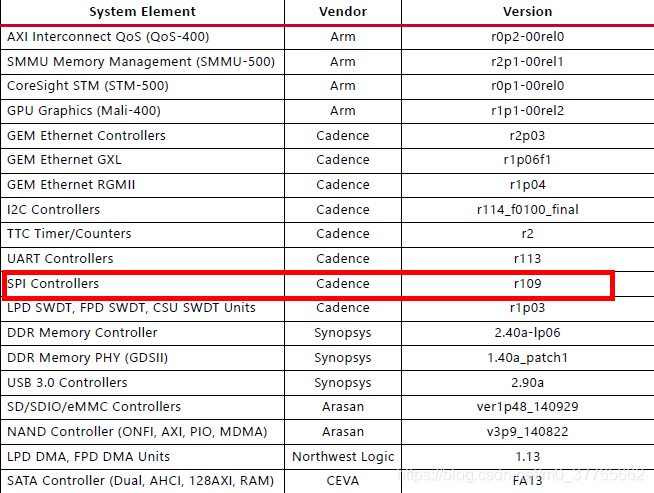
SPI主机控制器是具有特定属性的,这个主要看处理器上搭载的是哪个公司生产的SPI控制器,针对zynq中可以在其datasheet中找到其SPI控制器是cadence公司的,那么在内核中必然会存在cadence控制器的驱动程序(如果某个芯片在linux内核驱动中没有对应的驱动程序,那就说明这个芯片太小众了,估计后续技术支持也跟不上)
SPI核心是通用文件,一方面对SPI子系统进行初始化工作,注册spi bus,注册spi_master class,同时提供spi设备驱动对spi总线进行操作的API。SPI设备驱动包含的种类较多,可以是FLASH驱动、RTC驱动等等,通常对于应用程序来说,在应用层中直接操作设备的file_operation的接口,根本不需要关心SPI总线是如何工作的,这就能很好的将主机与设备进行隔离。
那有人要说了,我就想用个SPI去发个数据,那怎么办呢?当然,linux内核也可以将主机控制器实现为一个字符设备spidev,这是一个通用的SPI设备文件,应用程序可直接利用spidev来控制SPI主机控制器来产生时序信号,实现对SPI设备的访问。
在linux内核源码里,SPI核心是由\drivers\spi\spi.c来实现的,主机控制器程序是由\drivers\spi\spi-cadence.c来实现的,字符设备spidev由\drivers\spi\spidev.c实现。下面,我们以spidev.c、spi.c、spi-cadence.c这三个文件来分析SPI的总线驱动模型。
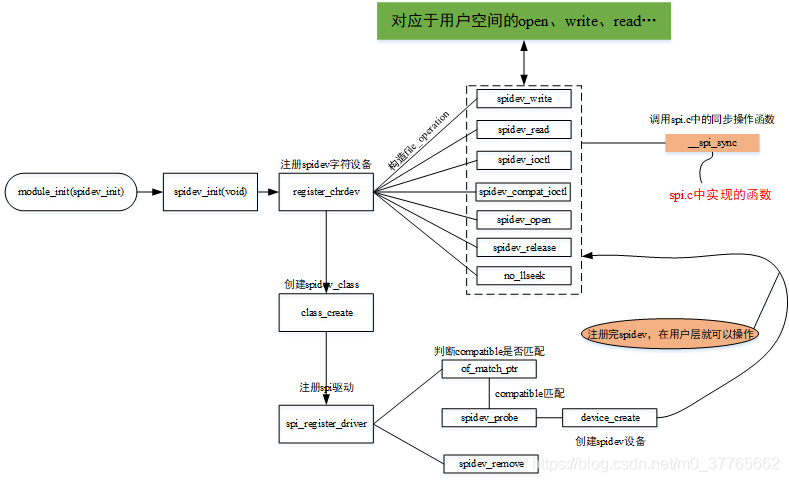
首先,我们看看这个spidev.c文件,我们可以先猜猜这个文件是干啥的?首先它是一个字符设备,那么必然满足字符设备的框架(注册设备、构造file_operation结构体、提供给虚拟文件系统的open、read、write函数接口)。
#include
#include
#include
#include
#include
#include
#include
#include
#include
#include
#include
#include
#include
#include #include
#include #include #define SPIDEV_MAJOR			153	/* assigned */
#define N_SPI_MINORS			32	/* ... up to 256 */static DECLARE_BITMAP(minors, N_SPI_MINORS);#define SPI_MODE_MASK		(SPI_CPHA | SPI_CPOL | SPI_CS_HIGH \| SPI_LSB_FIRST | SPI_3WIRE | SPI_LOOP \| SPI_NO_CS | SPI_READY | SPI_TX_DUAL \| SPI_TX_QUAD | SPI_RX_DUAL | SPI_RX_QUAD)struct spidev_data {                        //spidev的结构体dev_t			devt;spinlock_t		spi_lock;struct spi_device	*spi;struct list_head	device_entry;struct mutex		buf_lock;unsigned		users;u8			*tx_buffer;u8			*rx_buffer;u32			speed_hz;
};static LIST_HEAD(device_list);
static DEFINE_MUTEX(device_list_lock);static unsigned bufsiz = 4096;
module_param(bufsiz, uint, S_IRUGO);
MODULE_PARM_DESC(bufsiz, "data bytes in biggest supported SPI message");/*------------------------spidev的同步操作-----------------------------*/
static ssize_t spidev_sync(struct spidev_data *spidev, struct spi_message *message)
{DECLARE_COMPLETION_ONSTACK(done);int status;struct spi_device *spi;spin_lock_irq(&spidev->spi_lock);spi = spidev->spi;spin_unlock_irq(&spidev->spi_lock);if (spi == NULL)status = -ESHUTDOWN;elsestatus = spi_sync(spi, message);		/*调用spi.c中的函数,进行同步操作*/if (status == 0)status = message->actual_length;return status;
}/*------------------------spidev同步写操作-----------------------------*/
static inline ssize_t
spidev_sync_write(struct spidev_data *spidev, size_t len)
{struct spi_transfer	t = {.tx_buf		= spidev->tx_buffer,.len		= len,.speed_hz	= spidev->speed_hz,};struct spi_message	m;spi_message_init(&m);spi_message_add_tail(&t, &m);return spidev_sync(spidev, &m);
}/*------------------------spidev同步读操作-----------------------------*/
static inline ssize_t
spidev_sync_read(struct spidev_data *spidev, size_t len)
{struct spi_transfer	t = {.rx_buf		= spidev->rx_buffer,.len		= len,.speed_hz	= spidev->speed_hz,};struct spi_message	m;spi_message_init(&m);spi_message_add_tail(&t, &m);return spidev_sync(spidev, &m);
}/*------------------------spidev只读-----------------------------*/
/* Read-only message with current device setup */
static ssize_t
spidev_read(struct file *filp, char __user *buf, size_t count, loff_t *f_pos)
/*spidev读操作(只读模式),,对应于用户空间的read函数*/
{struct spidev_data	*spidev;ssize_t			status = 0;/* chipselect only toggles at start or end of operation */if (count > bufsiz)return -EMSGSIZE;spidev = filp->private_data;mutex_lock(&spidev->buf_lock);status = spidev_sync_read(spidev, count);		/*spidev同步读操作*/if (status > 0) {unsigned long	missing;missing = copy_to_user(buf, spidev->rx_buffer, status);			/*将读回来的数返回给用户空间*/if (missing == status)status = -EFAULT;elsestatus = status - missing;}mutex_unlock(&spidev->buf_lock);return status;
}/*------------------------spidev只写-----------------------------*/
/* Write-only message with current device setup */
static ssize_t
spidev_write(struct file *filp, const char __user *buf,
/*spidev写操作(只写模式),对应于用户空间的write函数*/size_t count, loff_t *f_pos)
{struct spidev_data	*spidev;ssize_t			status = 0;unsigned long		missing;/* chipselect only toggles at start or end of operation */if (count > bufsiz)return -EMSGSIZE;spidev = filp->private_data;mutex_lock(&spidev->buf_lock);missing = copy_from_user(spidev->tx_buffer, buf, count);	/*将用户空间中写入spidev的数据拷贝到内核空间*/if (missing == 0)status = spidev_sync_write(spidev, count);		/*进行同步写操作*/elsestatus = -EFAULT;mutex_unlock(&spidev->buf_lock);return status;
}/*------------------------spidev读写操作-----------------------------*/
static int spidev_message(struct spidev_data *spidev,		/*启动spidev的数据传输,相当于写一次读一次*/struct spi_ioc_transfer *u_xfers, unsigned n_xfers)
{struct spi_message	msg;struct spi_transfer	*k_xfers;struct spi_transfer	*k_tmp;struct spi_ioc_transfer *u_tmp;unsigned		n, total, tx_total, rx_total;u8			*tx_buf, *rx_buf;int			status = -EFAULT;spi_message_init(&msg);k_xfers = kcalloc(n_xfers, sizeof(*k_tmp), GFP_KERNEL);if (k_xfers == NULL)return -ENOMEM;/* Construct spi_message, copying any tx data to bounce buffer.* We walk the array of user-provided transfers, using each one* to initialize a kernel version of the same transfer.*/tx_buf = spidev->tx_buffer;rx_buf = spidev->rx_buffer;total = 0;tx_total = 0;rx_total = 0;for (n = n_xfers, k_tmp = k_xfers, u_tmp = u_xfers;n;n--, k_tmp++, u_tmp++) {k_tmp->len = u_tmp->len;total += k_tmp->len;/* Since the function returns the total length of transfers* on success, restrict the total to positive int values to* avoid the return value looking like an error.  Also check* each transfer length to avoid arithmetic overflow.*/if (total > INT_MAX || k_tmp->len > INT_MAX) {status = -EMSGSIZE;goto done;}if (u_tmp->rx_buf) {/* this transfer needs space in RX bounce buffer */rx_total += k_tmp->len;if (rx_total > bufsiz) {status = -EMSGSIZE;goto done;}k_tmp->rx_buf = rx_buf;if (!access_ok(VERIFY_WRITE, (u8 __user *)(uintptr_t) u_tmp->rx_buf,u_tmp->len))goto done;rx_buf += k_tmp->len;}if (u_tmp->tx_buf) {/* this transfer needs space in TX bounce buffer */tx_total += k_tmp->len;if (tx_total > bufsiz) {status = -EMSGSIZE;goto done;}k_tmp->tx_buf = tx_buf;if (copy_from_user(tx_buf, (const u8 __user *)(uintptr_t) u_tmp->tx_buf,u_tmp->len))goto done;tx_buf += k_tmp->len;}k_tmp->cs_change = !!u_tmp->cs_change;k_tmp->tx_nbits = u_tmp->tx_nbits;k_tmp->rx_nbits = u_tmp->rx_nbits;k_tmp->bits_per_word = u_tmp->bits_per_word;k_tmp->delay_usecs = u_tmp->delay_usecs;k_tmp->speed_hz = u_tmp->speed_hz;if (!k_tmp->speed_hz)k_tmp->speed_hz = spidev->speed_hz;
#ifdef VERBOSEdev_dbg(&spidev->spi->dev,"  xfer len %u %s%s%s%dbits %u usec %uHz\n",u_tmp->len,u_tmp->rx_buf ? "rx " : "",u_tmp->tx_buf ? "tx " : "",u_tmp->cs_change ? "cs " : "",u_tmp->bits_per_word ? : spidev->spi->bits_per_word,u_tmp->delay_usecs,u_tmp->speed_hz ? : spidev->spi->max_speed_hz);
#endifspi_message_add_tail(k_tmp, &msg);}status = spidev_sync(spidev, &msg);if (status < 0)goto done;/* copy any rx data out of bounce buffer */rx_buf = spidev->rx_buffer;for (n = n_xfers, u_tmp = u_xfers; n; n--, u_tmp++) {if (u_tmp->rx_buf) {if (__copy_to_user((u8 __user *)(uintptr_t) u_tmp->rx_buf, rx_buf,u_tmp->len)) {status = -EFAULT;goto done;}rx_buf += u_tmp->len;}}status = total;done:kfree(k_xfers);return status;
}/*------------------------获取用户空间的ioc消息体-----------------------------*/
static struct spi_ioc_transfer *
spidev_get_ioc_message(unsigned int cmd, struct spi_ioc_transfer __user *u_ioc,unsigned *n_ioc)
{struct spi_ioc_transfer	*ioc;u32	tmp;/* Check type, command number and direction */if (_IOC_TYPE(cmd) != SPI_IOC_MAGIC|| _IOC_NR(cmd) != _IOC_NR(SPI_IOC_MESSAGE(0))|| _IOC_DIR(cmd) != _IOC_WRITE)return ERR_PTR(-ENOTTY);tmp = _IOC_SIZE(cmd);if ((tmp % sizeof(struct spi_ioc_transfer)) != 0)return ERR_PTR(-EINVAL);*n_ioc = tmp / sizeof(struct spi_ioc_transfer);if (*n_ioc == 0)return NULL;/* copy into scratch area */ioc = kmalloc(tmp, GFP_KERNEL);if (!ioc)return ERR_PTR(-ENOMEM);if (__copy_from_user(ioc, u_ioc, tmp)) {kfree(ioc);return ERR_PTR(-EFAULT);}return ioc;
}/*------------------------spi_ioctl函数,对应于用户空间的ioctl函数-----------------------------*/
static long
spidev_ioctl(struct file *filp, unsigned int cmd, unsigned long arg)
{int			err = 0;int			retval = 0;struct spidev_data	*spidev;struct spi_device	*spi;u32			tmp;unsigned		n_ioc;struct spi_ioc_transfer	*ioc;/* Check type and command number */if (_IOC_TYPE(cmd) != SPI_IOC_MAGIC)return -ENOTTY;/* Check access direction once here; don't repeat below.* IOC_DIR is from the user perspective, while access_ok is* from the kernel perspective; so they look reversed.*/if (_IOC_DIR(cmd) & _IOC_READ)err = !access_ok(VERIFY_WRITE,(void __user *)arg, _IOC_SIZE(cmd));if (err == 0 && _IOC_DIR(cmd) & _IOC_WRITE)err = !access_ok(VERIFY_READ,(void __user *)arg, _IOC_SIZE(cmd));if (err)return -EFAULT;/* guard against device removal before, or while,* we issue this ioctl.*/spidev = filp->private_data;spin_lock_irq(&spidev->spi_lock);spi = spi_dev_get(spidev->spi);spin_unlock_irq(&spidev->spi_lock);if (spi == NULL)return -ESHUTDOWN;/* use the buffer lock here for triple duty:*  - prevent I/O (from us) so calling spi_setup() is safe;*  - prevent concurrent SPI_IOC_WR_* from morphing*    data fields while SPI_IOC_RD_* reads them;*  - SPI_IOC_MESSAGE needs the buffer locked "normally".*/mutex_lock(&spidev->buf_lock);switch (cmd) {			/*判断ioctl传入的命令*//* read requests */case SPI_IOC_RD_MODE:retval = __put_user(spi->mode & SPI_MODE_MASK,(__u8 __user *)arg);break;case SPI_IOC_RD_MODE32:retval = __put_user(spi->mode & SPI_MODE_MASK,(__u32 __user *)arg);break;case SPI_IOC_RD_LSB_FIRST:retval = __put_user((spi->mode & SPI_LSB_FIRST) ?  1 : 0,(__u8 __user *)arg);break;case SPI_IOC_RD_BITS_PER_WORD:retval = __put_user(spi->bits_per_word, (__u8 __user *)arg);break;case SPI_IOC_RD_MAX_SPEED_HZ:retval = __put_user(spidev->speed_hz, (__u32 __user *)arg);break;/* write requests */case SPI_IOC_WR_MODE:case SPI_IOC_WR_MODE32:if (cmd == SPI_IOC_WR_MODE)retval = __get_user(tmp, (u8 __user *)arg);elseretval = __get_user(tmp, (u32 __user *)arg);if (retval == 0) {u32	save = spi->mode;if (tmp & ~SPI_MODE_MASK) {retval = -EINVAL;break;}tmp |= spi->mode & ~SPI_MODE_MASK;spi->mode = (u16)tmp;retval = spi_setup(spi);if (retval < 0)spi->mode = save;elsedev_dbg(&spi->dev, "spi mode %x\n", tmp);}break;case SPI_IOC_WR_LSB_FIRST:retval = __get_user(tmp, (__u8 __user *)arg);if (retval == 0) {u32	save = spi->mode;if (tmp)spi->mode |= SPI_LSB_FIRST;elsespi->mode &= ~SPI_LSB_FIRST;retval = spi_setup(spi);if (retval < 0)spi->mode = save;elsedev_dbg(&spi->dev, "%csb first\n",tmp ? 'l' : 'm');}break;case SPI_IOC_WR_BITS_PER_WORD:retval = __get_user(tmp, (__u8 __user *)arg);if (retval == 0) {u8	save = spi->bits_per_word;spi->bits_per_word = tmp;retval = spi_setup(spi);if (retval < 0)spi->bits_per_word = save;elsedev_dbg(&spi->dev, "%d bits per word\n", tmp);}break;case SPI_IOC_WR_MAX_SPEED_HZ:retval = __get_user(tmp, (__u32 __user *)arg);if (retval == 0) {u32	save = spi->max_speed_hz;spi->max_speed_hz = tmp;retval = spi_setup(spi);if (retval >= 0)spidev->speed_hz = tmp;elsedev_dbg(&spi->dev, "%d Hz (max)\n", tmp);spi->max_speed_hz = save;}break;default:					/*执行一次发送*//* segmented and/or full-duplex I/O request *//* Check message and copy into scratch area */ioc = spidev_get_ioc_message(cmd,(struct spi_ioc_transfer __user *)arg, &n_ioc);if (IS_ERR(ioc)) {retval = PTR_ERR(ioc);break;}if (!ioc)break;	/* n_ioc is also 0 *//* translate to spi_message, execute */retval = spidev_message(spidev, ioc, n_ioc);kfree(ioc);break;}mutex_unlock(&spidev->buf_lock);spi_dev_put(spi);return retval;
}#ifdef CONFIG_COMPAT
static long
spidev_compat_ioc_message(struct file *filp, unsigned int cmd,unsigned long arg)
{struct spi_ioc_transfer __user	*u_ioc;int				retval = 0;struct spidev_data		*spidev;struct spi_device		*spi;unsigned			n_ioc, n;struct spi_ioc_transfer		*ioc;u_ioc = (struct spi_ioc_transfer __user *) compat_ptr(arg);if (!access_ok(VERIFY_READ, u_ioc, _IOC_SIZE(cmd)))return -EFAULT;/* guard against device removal before, or while,* we issue this ioctl.*/spidev = filp->private_data;spin_lock_irq(&spidev->spi_lock);spi = spi_dev_get(spidev->spi);spin_unlock_irq(&spidev->spi_lock);if (spi == NULL)return -ESHUTDOWN;/* SPI_IOC_MESSAGE needs the buffer locked "normally" */mutex_lock(&spidev->buf_lock);/* Check message and copy into scratch area */ioc = spidev_get_ioc_message(cmd, u_ioc, &n_ioc);if (IS_ERR(ioc)) {retval = PTR_ERR(ioc);goto done;}if (!ioc)goto done;	/* n_ioc is also 0 *//* Convert buffer pointers */for (n = 0; n < n_ioc; n++) {ioc[n].rx_buf = (uintptr_t) compat_ptr(ioc[n].rx_buf);ioc[n].tx_buf = (uintptr_t) compat_ptr(ioc[n].tx_buf);}/* translate to spi_message, execute */retval = spidev_message(spidev, ioc, n_ioc);kfree(ioc);done:mutex_unlock(&spidev->buf_lock);spi_dev_put(spi);return retval;
}static long
spidev_compat_ioctl(struct file *filp, unsigned int cmd, unsigned long arg)
{if (_IOC_TYPE(cmd) == SPI_IOC_MAGIC&& _IOC_NR(cmd) == _IOC_NR(SPI_IOC_MESSAGE(0))&& _IOC_DIR(cmd) == _IOC_WRITE)return spidev_compat_ioc_message(filp, cmd, arg);return spidev_ioctl(filp, cmd, (unsigned long)compat_ptr(arg));
}
#else
#define spidev_compat_ioctl NULL
#endif /* CONFIG_COMPAT *//*------------------------打开spidev设备-----------------------------*/
static int spidev_open(struct inode *inode, struct file *filp)
{struct spidev_data	*spidev;int			status = -ENXIO;mutex_lock(&device_list_lock);list_for_each_entry(spidev, &device_list, device_entry) {if (spidev->devt == inode->i_rdev) {status = 0;break;}}if (status) {pr_debug("spidev: nothing for minor %d\n", iminor(inode));goto err_find_dev;}if (!spidev->tx_buffer) {spidev->tx_buffer = kmalloc(bufsiz, GFP_KERNEL);/*从内核中分配一块内存给tx_buffer*/if (!spidev->tx_buffer) {dev_dbg(&spidev->spi->dev, "open/ENOMEM\n");status = -ENOMEM;goto err_find_dev;}}if (!spidev->rx_buffer) {spidev->rx_buffer = kmalloc(bufsiz, GFP_KERNEL);/*从内核中分配一块内存给rx_buffer*/if (!spidev->rx_buffer) {dev_dbg(&spidev->spi->dev, "open/ENOMEM\n");status = -ENOMEM;goto err_alloc_rx_buf;}}spidev->users++;filp->private_data = spidev;nonseekable_open(inode, filp);		/*不需要可搜索文件描述符的子系统使用它*/mutex_unlock(&device_list_lock);return 0;err_alloc_rx_buf:kfree(spidev->tx_buffer);spidev->tx_buffer = NULL;
err_find_dev:mutex_unlock(&device_list_lock);return status;
}/*------------------------释放spidev设备-----------------------------*/
static int spidev_release(struct inode *inode, struct file *filp)
{struct spidev_data	*spidev;mutex_lock(&device_list_lock);spidev = filp->private_data;filp->private_data = NULL;/* last close? */spidev->users--;if (!spidev->users) {int		dofree;kfree(spidev->tx_buffer);spidev->tx_buffer = NULL;kfree(spidev->rx_buffer);spidev->rx_buffer = NULL;spin_lock_irq(&spidev->spi_lock);if (spidev->spi)spidev->speed_hz = spidev->spi->max_speed_hz;/* ... after we unbound from the underlying device? */dofree = (spidev->spi == NULL);spin_unlock_irq(&spidev->spi_lock);if (dofree)kfree(spidev);}mutex_unlock(&device_list_lock);return 0;
}/*-------------------------------------构造file_operation结构体------------------------------------*/
static const struct file_operations spidev_fops = {			.owner =	THIS_MODULE,/* REVISIT switch to aio primitives, so that userspace* gets more complete API coverage.  It'll simplify things* too, except for the locking.*/.write =	spidev_write,.read =		spidev_read,.unlocked_ioctl = spidev_ioctl,.compat_ioctl = spidev_compat_ioctl,.open =		spidev_open,.release =	spidev_release,.llseek =	no_llseek,
};/*-------------------------------------------------------------------------*//* The main reason to have this class is to make mdev/udev create the* /dev/spidevB.C character device nodes exposing our userspace API.* It also simplifies memory management.*/static struct class *spidev_class;#ifdef CONFIG_OF
static const struct of_device_id spidev_dt_ids[] = {	//驱动程序的可匹配的设备列表{ .compatible = "rohm,dh2228fv" },{ .compatible = "lineartechnology,ltc2488" },{ .compatible = "foocorp,modem" },{},
};
MODULE_DEVICE_TABLE(of, spidev_dt_ids);
#endif#ifdef CONFIG_ACPI/* Dummy SPI devices not to be used in production systems */
#define SPIDEV_ACPI_DUMMY	1static const struct acpi_device_id spidev_acpi_ids[] = {/** The ACPI SPT000* devices are only meant for development and* testing. Systems used in production should have a proper ACPI* description of the connected peripheral and they should also use* a proper driver instead of poking directly to the SPI bus.*/{ "SPT0001", SPIDEV_ACPI_DUMMY },{ "SPT0002", SPIDEV_ACPI_DUMMY },{ "SPT0003", SPIDEV_ACPI_DUMMY },{},
};
MODULE_DEVICE_TABLE(acpi, spidev_acpi_ids);static void spidev_probe_acpi(struct spi_device *spi)
{const struct acpi_device_id *id;if (!has_acpi_companion(&spi->dev))return;id = acpi_match_device(spidev_acpi_ids, &spi->dev);if (WARN_ON(!id))return;if (id->driver_data == SPIDEV_ACPI_DUMMY)dev_warn(&spi->dev, "do not use this driver in production systems!\n");
}
#else
static inline void spidev_probe_acpi(struct spi_device *spi) {}
#endif/*-------------------------------------------------------------------------*/
static int spidev_probe(struct spi_device *spi)		/*spidev初始化函数*/
{struct spidev_data	*spidev;int			status;unsigned long		minor;/** spidev should never be referenced in DT without a specific* compatible string, it is a Linux implementation thing* rather than a description of the hardware.*/if (spi->dev.of_node && !of_match_device(spidev_dt_ids, &spi->dev)) {			/*判断设备树中有没有匹配的字符串*/dev_err(&spi->dev, "buggy DT: spidev listed directly in DT\n");WARN_ON(spi->dev.of_node &&!of_match_device(spidev_dt_ids, &spi->dev));}spidev_probe_acpi(spi);			/*高级配置和电源管理接口*//* Allocate driver data */spidev = kzalloc(sizeof(*spidev), GFP_KERNEL);	/*从内核中分配一个spidev_data结构体*/if (!spidev)return -ENOMEM;/* Initialize the driver data */spidev->spi = spi;spin_lock_init(&spidev->spi_lock);mutex_init(&spidev->buf_lock);INIT_LIST_HEAD(&spidev->device_entry);/* If we can allocate a minor number, hook up this device.* Reusing minors is fine so long as udev or mdev is working.*/mutex_lock(&device_list_lock);minor = find_first_zero_bit(minors, N_SPI_MINORS);	/*查找一个可用的次设备号*/if (minor < N_SPI_MINORS) {struct device *dev;spidev->devt = MKDEV(SPIDEV_MAJOR, minor);dev = device_create(spidev_class, &spi->dev, spidev->devt,	/*创建spidev设备*/spidev, "spidev%d.%d",spi->master->bus_num, spi->chip_select);status = PTR_ERR_OR_ZERO(dev);} else {dev_dbg(&spi->dev, "no minor number available!\n");status = -ENODEV;}if (status == 0) {set_bit(minor, minors);list_add(&spidev->device_entry, &device_list);}mutex_unlock(&device_list_lock);spidev->speed_hz = spi->max_speed_hz;if (status == 0)spi_set_drvdata(spi, spidev);elsekfree(spidev);return status;
}static int spidev_remove(struct spi_device *spi)	/*spidev移除函数*/
{struct spidev_data	*spidev = spi_get_drvdata(spi);/* make sure ops on existing fds can abort cleanly */spin_lock_irq(&spidev->spi_lock);spidev->spi = NULL;spin_unlock_irq(&spidev->spi_lock);/* prevent new opens */mutex_lock(&device_list_lock);list_del(&spidev->device_entry);device_destroy(spidev_class, spidev->devt);	/*从spidev_class删除spidev*/clear_bit(MINOR(spidev->devt), minors);		/*清除当前spidev的次设备号*/if (spidev->users == 0)kfree(spidev);mutex_unlock(&device_list_lock);return 0;
}static struct spi_driver spidev_spi_driver = {.driver = {.name =		"spidev",.of_match_table = of_match_ptr(spidev_dt_ids),.acpi_match_table = ACPI_PTR(spidev_acpi_ids),},.probe =	spidev_probe,.remove =	spidev_remove,/* NOTE:  suspend/resume methods are not necessary here.* We don't do anything except pass the requests to/from* the underlying controller.  The refrigerator handles* most issues; the controller driver handles the rest.*/
};/*-------------------------------------------------------------------------*/static int __init spidev_init(void)
{int status;/* Claim our 256 reserved device numbers.  Then register a class* that will key udev/mdev to add/remove /dev nodes.  Last, register* the driver which manages those device numbers.*/BUILD_BUG_ON(N_SPI_MINORS > 256);status = register_chrdev(SPIDEV_MAJOR, "spi", &spidev_fops);/*注册spidev字符设备*/if (status < 0)return status;spidev_class = class_create(THIS_MODULE, "spidev");	/*创建spidev_class,并将spidev注册到内核中*/if (IS_ERR(spidev_class)) {unregister_chrdev(SPIDEV_MAJOR, spidev_spi_driver.driver.name);return PTR_ERR(spidev_class);}status = spi_register_driver(&spidev_spi_driver);	/*注册spi驱动*/if (status < 0) {class_destroy(spidev_class);unregister_chrdev(SPIDEV_MAJOR, spidev_spi_driver.driver.name);}return status;
}
module_init(spidev_init);			//作为模块加载进内核static void __exit spidev_exit(void)
{spi_unregister_driver(&spidev_spi_driver);class_destroy(spidev_class);unregister_chrdev(SPIDEV_MAJOR, spidev_spi_driver.driver.name);
}
module_exit(spidev_exit);			//从内核卸载该模块MODULE_AUTHOR("Andrea Paterniani, ");//模块声明
MODULE_DESCRIPTION("User mode SPI device interface");
MODULE_LICENSE("GPL");
MODULE_ALIAS("spi:spidev");
spidev.c文件中包含有841行代码,那么我们应该怎么看这个代码呢?其实要想初步了解下各个函数的意思还是比较简单的,我们顺着内核模块加载的思路去分析下代码。
当驱动编译好要insmod进内核时,执行的就是module_init(spidev_init),有加载必然有卸载函数,卸载时就执行module_exit(spidev_exit)。那么我们从module_init(spidev_init)来分析:
下面我们看看spi-cadence.c
/** Cadence SPI controller driver (master mode only)** Copyright (C) 2008 - 2014 Xilinx, Inc.** based on Blackfin On-Chip SPI Driver (spi_bfin5xx.c)** This program is free software; you can redistribute it and/or modify it under* the terms of the GNU General Public License version 2 as published by the* Free Software Foundation; either version 2 of the License, or (at your* option) any later version.*/#include
#include
#include
#include
#include
#include
#include
#include
#include
#include /* Name of this driver */
#define CDNS_SPI_NAME		"cdns-spi"/* Register offset definitions */
#define CDNS_SPI_CR	0x00 /* Configuration  Register, RW */
#define CDNS_SPI_ISR	0x04 /* Interrupt Status Register, RO */
#define CDNS_SPI_IER	0x08 /* Interrupt Enable Register, WO */
#define CDNS_SPI_IDR	0x0c /* Interrupt Disable Register, WO */
#define CDNS_SPI_IMR	0x10 /* Interrupt Enabled Mask Register, RO */
#define CDNS_SPI_ER	0x14 /* Enable/Disable Register, RW */
#define CDNS_SPI_DR	0x18 /* Delay Register, RW */
#define CDNS_SPI_TXD	0x1C /* Data Transmit Register, WO */
#define CDNS_SPI_RXD	0x20 /* Data Receive Register, RO */
#define CDNS_SPI_SICR	0x24 /* Slave Idle Count Register, RW */
#define CDNS_SPI_THLD	0x28 /* Transmit FIFO Watermark Register,RW */#define SPI_AUTOSUSPEND_TIMEOUT		3000
/** SPI Configuration Register bit Masks** This register contains various control bits that affect the operation* of the SPI controller*/
#define CDNS_SPI_CR_MANSTRT	0x00010000 /* Manual TX Start */
#define CDNS_SPI_CR_CPHA		0x00000004 /* Clock Phase Control */
#define CDNS_SPI_CR_CPOL		0x00000002 /* Clock Polarity Control */
#define CDNS_SPI_CR_SSCTRL		0x00003C00 /* Slave Select Mask */
#define CDNS_SPI_CR_PERI_SEL	0x00000200 /* Peripheral Select Decode */
#define CDNS_SPI_CR_BAUD_DIV	0x00000038 /* Baud Rate Divisor Mask */
#define CDNS_SPI_CR_MSTREN		0x00000001 /* Master Enable Mask */
#define CDNS_SPI_CR_MANSTRTEN	0x00008000 /* Manual TX Enable Mask */
#define CDNS_SPI_CR_SSFORCE	0x00004000 /* Manual SS Enable Mask */
#define CDNS_SPI_CR_BAUD_DIV_4	0x00000008 /* Default Baud Div Mask */
#define CDNS_SPI_CR_DEFAULT	(CDNS_SPI_CR_MSTREN | \CDNS_SPI_CR_SSCTRL | \CDNS_SPI_CR_BAUD_DIV_4)
//	CDNS_SPI_CR_SSFORCE | \/** SPI Configuration Register - Baud rate and slave select** These are the values used in the calculation of baud rate divisor and* setting the slave select.*/#define CDNS_SPI_BAUD_DIV_MAX		7 /* Baud rate divisor maximum */
#define CDNS_SPI_BAUD_DIV_MIN		1 /* Baud rate divisor minimum */
#define CDNS_SPI_BAUD_DIV_SHIFT		3 /* Baud rate divisor shift in CR */
#define CDNS_SPI_SS_SHIFT		10 /* Slave Select field shift in CR */
#define CDNS_SPI_SS0			0x1 /* Slave Select zero *//** SPI Interrupt Registers bit Masks** All the four interrupt registers (Status/Mask/Enable/Disable) have the same* bit definitions.*/
#define CDNS_SPI_IXR_TXOW	0x00000004 /* SPI TX FIFO Overwater */
#define CDNS_SPI_IXR_MODF	0x00000002 /* SPI Mode Fault */
#define CDNS_SPI_IXR_RXNEMTY 0x00000010 /* SPI RX FIFO Not Empty */
#define CDNS_SPI_IXR_DEFAULT	(CDNS_SPI_IXR_TXOW | \CDNS_SPI_IXR_MODF)
#define CDNS_SPI_IXR_TXFULL	0x00000008 /* SPI TX Full */
#define CDNS_SPI_IXR_ALL	0x0000007F /* SPI all interrupts *//** SPI Enable Register bit Masks** This register is used to enable or disable the SPI controller*/
#define CDNS_SPI_ER_ENABLE	0x00000001 /* SPI Enable Bit Mask */
#define CDNS_SPI_ER_DISABLE	0x0 /* SPI Disable Bit Mask *//* SPI FIFO depth in bytes */
#define CDNS_SPI_FIFO_DEPTH	128/* Default number of chip select lines */
#define CDNS_SPI_DEFAULT_NUM_CS		4/*** struct cdns_spi - This definition defines spi driver instance* @regs:		Virtual address of the SPI controller registers* @ref_clk:		Pointer to the peripheral clock* @pclk:		Pointer to the APB clock* @speed_hz:		Current SPI bus clock speed in Hz* @txbuf:		Pointer	to the TX buffer* @rxbuf:		Pointer to the RX buffer* @tx_bytes:		Number of bytes left to transfer* @rx_bytes:		Number of bytes requested* @dev_busy:		Device busy flag* @is_decoded_cs:	Flag for decoder property set or not*/
struct cdns_spi {			/*定义cadence_spi驱动结构体,一个结构体就是一个对象*/void __iomem *regs;struct clk *ref_clk;struct clk *pclk;u32 speed_hz;const u8 *txbuf;u8 *rxbuf;int tx_bytes;int rx_bytes;u8 dev_busy;u32 is_decoded_cs;
};/* Macros for the SPI controller read/write */
static inline u32 cdns_spi_read(struct cdns_spi *xspi, u32 offset)/*cadence_spi读寄存器*/
{return readl_relaxed(xspi->regs + offset);
}static inline void cdns_spi_write(struct cdns_spi *xspi, u32 offset, u32 val)/*cadence_spi写寄存器*/
{writel_relaxed(val, xspi->regs + offset);
}/*** cdns_spi_init_hw - Initialize the hardware and configure the SPI controller* @xspi:	Pointer to the cdns_spi structure** On reset the SPI controller is configured to be in master mode, baud rate* divisor is set to 4, threshold value for TX FIFO not full interrupt is set* to 1 and size of the word to be transferred as 8 bit.* This function initializes the SPI controller to disable and clear all the* interrupts, enable manual slave select and manual start, deselect all the* chip select lines, and enable the SPI controller.*/
static void cdns_spi_init_hw(struct cdns_spi *xspi)/*初始化cadence spi控制器*/
{u32 ctrl_reg = CDNS_SPI_CR_DEFAULT;	/*控制寄存器默认为:主机模式使能、无外设被片选、手动片选使能、4分频*/if (xspi->is_decoded_cs)ctrl_reg |= CDNS_SPI_CR_PERI_SEL;								/*外设片选3-8译码*/cdns_spi_write(xspi, CDNS_SPI_ER, CDNS_SPI_ER_DISABLE);				/*SPI模块去使能*/cdns_spi_write(xspi, CDNS_SPI_IDR, CDNS_SPI_IXR_ALL);				/*去使能中断寄存器*//* Clear the RX FIFO */while (cdns_spi_read(xspi, CDNS_SPI_ISR) & CDNS_SPI_IXR_RXNEMTY)	/*等待中断状态寄存器和rx_fifo被清空*/cdns_spi_read(xspi, CDNS_SPI_RXD);cdns_spi_write(xspi, CDNS_SPI_ISR, CDNS_SPI_IXR_ALL);				/*清空spi中断控制器的状态*/cdns_spi_write(xspi, CDNS_SPI_CR, ctrl_reg);						/*配置控制寄存器*/cdns_spi_write(xspi, CDNS_SPI_ER, CDNS_SPI_ER_ENABLE);				/*使能SPI*/
}/*** cdns_spi_chipselect - Select or deselect the chip select line* @spi:	Pointer to the spi_device structure* @is_high:	Select(0) or deselect (1) the chip select line*/
static void cdns_spi_chipselect(struct spi_device *spi, bool is_high)/*片选操作*/
{struct cdns_spi *xspi = spi_master_get_devdata(spi->master);	/*获取spi->master的相关信息*/u32 ctrl_reg;ctrl_reg = cdns_spi_read(xspi, CDNS_SPI_CR);	/*读spi控制寄存器的值*/if (is_high) {/* Deselect the slave */ctrl_reg |= CDNS_SPI_CR_SSCTRL;		/*不选择该从机*/} else {/* Select the slave */ctrl_reg &= ~CDNS_SPI_CR_SSCTRL;if (!(xspi->is_decoded_cs))			/*是否用3-8译码器来片选*/ctrl_reg |= ((~(CDNS_SPI_SS0 << spi->chip_select)) <chip_select << CDNS_SPI_SS_SHIFT) &CDNS_SPI_CR_SSCTRL;}cdns_spi_write(xspi, CDNS_SPI_CR, ctrl_reg);		/*重新写控制寄存器的片选位*/
}/*** cdns_spi_config_clock_mode - Sets clock polarity and phase* @spi:	Pointer to the spi_device structure** Sets the requested clock polarity and phase.*/
static void cdns_spi_config_clock_mode(struct spi_device *spi)/*配置时钟相位和极性*/
{struct cdns_spi *xspi = spi_master_get_devdata(spi->master);/*获取spi->master的相关信息*/u32 ctrl_reg, new_ctrl_reg;new_ctrl_reg = cdns_spi_read(xspi, CDNS_SPI_CR);ctrl_reg = new_ctrl_reg;/* Set the SPI clock phase and clock polarity */new_ctrl_reg &= ~(CDNS_SPI_CR_CPHA | CDNS_SPI_CR_CPOL);if (spi->mode & SPI_CPHA)new_ctrl_reg |= CDNS_SPI_CR_CPHA;if (spi->mode & SPI_CPOL)new_ctrl_reg |= CDNS_SPI_CR_CPOL;if (new_ctrl_reg != ctrl_reg) {/** Just writing the CR register does not seem to apply the clock* setting changes. This is problematic when changing the clock* polarity as it will cause the SPI slave to see spurious clock* transitions. To workaround the issue toggle the ER register.*/cdns_spi_write(xspi, CDNS_SPI_ER, CDNS_SPI_ER_DISABLE);cdns_spi_write(xspi, CDNS_SPI_CR, new_ctrl_reg);	/*重新写控制寄存器的时钟模式*/cdns_spi_write(xspi, CDNS_SPI_ER, CDNS_SPI_ER_ENABLE);}
}/*** cdns_spi_config_clock_freq - Sets clock frequency* @spi:	Pointer to the spi_device structure* @transfer:	Pointer to the spi_transfer structure which provides*		information about next transfer setup parameters** Sets the requested clock frequency.* Note: If the requested frequency is not an exact match with what can be* obtained using the prescalar value the driver sets the clock frequency which* is lower than the requested frequency (maximum lower) for the transfer. If* the requested frequency is higher or lower than that is supported by the SPI* controller the driver will set the highest or lowest frequency supported by* controller.*/
static void cdns_spi_config_clock_freq(struct spi_device *spi,/*设置SPI时钟频率*/struct spi_transfer *transfer)
{struct cdns_spi *xspi = spi_master_get_devdata(spi->master);u32 ctrl_reg, baud_rate_val;unsigned long frequency;frequency = clk_get_rate(xspi->ref_clk);ctrl_reg = cdns_spi_read(xspi, CDNS_SPI_CR);/* Set the clock frequency */if (xspi->speed_hz != transfer->speed_hz) {/* first valid value is 1 */baud_rate_val = CDNS_SPI_BAUD_DIV_MIN;while ((baud_rate_val < CDNS_SPI_BAUD_DIV_MAX) &&(frequency / (2 << baud_rate_val)) > transfer->speed_hz)baud_rate_val++;ctrl_reg &= ~CDNS_SPI_CR_BAUD_DIV;ctrl_reg |= baud_rate_val << CDNS_SPI_BAUD_DIV_SHIFT;xspi->speed_hz = frequency / (2 << baud_rate_val);}cdns_spi_write(xspi, CDNS_SPI_CR, ctrl_reg);
}/*** cdns_spi_setup_transfer - Configure SPI controller for specified transfer* @spi:	Pointer to the spi_device structure* @transfer:	Pointer to the spi_transfer structure which provides*		information about next transfer setup parameters** Sets the operational mode of SPI controller for the next SPI transfer and* sets the requested clock frequency.** Return:	Always 0*/
static int cdns_spi_setup_transfer(struct spi_device *spi,/*为指定的发送配置SPI控制器*/struct spi_transfer *transfer)
{struct cdns_spi *xspi = spi_master_get_devdata(spi->master);cdns_spi_config_clock_freq(spi, transfer);dev_dbg(&spi->dev, "%s, mode %d, %u bits/w, %u clock speed\n",__func__, spi->mode, spi->bits_per_word,xspi->speed_hz);return 0;
}/*** cdns_spi_fill_tx_fifo - Fills the TX FIFO with as many bytes as possible* @xspi:	Pointer to the cdns_spi structure*/
static void cdns_spi_fill_tx_fifo(struct cdns_spi *xspi)/*向tx_buf中填充数据*/
{unsigned long trans_cnt = 0;while ((trans_cnt < CDNS_SPI_FIFO_DEPTH) &&(xspi->tx_bytes > 0)) {if (xspi->txbuf)cdns_spi_write(xspi, CDNS_SPI_TXD, *xspi->txbuf++);elsecdns_spi_write(xspi, CDNS_SPI_TXD, 0);xspi->tx_bytes--;trans_cnt++;}
}/*** cdns_spi_irq - Interrupt service routine of the SPI controller* @irq:	IRQ number* @dev_id:	Pointer to the xspi structure** This function handles TX empty and Mode Fault interrupts only.* On TX empty interrupt this function reads the received data from RX FIFO and* fills the TX FIFO if there is any data remaining to be transferred.* On Mode Fault interrupt this function indicates that transfer is completed,* the SPI subsystem will identify the error as the remaining bytes to be* transferred is non-zero.** Return:	IRQ_HANDLED when handled; IRQ_NONE otherwise.*/
static irqreturn_t cdns_spi_irq(int irq, void *dev_id)/*SPI控制器中断服务*/
{struct spi_master *master = dev_id;struct cdns_spi *xspi = spi_master_get_devdata(master);u32 intr_status, status;status = IRQ_NONE;intr_status = cdns_spi_read(xspi, CDNS_SPI_ISR);cdns_spi_write(xspi, CDNS_SPI_ISR, intr_status);if (intr_status & CDNS_SPI_IXR_MODF) {/* Indicate that transfer is completed, the SPI subsystem will* identify the error as the remaining bytes to be* transferred is non-zero*/cdns_spi_write(xspi, CDNS_SPI_IDR, CDNS_SPI_IXR_DEFAULT);spi_finalize_current_transfer(master);status = IRQ_HANDLED;} else if (intr_status & CDNS_SPI_IXR_TXOW) {unsigned long trans_cnt;trans_cnt = xspi->rx_bytes - xspi->tx_bytes;/* Read out the data from the RX FIFO */while (trans_cnt) {u8 data;data = cdns_spi_read(xspi, CDNS_SPI_RXD);if (xspi->rxbuf)*xspi->rxbuf++ = data;xspi->rx_bytes--;trans_cnt--;}if (xspi->tx_bytes) {/* There is more data to send */cdns_spi_fill_tx_fifo(xspi);} else {/* Transfer is completed */cdns_spi_write(xspi, CDNS_SPI_IDR,CDNS_SPI_IXR_DEFAULT);spi_finalize_current_transfer(master);}status = IRQ_HANDLED;}return status;
}static int cdns_prepare_message(struct spi_master *master,/*准备发送*/struct spi_message *msg)
{cdns_spi_config_clock_mode(msg->spi);return 0;
}/*** cdns_transfer_one - Initiates the SPI transfer* @master:	Pointer to spi_master structure* @spi:	Pointer to the spi_device structure* @transfer:	Pointer to the spi_transfer structure which provides*		information about next transfer parameters** This function fills the TX FIFO, starts the SPI transfer and* returns a positive transfer count so that core will wait for completion.** Return:	Number of bytes transferred in the last transfer*/
static int cdns_transfer_one(struct spi_master *master,/*初始化SPI发送*/struct spi_device *spi,struct spi_transfer *transfer)
{struct cdns_spi *xspi = spi_master_get_devdata(master);xspi->txbuf = transfer->tx_buf;xspi->rxbuf = transfer->rx_buf;xspi->tx_bytes = transfer->len;xspi->rx_bytes = transfer->len;cdns_spi_setup_transfer(spi, transfer);/*设置SPI时钟频率*/cdns_spi_fill_tx_fifo(xspi);/*向tx_buf中填充数据*/cdns_spi_write(xspi, CDNS_SPI_IER, CDNS_SPI_IXR_DEFAULT);return transfer->len;
}/*** cdns_prepare_transfer_hardware - Prepares hardware for transfer.* @master:	Pointer to the spi_master structure which provides*		information about the controller.** This function enables SPI master controller.** Return:	0 always*/
static int cdns_prepare_transfer_hardware(struct spi_master *master)/*准备硬件去发送*/
{struct cdns_spi *xspi = spi_master_get_devdata(master);cdns_spi_write(xspi, CDNS_SPI_ER, CDNS_SPI_ER_ENABLE);return 0;
}/*** cdns_unprepare_transfer_hardware - Relaxes hardware after transfer* @master:	Pointer to the spi_master structure which provides*		information about the controller.** This function disables the SPI master controller.** Return:	0 always*/
static int cdns_unprepare_transfer_hardware(struct spi_master *master)/*发送完成后释放硬件*/
{struct cdns_spi *xspi = spi_master_get_devdata(master);cdns_spi_write(xspi, CDNS_SPI_ER, CDNS_SPI_ER_DISABLE);return 0;
}/*** cdns_spi_probe - Probe method for the SPI driver* @pdev:	Pointer to the platform_device structure** This function initializes the driver data structures and the hardware.** Return:	0 on success and error value on error*/
static int cdns_spi_probe(struct platform_device *pdev)/*cadence_spi驱动探针函数*/
{int ret = 0, irq;struct spi_master *master;struct cdns_spi *xspi;struct resource *res;u32 num_cs;master = spi_alloc_master(&pdev->dev, sizeof(*xspi));//分配一个SPI主机控制器if (!master)return -ENOMEM;xspi = spi_master_get_devdata(master);master->dev.of_node = pdev->dev.of_node;platform_set_drvdata(pdev, master);res = platform_get_resource(pdev, IORESOURCE_MEM, 0);	//获取设备树中SPI的IO资源xspi->regs = devm_ioremap_resource(&pdev->dev, res);	//对寄存器进行映射if (IS_ERR(xspi->regs)) {ret = PTR_ERR(xspi->regs);goto remove_master;}xspi->pclk = devm_clk_get(&pdev->dev, "pclk");		//获取ARB时钟,用作配置寄存器if (IS_ERR(xspi->pclk)) {dev_err(&pdev->dev, "pclk clock not found.\n");ret = PTR_ERR(xspi->pclk);goto remove_master;}xspi->ref_clk = devm_clk_get(&pdev->dev, "ref_clk");	//获取参考时钟,用作波特率if (IS_ERR(xspi->ref_clk)) {dev_err(&pdev->dev, "ref_clk clock not found.\n");ret = PTR_ERR(xspi->ref_clk);goto remove_master;}ret = clk_prepare_enable(xspi->pclk);			//使能APB时钟if (ret) {dev_err(&pdev->dev, "Unable to enable APB clock.\n");goto remove_master;}ret = clk_prepare_enable(xspi->ref_clk);		//使能参考时钟if (ret) {dev_err(&pdev->dev, "Unable to enable device clock.\n");goto clk_dis_apb;}pm_runtime_use_autosuspend(&pdev->dev);pm_runtime_set_autosuspend_delay(&pdev->dev, SPI_AUTOSUSPEND_TIMEOUT);pm_runtime_set_active(&pdev->dev);pm_runtime_enable(&pdev->dev);ret = of_property_read_u32(pdev->dev.of_node, "num-cs", &num_cs);//获取设备树中num-cs资源if (ret < 0)master->num_chipselect = CDNS_SPI_DEFAULT_NUM_CS;elsemaster->num_chipselect = num_cs;ret = of_property_read_u32(pdev->dev.of_node, "is-decoded-cs",//获取设备树中is-decoded-cs资源&xspi->is_decoded_cs);if (ret < 0)xspi->is_decoded_cs = 0;/* SPI controller initializations */cdns_spi_init_hw(xspi);pm_runtime_mark_last_busy(&pdev->dev);pm_runtime_put_autosuspend(&pdev->dev);irq = platform_get_irq(pdev, 0);//获取设备树中中断资源if (irq <= 0) {ret = -ENXIO;dev_err(&pdev->dev, "irq number is invalid\n");goto clk_dis_all;}ret = devm_request_irq(&pdev->dev, irq, cdns_spi_irq,//向系统申请中断0, pdev->name, master);if (ret != 0) {ret = -ENXIO;dev_err(&pdev->dev, "request_irq failed\n");goto clk_dis_all;}master->prepare_transfer_hardware = cdns_prepare_transfer_hardware;		//使能SPI寄存器master->prepare_message = cdns_prepare_message;							//设置SPI的时钟和相位master->transfer_one = cdns_transfer_one;								//设置波特率master->unprepare_transfer_hardware = cdns_unprepare_transfer_hardware;	//关闭SPI寄存器master->set_cs = cdns_spi_chipselect;									//片选master->auto_runtime_pm = true;master->mode_bits = SPI_CPOL | SPI_CPHA;/* Set to default valid value */master->max_speed_hz = clk_get_rate(xspi->ref_clk) / 4;	//	设置波特率、字长默认值xspi->speed_hz = master->max_speed_hz;master->bits_per_word_mask = SPI_BPW_MASK(8);ret = spi_register_master(master);		//向系统注册SPI主机控制器if (ret) {dev_err(&pdev->dev, "spi_register_master failed\n");goto clk_dis_all;}return ret;clk_dis_all:pm_runtime_set_suspended(&pdev->dev);pm_runtime_disable(&pdev->dev);clk_disable_unprepare(xspi->ref_clk);
clk_dis_apb:clk_disable_unprepare(xspi->pclk);
remove_master:spi_master_put(master);return ret;
}/*** cdns_spi_remove - Remove method for the SPI driver* @pdev:	Pointer to the platform_device structure** This function is called if a device is physically removed from the system or* if the driver module is being unloaded. It frees all resources allocated to* the device.** Return:	0 on success and error value on error*/
static int cdns_spi_remove(struct platform_device *pdev)/*cadence_spi驱动移除*/
{struct spi_master *master = platform_get_drvdata(pdev);struct cdns_spi *xspi = spi_master_get_devdata(master);cdns_spi_write(xspi, CDNS_SPI_ER, CDNS_SPI_ER_DISABLE);clk_disable_unprepare(xspi->ref_clk);clk_disable_unprepare(xspi->pclk);pm_runtime_set_suspended(&pdev->dev);pm_runtime_disable(&pdev->dev);spi_unregister_master(master);return 0;
}/*** cdns_spi_suspend - Suspend method for the SPI driver* @dev:	Address of the platform_device structure** This function disables the SPI controller and* changes the driver state to "suspend"** Return:	0 on success and error value on error*/
static int __maybe_unused cdns_spi_suspend(struct device *dev)/*cadence_spi驱动暂停*/
{struct platform_device *pdev = to_platform_device(dev);struct spi_master *master = platform_get_drvdata(pdev);return spi_master_suspend(master);
}/*** cdns_spi_resume - Resume method for the SPI driver* @dev:	Address of the platform_device structure** This function changes the driver state to "ready"** Return:	0 on success and error value on error*/
static int __maybe_unused cdns_spi_resume(struct device *dev)/*cadence_spi驱动恢复*/
{struct platform_device *pdev = to_platform_device(dev);struct spi_master *master = platform_get_drvdata(pdev);struct cdns_spi *xspi = spi_master_get_devdata(master);cdns_spi_init_hw(xspi);return spi_master_resume(master);
}/*** cdns_spi_runtime_resume - Runtime resume method for the SPI driver* @dev:	Address of the platform_device structure** This function enables the clocks** Return:	0 on success and error value on error*/
static int __maybe_unused cnds_runtime_resume(struct device *dev)/*SPI驱动程序的运行时恢复*/
{struct spi_master *master = dev_get_drvdata(dev);struct cdns_spi *xspi = spi_master_get_devdata(master);int ret;ret = clk_prepare_enable(xspi->pclk);if (ret) {dev_err(dev, "Cannot enable APB clock.\n");return ret;}ret = clk_prepare_enable(xspi->ref_clk);if (ret) {dev_err(dev, "Cannot enable device clock.\n");clk_disable(xspi->pclk);return ret;}return 0;
}/*** cdns_spi_runtime_suspend - Runtime suspend method for the SPI driver* @dev:	Address of the platform_device structure** This function disables the clocks** Return:	Always 0*/
static int __maybe_unused cnds_runtime_suspend(struct device *dev)/*SPI驱动程序的运行时挂起*/
{struct spi_master *master = dev_get_drvdata(dev);struct cdns_spi *xspi = spi_master_get_devdata(master);clk_disable_unprepare(xspi->ref_clk);clk_disable_unprepare(xspi->pclk);return 0;
}static const struct dev_pm_ops cdns_spi_dev_pm_ops = {SET_RUNTIME_PM_OPS(cnds_runtime_suspend,cnds_runtime_resume, NULL)SET_SYSTEM_SLEEP_PM_OPS(cdns_spi_suspend, cdns_spi_resume)
};static const struct of_device_id cdns_spi_of_match[] = {{ .compatible = "xlnx,zynq-spi-r1p6" },{ .compatible = "cdns,spi-r1p6" },{ /* end of table */ }
};
MODULE_DEVICE_TABLE(of, cdns_spi_of_match);/* cdns_spi_driver - This structure defines the SPI subsystem platform driver */
static struct platform_driver cdns_spi_driver = {.probe	= cdns_spi_probe,.remove	= cdns_spi_remove,.driver = {.name = CDNS_SPI_NAME,.of_match_table = cdns_spi_of_match,.pm = &cdns_spi_dev_pm_ops,},
};module_platform_driver(cdns_spi_driver);MODULE_AUTHOR("Xilinx, Inc.");
MODULE_DESCRIPTION("Cadence SPI driver");
MODULE_LICENSE("GPL");
spi-cadence.c文件中包含有548行代码,主要作用就是配置SPI主机控制器的,我们可以顺着module_platform_driver(cdns_spi_driver)往下看:
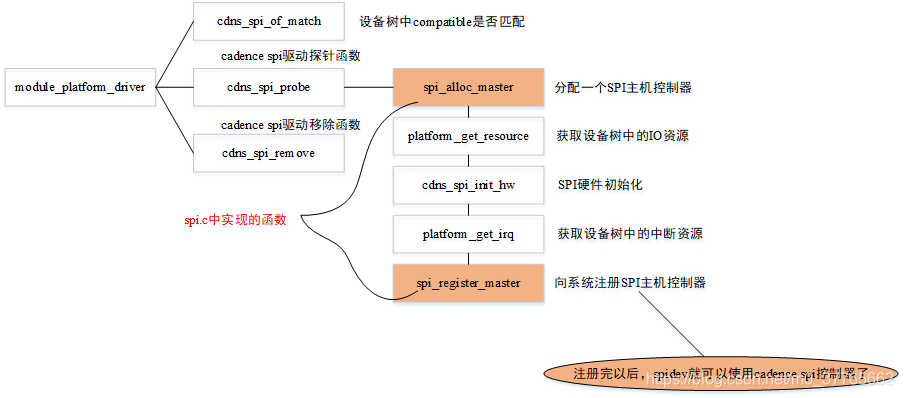
在我们看完上面两个c文件后,明显能看到这两个文件并没有直接调用或者交互的关系,但都跟spi.c有调用关系,所以很显然,spi.c的作用就是让spidev和spi-cadence能够关联起来。
我们可以想一想,这个spi.c需要做哪些工作呢?
| spidev.c | 注册了SPI设备,构造了file_operation结构体 |
| spi-cadence.c | 注册了主机控制器,初始化了主机控制器的硬件 |
| spi.c | ??? |
联想下平台系统驱动的框架:设备-驱动-总线模型,因为SPI总线也是由平台总线派生出来的,所以必然也会遵循这个架构。那么是不是就可以猜测spi.c的作用就是注册SPI总线呢?当然spi.c还有一个作用就是怎么将spidev和spi-cadence连接起来,我们来看看spi.c到底干了啥?
static int __init spi_init(void)
{int	status;buf = kmalloc(SPI_BUFSIZ, GFP_KERNEL);if (!buf) {status = -ENOMEM;goto err0;}status = bus_register(&spi_bus_type);	/*注册spi总线*/if (status < 0)goto err1;status = class_register(&spi_master_class);		/*将spi_master注册到内核中*/if (status < 0)goto err2;if (IS_ENABLED(CONFIG_OF_DYNAMIC))WARN_ON(of_reconfig_notifier_register(&spi_of_notifier));if (IS_ENABLED(CONFIG_ACPI))WARN_ON(acpi_reconfig_notifier_register(&spi_acpi_notifier));return 0;err2:bus_unregister(&spi_bus_type);
err1:kfree(buf);buf = NULL;
err0:return status;
}/* board_info is normally registered in arch_initcall(),* but even essential drivers wait till later** REVISIT only boardinfo really needs static linking. the rest (device and* driver registration) _could_ be dynamically linked (modular) ... costs* include needing to have boardinfo data structures be much more public.*/
postcore_initcall(spi_init);//在moudule_init之前加载
上面这段代码的作用就是向内核注册SPI总线,以及向内核注册spi的主机控制器,只有在spi.c中先注册了主机控制器,在spi-cadence.c中才可以向内核申请一个SPI主机控制器,以及向内核注册;显然,spi-cadence.c与spi.c的联系就建立起来了。而spidev.c与spi.c的联系比较复杂,这块内容留着后面再分析吧。
那么,在我们看完这三个文件后,基本上可以梳理下SPI的驱动是怎么实现的了。
第一步:向内核注册SPI总线以及SPI主机控制器;
第二步:向内核申请一个SPI主机控制器的空间,注册我们要用的主机控制器;
第三步:向内核注册SPI设备,以及构造file_operation结构体;
有了这三步,用户空间就可以通过open、write、read、ioctl函数来操作字符设备spidev了。
本文来自互联网用户投稿,文章观点仅代表作者本人,不代表本站立场,不承担相关法律责任。如若转载,请注明出处。 如若内容造成侵权/违法违规/事实不符,请点击【内容举报】进行投诉反馈!