数据压缩原理与应用 Huffman编码
一.Huffman编码的原理
Huffman Coding (霍夫曼编码)是一种无失真编码的编码方式,Huffman 编码是可变字长编码(VLC)的一种。
Huffman 编码基于信源的概率统计模型,它的基本思路是出现概率大的信源符号编长码,出现概率小的信源符号编短码,从而使平均码长最小。
在计算机数据处理中,霍夫曼编码使用变长编码表对源符号(如文件中的一个字母)进行编码,其中变长编码表是通过一种评估来源符号出现机率的方法得到的,出现机率高的字母使用较短的编码,反之出现机率低的则使用较长的编码,这便使编码之后的字符串的平均长度、期望值降低,从而达到无损压缩数据的目的。
在程序实现中常使用一种叫做树的数据结构实现 Huffman 编码,由它编出的码是即时码。
| huffman编码流程 |
|---|
| 统计符号的发生概率 |
| 将频率从小到大排序 |
| 每一次选出最小的两个值,作为二叉树的两个叶子节点,将和作为它们的根节点,这两个叶子节点不再参与比较,新的根节点参与比较 |
| 重复第三步 |
| 将形成的二叉树的左节点标 0,右节点标 1,把从最上面的根节点到最下面的叶子节点途中遇到的 0,1 序列串起来,就得到了各个符号的编码 |
举例:
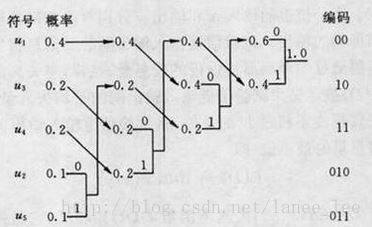
- huffman节点
/*huffman二叉树*/typedef struct huffman_node_tag{unsigned char isLeaf;//判断是否为叶节点unsigned long count;//字符数,字母出现的频率,节点代表的符号加权和struct huffman_node_tag *parent;//当前节点的父节点union{struct{struct huffman_node_tag *zero, *one;//若是叶子,则该项表示信源符号,若不是叶子,则此项为该结点左右孩子的指针};unsigned char symbol;};} huffman_node;- huffman编码
typedef struct huffman_code_tag{/* The length of this code in bits. *//*码字的长度(单位:位)*/unsigned long numbits;/* The bits that make up this code. The firstbit is at position 0 in bits[0]. The secondbit is at position 1 in bits[0]. The eighthbit is at position 7 in bits[0]. The ninthbit is at position 0 in bits[1]. *//* 码字, 码字的第 1 位存于 bits[0]的第 1 位,码字的第 2 位存于 bits[0]的第的第 2 位,码字的第 8 位存于 bits[0]的第的第 8 位,码字的第 9 位存于 bits[1]的第的第 1 位 */unsigned char *bits;} huffman_code;- huffman表格
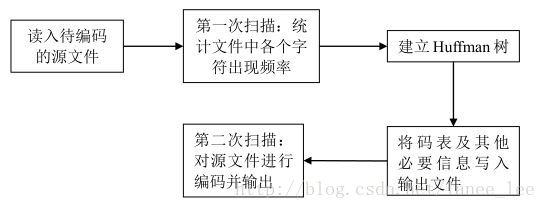
/*对输出的表格进行结构化 针对huff_run main函数 *///输出的表格有些变量可以直接写进结构体里,如此表格可以很快输出,再加入新变量也不会很复杂typedef struct huffman_statistics_result{float freq[256];unsigned long numbits[256];unsigned char bits[256][100];}huffman_stat;二.实验流程
三.代码分析
1.读取待编码的文件
首先对命令行的参数进行定义
static voidusage(FILE* out)//命令行参数的设置{fputs("Usage: huffcode [-i] [-o"-i - input file (default is standard input)\n"//输入文件"-o - output file (default is standard output)\n"//输出文件"-d - decompress\n"//解压缩操作"-c - compress (default)\n"//压缩操作"-m - read file into memory, compress, then write to file (not default)\n",//读内存"-t - output huffman statistics\n",//输出huffman统计表格out);}主函数,对命令行参数进行设计
intmain(int argc, char** argv)//命令行参数{char memory = 0;//内存操作的标识符char compress = 1;//解压缩的标识符int opt;//命令行参数选项const char *file_in = NULL, *file_out = NULL;const char *file_out_table = NULL;FILE *in = stdin;FILE *out = stdout;FILE * outTable = NULL;/* Get the command line arguments. */while((opt = getopt(argc, argv, "i:o:cdhvmt:")) != -1) //读取命令行参数的选项{switch(opt){case 'i':file_in = optarg;//选择i,输入文件break;case 'o':file_out = optarg;//选择o,输出文件break;case 'c':compress = 1;//选择c,压缩break;case 'd':compress = 0;//选择d,解压缩break;case 'h':usage(stdout);//选择h,输出参数用法说明return 0;case 'v':version(stdout);//选择v,输出版本号信息return 0;case 'm'://选择m,内存操作memory = 1;break;case 't'://选t,输出统计数据表格file_out_table = optarg; break;default:usage(stderr);return 1;}}/* If an input file is given then open it. */if(file_in){//(省略)}/* If an output file is given then create it. */if(file_out){//(省略)}//by yzhang for huffman statisticsif(file_out_table){outTable = fopen(file_out_table, "w");if(!outTable){fprintf(stderr,"Can't open output file '%s': %s\n",file_out_table, strerror(errno));//strerror函数为通过标准错误的标号,获得错误的描述字符串 ,将单纯的错误标号转为字符串描述return 1;}}//end by yzhang//(省略)}使用库函数中的getopt解析命令行参数,命令行参数可设置成

然后打开文件
先定义一个数值,因为符号范围在0-255,所以统计频率和码字编码时的数值为256。
#define MAX_SYMBOLS 256typedef huffman_node* SymbolFrequencies[MAX_SYMBOLS];//频率typedef huffman_code* SymbolEncoder[MAX_SYMBOLS];//码字 int huffman_encode_file(FILE *in, FILE *out, FILE *out_Table) //对文件进行Huffman编码/*step1:changed by yzhang for huffman statistics from (FILE *in, FILE *out) to (FILE *in, FILE *out, FILE *out_Table)*/{SymbolFrequencies sf;SymbolEncoder *se;huffman_node *root = NULL;int rc;unsigned int symbol_count;//文件中各字节出现的次数huffman_stat hs;/* Get the frequency of each symbol in the input file. */symbol_count = get_symbol_frequencies(&sf, in); //统计第一遍扫面后,文件中各符号出现的频率huffST_getSymFrequencies(&sf,&hs,symbol_count);/* Build an optimal table from the symbolCount. */se = calculate_huffman_codes(&sf); //根据得到的符号频率建立一棵Huffman树和码表root = sf[0];//将sf[0]设为根结点//step3:add by yzhang for huffman statistics... output the statistics to filehuffST_getcodeword(se, &hs);//获得码字output_huffman_statistics(&hs,out_Table);//建立码表//end by yzhang/* Scan the file again and, using the tablepreviously built, encode it into the output file. *//*再一次扫描文件,使用之前构建的表,将其编码到输出文件中*/rewind(in);//回到文件开头,准备第二遍扫描文件rc = write_code_table(out, se, symbol_count);//先在输出文件中写入码表if(rc == 0)rc = do_file_encode(in, out, se);//写完后根据码表进行编码/* Free the Huffman tree. */free_huffman_tree(root);free_encoder(se);return rc;}2.统计各字节出现的频率
static unsigned intget_symbol_frequencies(SymbolFrequencies *pSF, FILE *in){int c;unsigned int total_count = 0;//初始化/* Set all frequencies to 0. */init_frequencies(pSF);//将所有符号的频率设为0/* Count the frequency of each symbol in the input file. *//*计算输入文件中每个符号的频率*/while((c = fgetc(in)) != EOF)//如果符号存在{unsigned char uc = c;if(!(*pSF)[uc])(*pSF)[uc] = new_leaf_node(uc);//新建一个叶节点++(*pSF)[uc]->count;//叶节点的出现次数+1++total_count;//总数+1}return total_count;}上述统计频率的函数中调用了new_leaf_node 函数,新建叶节点
static huffman_node*new_leaf_node(unsigned char symbol)//增加叶节点{huffman_node *p = (huffman_node*)malloc(sizeof(huffman_node));p->isLeaf = 1;//新建的是叶节点,所以isLeaf设为1p->symbol = symbol;//节点存储的信源符号p->count = 0;//因为还没统计概率所以数目设为0p->parent = 0;//未知父节点,同样设为空return p;}3.建立huffman树
static SymbolEncoder*calculate_huffman_codes(SymbolFrequencies * pSF)//对统计后的码字频率按升序进行排序{unsigned int i = 0;unsigned int n = 0;huffman_node *m1 = NULL, *m2 = NULL;//m1存放左子节点的地址,m2则为右子节点//输出未排序前统计的频率 #if 1printf("BEFORE SORT\n");print_freqs(pSF); #endif/* Sort the symbol frequency array by ascending frequency. *//*按升序对符号频率数组进行排序*/qsort((*pSF), MAX_SYMBOLS, sizeof((*pSF)[0]), SFComp); /*qsort是排序函数,可自定义排序方式,SFComp为升序排列*///输出排序后的统计频率#if 1 printf("AFTER SORT\n");print_freqs(pSF);#endif/* Get the number of symbols. *//* 统计下信源符号数,因为符号范围在0-255,但不一定完全包含256个字符*/for(n = 0; n < MAX_SYMBOLS && (*pSF)[n]; ++n);/*建立huffman树*/for(i = 0; i < n - 1; ++i){/* Set m1 and m2 to the two subsets of least probability. */m1 = (*pSF)[0];//m1存放的是左孩子m2 = (*pSF)[1];//m2存放的是右孩子/* Replace m1 and m2 with a set {m1, m2} whose probability* is the sum of that of m1 and m2. */(*pSF)[0] = m1->parent = m2->parent =new_nonleaf_node(m1->count + m2->count, m1, m2);//调用了new_nonleaf_node,将原先的左孩子和右孩子相加的值作为父节点的值 //而父节点作为现在的左子节点(*pSF)[1] = NULL;//右子节点设为NULL,即无/* Put newSet into the correct count position in pSF. */qsort((*pSF), n, sizeof((*pSF)[0]), SFComp);//将现在n-1个数据重新进行排序}/* Build the SymbolEncoder array from the tree. */pSE = (SymbolEncoder*)malloc(sizeof(SymbolEncoder));//分配码字节点指针数组的内存空间memset(pSE, 0, sizeof(SymbolEncoder));//初始化该数组build_symbol_encoder((*pSF)[0], pSE);//建立所有的码字节点return pSE;}在 qsort((*pSF), MAX_SYMBOLS, sizeof((*pSF)[0]), SFComp) 中,排序方式是由SFComp决定,下面分析SFComp
static intSFComp(const void *p1, const void *p2) //自定义的排序顺序函数,把节点数组由小到大排序{const huffman_node *hn1 = *(const huffman_node**)p1;const huffman_node *hn2 = *(const huffman_node**)p2;//把两个排序指针设为自定义的树节点类型/* Sort all NULLs to the end. */if(hn1 == NULL && hn2 == NULL)//如果两个节点都为空,则返回0return 0;if(hn1 == NULL)//若第一个节点为空,说明第二个节点大于第一个节点,返回1return 1;//if(hn2 == NULL)//若第二个节点为空,说明小于第一个节点,返回-1return -1;if(hn1->count > hn2->count)//若二者指向的数值,一大于二,返回1return 1;else if(hn1->count < hn2->count)//若二者指向的数值,二大于一,返回-1return -1;return 0;}建立huffman树时,得到父节点时调用了 new_nonleaf_node 函数,因为父节点不是叶子,所以函数也不相同
static huffman_node*new_nonleaf_node(unsigned long count, huffman_node *zero, huffman_node *one){huffman_node *p = (huffman_node*)malloc(sizeof(huffman_node));p->isLeaf = 0;//新建的是中间节点,所以isLeaf设为0p->count = count;//符号次数为父节点的符号出现次数p->zero = zero;//对应的左孩子p->one = one;//对应的右孩子p->parent = 0;//父节点为空return p;}举例, new_nonleaf_node

isleaf=0,count=count1+count2,parent=NULL,zero=0x1H,one=0x2H。
4.生成码字
本实验中huffman的编码是从叶到根部的编码,所以在生成码字时需要进行倒序处理

如上图所示,右下角的从叶到根的编码是1101,而生成的码字为1011
static voidbuild_symbol_encoder(huffman_node *subtree, SymbolEncoder *pSF){if(subtree == NULL)//如果树为空,返回return;if(subtree->isLeaf)(*pSF)[subtree->symbol] = new_code(subtree);//如果是叶节点,则对叶节点进行编码else{build_symbol_encoder(subtree->zero, pSF);build_symbol_encoder(subtree->one, pSF);}//如果不是,那么先访问左节点,到了叶节点之后再访问右节点//深度遍历}对叶节点进行的编码
static huffman_code*new_code(const huffman_node* leaf){/* Build the huffman code by walking up to* the root node and then reversing the bits,* since the Huffman code is calculated by* walking down the tree. *//** 通过走到根节点然后反转位来构建huffman代码,因为霍夫曼代码是通过树来计算的。*/unsigned long numbits = 0;//遍历过的字节unsigned char* bits = NULL;huffman_code *p;//码字节点while(leaf && leaf->parent)/* leaf=NULL,字符为空,无法编码。leaf !=0: 当前字符存在,应该编码 *//* leaf->parent=NULL,到达根结点,编码结束。leaf->parent !=0: 当前字符的编码仍未完成,即未完成由叶至根的该字符的编码过程 */{huffman_node *parent = leaf->parent;//当前结点的父亲unsigned char cur_bit = (unsigned char)(numbits % 8);//当前byteunsigned long cur_byte = numbits / 8;//当前bit/* If we need another byte to hold the code,then allocate it. */if(cur_bit == 0)//一个字节满则需要重新分配字节{size_t newSize = cur_byte + 1; //新的字节数为当前字节数+1,size_t 即为 unsigned int 类型bits = (char*)realloc(bits, newSize);/*extern void *realloc(void *mem_address, unsigned int newsize); 返回的void*,所以要进行强制类型转换*/bits[newSize - 1] = 0; /* Initialize the new byte. *///新增加的字节设为0}/* If a one must be added then or it in. If a zero* must be added then do nothing, since the byte* was initialized to zero. *//*如果leaf是其parent的左孩子,则无需改变bits[cur_byte]中的二进制数字,因为初始化值是0. *如果是右孩子,则需要位运算,按照左0右1的原则,在bit[cur_byte]相应位置变为1*///先把1右移到当前位(cur_bit)位置,再把当前字节(bits[cur_byte])与移位后的1做或操作if(leaf == parent->one)bits[cur_byte] |= 1 << cur_bit;++numbits;//增加bit数leaf = parent;//写下一个叶子,当前叶子即为父节点}if(bits)/*如果编码里头含有1, 则需要进行反转, 如果全为0, * 反转后和反转前是一样的, 就没必要反转了*/reverse_bits(bits, numbits);p = (huffman_code*)malloc(sizeof(huffman_code));p->numbits = numbits; /* 设置对指定的字符进行编码需要的位数 */p->bits = bits;/* 用来存储编码的区间 */return p;}生成码字的时候需要反转
/*反转数组的前((numbits/8)+1)个字符*/static voidreverse_bits(unsigned char* bits, unsigned long numbits){unsigned long numbytes = numbytes_from_numbits(numbits);//所占最多的字节数unsigned char *tmp =(unsigned char*)alloca(numbytes);// 分配内存/*_alloca是在栈(stack)上申请空间,用完马上就释放,设置一个tmp作为numbytes的临时变量,给这个tmp开numbytes同样大的空间*/unsigned long curbit;//当前比特数long curbyte = 0;//即将要反转的字节所在的的数组下标 memset(tmp, 0, numbytes);/*memset是计算机中C/C++语言函数。*将s所指向的某一块内存中的前n个字节的内容全部设置为ch指定的ASCII值, *第一个值为指定的内存地址,块的大小由第三个参数指定,*这个函数通常为新申请的内存做初始化工作, 其返回值为指向s的指针。*此处为给tmp全部赋值为0*/for(curbit = 0; curbit < numbits; ++curbit){unsigned int bitpos = curbit % 8;// 向左移动的位数if(curbit > 0 && curbit % 8 == 0)//如果一个字节已经反转完,则到下一个字节++curbyte;/*get_bit()第二个参数是0时,则为bit[0]最右一位;为numbits-curbit-1时,则为bit[numbytes-1]的最左一位。向左移位,使之可以按位或*/tmp[curbyte] |= (get_bit(bits, numbits - curbit - 1) << bitpos);}memcpy(bits, tmp, numbytes);//将tmp内的数据给bits} /*bit->byte,不足8位补齐*/static unsigned longnumbytes_from_numbits(unsigned long numbits){return numbits / 8 + (numbits % 8 ? 1 : 0);}//举例,若numbits=9,需要2字节,9/8+1=1+1=2//若numbits=5,需要1字节,5/8+1=0+1=15.输出文件
首先是输出码表,对文件进行编码
static intwrite_code_table(FILE* out, SymbolEncoder *se, unsigned int symbol_count){unsigned long i, count = 0;/* Determine the number of entries in se. *///统计实际字符个数for(i = 0; i < MAX_SYMBOLS; ++i){if((*se)[i])++count;}/* Write the number of entries in network byte order. */i = htonl(count); if(fwrite(&i, sizeof(i), 1, out) != 1)return 1;/* Write the number of bytes that will be encoded. */symbol_count = htonl(symbol_count);if(fwrite(&symbol_count, sizeof(symbol_count), 1, out) != 1)return 1;//写入码表/* Write the entries. */for(i = 0; i < MAX_SYMBOLS; ++i){huffman_code *p = (*se)[i];if(p){unsigned int numbytes;/* Write the 1 byte symbol. */fputc((unsigned char)i, out);//先写入符号/* Write the 1 byte code bit length. */fputc(p->numbits, out);//再写入码长/* Write the code bytes. */numbytes = numbytes_from_numbits(p->numbits);if(fwrite(p->bits, 1, numbytes, out) != numbytes)return 1;//最后写入码字}}return 0;} static intdo_file_encode(FILE* in, FILE* out, SymbolEncoder *se){unsigned char curbyte = 0;unsigned char curbit = 0;int c;while((c = fgetc(in)) != EOF){unsigned char uc = (unsigned char)c;huffman_code *code = (*se)[uc];unsigned long i;//读取字符数,找到当前字符uc对应的codefor(i = 0; i < code->numbits; ++i){/* Add the current bit to curbyte. */curbyte |= get_bit(code->bits, i) << curbit;//将当前的bit放进编码字节对应的位置/* If this byte is filled up then write it* out and reset the curbit and curbyte. *///如果该字节被填满,则写入该字节并重新设置curbit和curbyte。//针对每一个字节,都书写,且重新赋初值if(++curbit == 8){fputc(curbyte, out);curbyte = 0;curbit = 0;}}}/** If there is data in curbyte that has not been* output yet, which means that the last encoded* character did not fall on a byte boundary,* then output it.*///如果存在尚未输出的数据,则表示字节未满,补满if(curbit > 0)fputc(curbyte, out);return 0;}
编码结果可以看出符号数为256(100H),后面四字节对应码长,即文件所占空间,后面是码字。
四.实验结果
原文件和编码后的文件,以及编码后数据存储的文件

| 文件类型 | 平均码长 | 信源熵(bit/sym) | 原文件大小(kB) | 压缩后文件大小(kB) | 压缩比 |
|---|---|---|---|---|---|
| jpg | 7.996698 | 7.9787 | 63 | 64 | 0.98 |
| mp4 | 7.996456 | -7.97934 | 49533 | 49511 | 1.00 |
| rar | 8.000008 | 8.000008 | 463 | 464 | 0.99 |
| doc | 4.36568 | 4.348527 | 90 | 51 | 1.76 |
| avi | 6.13318 | 6.0958935 | 22315 | 17109 | 1.30 |
| xlsx | 7.228231 | -7.180883 | 13 | 13 | 1.00 |
| ppt | 7.473907 | -7.4465188 | 1256 | 1175 | 1.07 |
| png | 7.997136 | -7.9784109 | 94 | 95 | 0.99 |
| 7.989494 | -7.9746842 | 2837 | 2834 | 1.001 | |
| flv | 7.595216 | -7.5853566 | 22822 | 16428 | 1.39 |
下图是这十个文件的字符发生概率统计图,纵坐标为字符发生概率,横坐标为符号值


结合表格和统计图可以看出Huffman编码的平均码长基本接近于信源熵,且信源熵基本没有超过8bit/sym,因为符号值范围在0-255,所以熵值不会超过8,无失真编码中码长的下限即为信源熵。
对于这十个文件,压缩比最大的是doc文件,而相应的信源熵和平均码长也是最小的,分析图像可以看出,符号发生的概率不均匀。综上所述,Huffman编码对于符号分布不均的文件压缩效果较好,因为huffman是变长编码,不同概率,码长不同,而若字符概率都相近就没法按照大概率短码,小概率长码的原则进行编码,所以编码效果较差,有些文件编码后文件大小反而大于原文件,就是因为字符出现概率接近等概,如png和jpg。
本文来自互联网用户投稿,文章观点仅代表作者本人,不代表本站立场,不承担相关法律责任。如若转载,请注明出处。 如若内容造成侵权/违法违规/事实不符,请点击【内容举报】进行投诉反馈!